
Why rail matters for Cape Town’s traffic congestion
With the collapse of rail, roads become busier
 Add GroundUp on Google
Cape Town was the third most congested city in Africa in 2025, ahead of Johannesburg which sits at number six, and Cairo at 12th place.
This is an improvement from being the second-most congested city on the continent in 2023. Globally, Cape Town sits at 91 out of 492 cities, according to the latest statistics on the tomtom Traffic Index.
Studies, such as this one, show building new roads does not decrease traffic congestion, it merely encourages greater car use.
Road-based public transport such as minibus-taxis and buses help reduce congestion by reducing private cars transporting far fewer passengers, but logically, the only effective way to reduce road congestion is through efficient passenger rail.
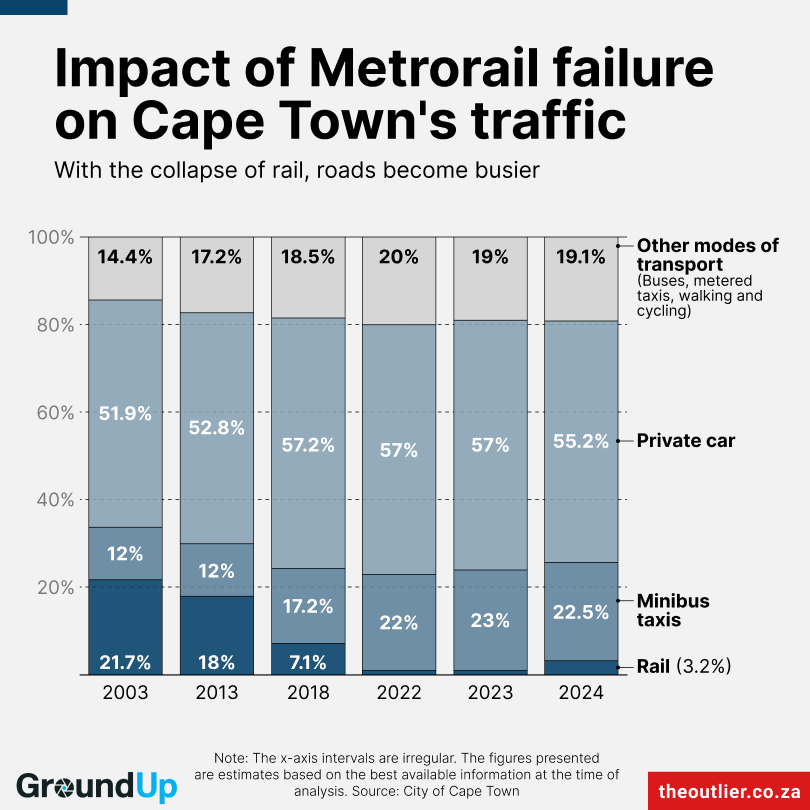
Cape Town has an extensive rail network in Metrorail, but mismanagement and corruption of its management agency, the Passenger Rail Agency South Africa (PRASA) saw passenger numbers decline from a high of about 600,000 per day in 2003, making up more than a fifth of all commuter trips, to a low of about 133,000 passengers a day in 2022, down to one out of every 50 daily commuters.

Statistics provided by the City of Cape Town show that the increasing failure of Metrorail services, which reached a low in 2019 and was exacerbated by the covid lockdown, led to increasing use of private cars and minibus-taxis. As Metrorail services have slowly improved, passenger numbers have started recovering, reaching about 200,000 per day by March 2026. This slight recovery is reflected in a proportionate decrease in private car and minibus-taxi use.
The use of buses, walking and cycling, and MyCiTi has remained relatively consistent throughout.
The figures underscore the City’s drive for the devolution of rail to City management in order to establish rail as the backbone of public transport in Cape Town. This has recently received support from national government within the draft National Rail Master Plan.
In supplying the above statistics, urban mobility mayco member Rob Quintas noted that along with the “implosion” of passenger rail, population growth has also contributed to the increase in road-based transport over the last 20 years.
Chart produced by The Outlier in partnership with GroundUp
Support independent journalism
Donate using Payfast

Don't miss out on the latest news
We respect your privacy, and promise we won't spam you.
Next: The Israel/US-Iran war is hitting South Africa hard – our oil dependency is why
Previous: Is abandoning a baby in a safe box a crime or an act of love? Court to decide
© 2026 GroundUp. This article is published under the GroundUp Republication Licence Version 1.0. Email [email protected] to request permission to republish.