
A shameful judicial record
Late judgments hit a new high in 2025, crossing the 300 mark
 Add GroundUp on Google
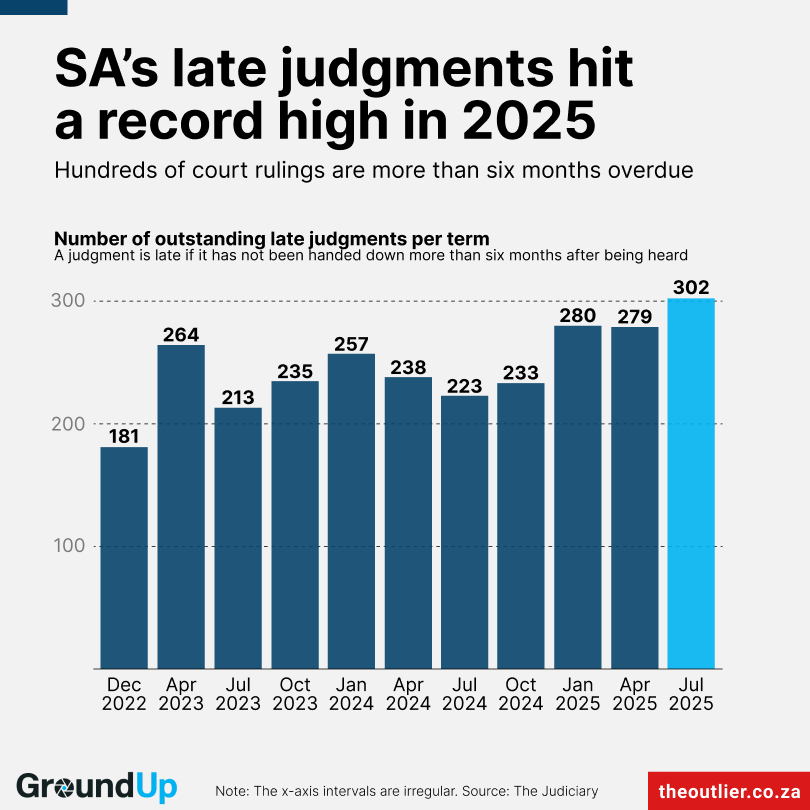
Our chart this week shows that the number of late outstanding judgments has risen from 181 in December 2022 to over 300 in July 2025, the latest term for which we have data. This data is taken from reports published, usually late, by the Office of the Chief Justice.
News publications like to boast when journalism achieves results. We, for example, shamelessly brag about how we exposed the cover-up of Thabo Bester escaping from prison, and how we helped turn the National Lotteries Commission into a more honest institution.
But we cannot brag about having any effect on the tardiness of the country’s judicial system. We have been reporting on late judgments since 2017, hoping to shame both the Department of Justice and the Office of the Chief Justice into taking measures to improve this dire situation. But as our chart of the week shows, we’ve had no success. On the contrary: the situation is getting worse.
In terms of norms laid out for judges in 2014 by then Chief Justice Mogoeng Mogoeng, judges should hand down rulings within three months of judgment being reserved. We started regularly publishing the number of late judgments in 2018, at one stage even building a database for the public to track late judgments.

We decided to set the definition of “late” at six months, not three. The one unfortunate thing our reporting did apparently manage to achieve was that the Office of the Chief Justice seized upon this generosity, and over time the official definition of a late judgment has morphed into six months. (The lesson to be learnt is never to offer state institutions a way out before they show results.)
Mbekezeli Benjamin, writing in GroundUp a year ago, explained how a big part of the problem is the number of vacancies in various courts. “Since 2021, the Moseneke Committee has conducted a detailed study to ‘rationalise’ the High Court, by redrawing some jurisdictional lines and increasing the judicial establishment. This issue is particularly urgent in the face of the crisis of court backlogs due to there having been no increase in the number of judges since 2008. The earliest trial dates in the Gauteng High Court are being issued for 2031.”
A shortage of judges is definitely a part of the problem. But some judges (and acting judges) have been plain lazy.
It is not only the judiciary that causes justice to be delayed. Every aspect of the system contributes to the problem. We recently wrote how low policing has sunk. Inspired by the Jacob Zuma trials, dodgy lawyers have become excellent at gaming the system, dragging out trials that should take months into years. The National Prosecuting Authority is in disarray. Frequently our reporters go to court to cover a trial, only for there to be a postponement because the prosecutor has failed to do their job.
South Africans are losing confidence in the justice system. There is an urgent need for the President, the Minister of Justice and the Chief Justice to recognise the situation for the crisis it is, and to take urgent steps to fix it.
Chart produced by The Outlier in partnership with GroundUp
Support independent journalism
Donate using Payfast

Don't miss out on the latest news
We respect your privacy, and promise we won't spam you.
© 2026 GroundUp. This article is published under the GroundUp Republication Licence Version 1.0. Email [email protected] to request permission to republish.