
Police fail to confiscate firearms from domestic violence perpetrators, report finds
Guns are used in 35% of murders of women

Protection orders and firearm seizure orders are not being adequately enforced, according to a research report. Photo: Augustas Didžgalvi (via Wikimedia, CC BY-SA 3.0)

- Women who face domestic gun violence are not being sufficiently protected despite legal provisions, according to a report by the Remove the Trigger campaign.
- In most femicide cases, the perpetrator is the woman’s intimate partner. In about 30% of these cases, there is a prior history of domestic violence.
- For various reasons, most domestic violence victims killed by their partners do not hold protection orders at the time of their deaths.
- Where women do have protection orders and/or orders for the perpetrators’ firearms to be seized, the orders are not sufficiently enforced.
There is insufficient protection for women who face domestic gun violence, according to a report by the Remove the Trigger campaign, launched at the Saartjie Baartman Memorial Centre in Athlone on Tuesday.
In the majority of cases where women are murdered, the perpetrators are their intimate partners. In about 30% of these cases, there was a prior history of domestic violence, according to the report. The true figure is likely higher.
Guns are also responsible for about 35% of women’s deaths.
Although there are legal provisions that require firearms to be removed in domestic violence cases, these are not adequately implemented.
Only about 2% of women domestic violence victims killed in 2017 held protection orders at the time of their killing. And where protection orders are held, they are not properly enforced, and firearms are seldom permanently removed from abusive partners.
“Firearms do not get removed,” said gender violence researcher Lisa Vetten, who authored the report, during the launch. “There are a couple of reasons for this: women not knowing that they can ask for a firearm to be removed, magistrates not ordering the removal of a firearm when criminal charges are laid, and police not seizing firearms [when they are ordered to].”
A history of domestic violence or protection orders should be used to deny people firearm competence certificates, but aren’t, said Vetten.
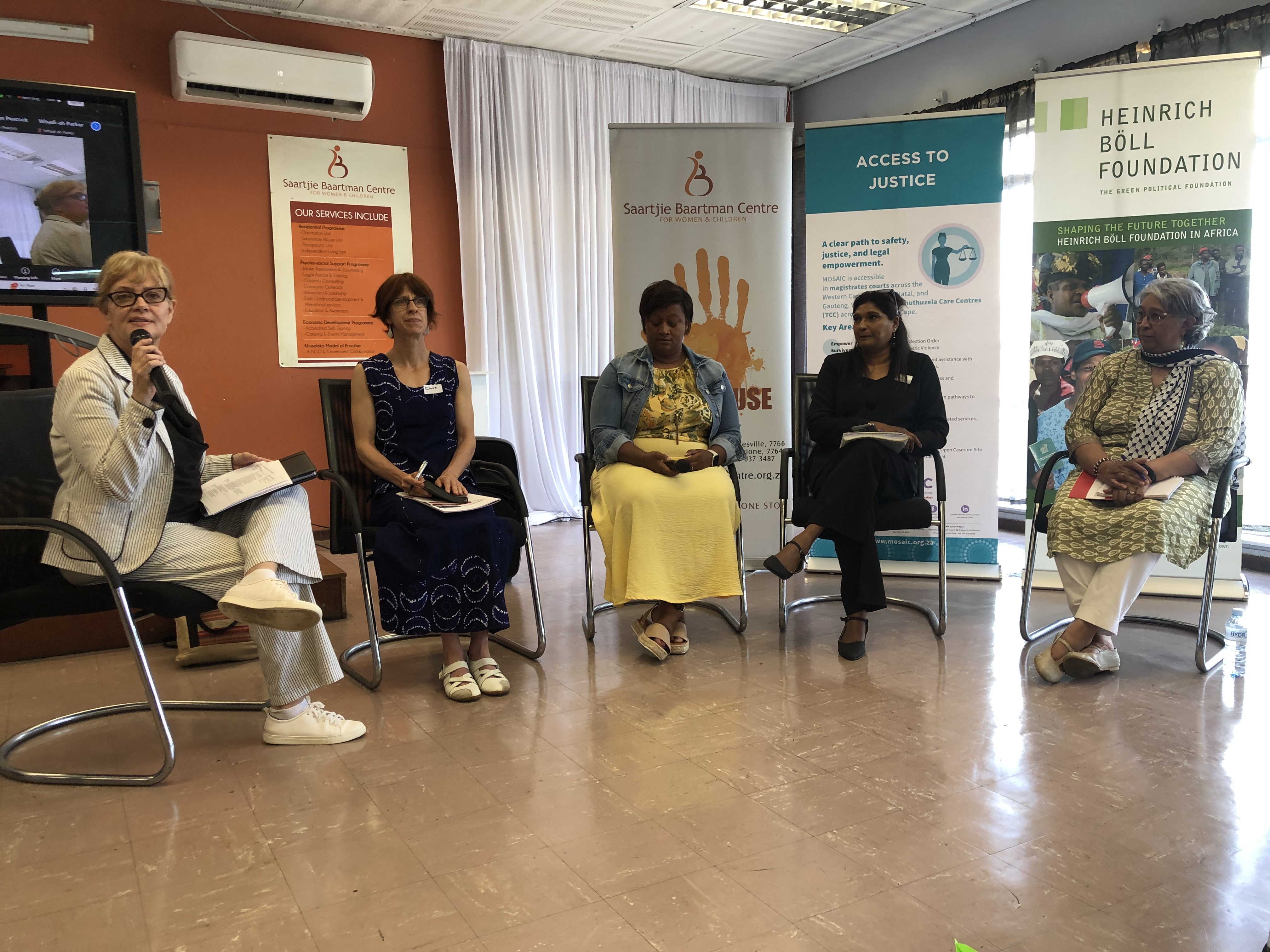
Panellists at the report launch: Bernadine Bachar, director of the Saartjie Baartman Centre, Claire Taylor from Gun Free SA, Henrietta du Preez, Jessica Shah, and Dr Naeema Abrahams from the SA Medical Research Council. Photo: Mary-Anne Gontsana
Jessica Shah, speaking at the event, told how her daughter, Sasha Lee, was fatally shot at the age of 25 by her abusive former partner, Kyle Inderlall, in 2022 in KwaZulu-Natal.
Inderlall was a security guard and was in possession of a work-issued firearm. He also owned a rifle and another firearm, which he would frequently use to threaten her.
This was despite Shah having taken out a protection order against Inderlall, and a court order for Inderlall’s firearms to be removed. Another partner of Inderlall also had a protection order against him.
The report also notes that firearms not only do harm when they kill, but also when they are used for emotional and physical abuse.
Henrietta du Preez, a domestic violence survivor and former police officer, shared at the event how she was abused by the father of her children. He was also a police officer and would often use his police-issued firearm to intimidate her.
“I came to a point where I knew that as long as I acted accordingly and did not make him mad, I would not get shot,” said du Preez.
He would also intimidate her with pepper spray, a taser and work boots. He also attempted to run her over with a police van.
Du Preez turned to the courts for protection and maintenance orders, and approached social work services and the police for assistance. Police managers told her they would not get involved in officers’ private lives. Ultimately, she was not assisted.
The report recommends that the police publish statistics annually on how many firearm competency certificates are denied or opposed because of past domestic violence, and on compliance with firearm removal orders. This data must be made available to researchers and policymakers to assess the efficacy of the firearms control act, the report says.
The report also calls for the Domestic Violence Act regulations to be amended so that there is a dedicated form to be used for seizing firearms, which must be completed and returned to the court by police officers. If a firearm is not removed, there must be an explanation why.
“When the courts order the removal of a firearm, the police are not permitted to disregard the instruction and disciplinary measures must be instituted accordingly should they do so,” reads the report.
Support independent journalism
Donate using Payfast

Don't miss out on the latest news
We respect your privacy, and promise we won't spam you.
Next: New law will reveal South Africa’s huge pay gaps
Previous: Clinic staff are extorting immigrants to access life-saving medicines
© 2025 GroundUp. This article is licensed under a Creative Commons Attribution-NoDerivatives 4.0 International License.
You may republish this article, so long as you credit the authors and GroundUp, and do not change the text. Please include a link back to the original article.
We put an invisible pixel in the article so that we can count traffic to republishers. All analytics tools are solely on our servers. We do not give our logs to any third party. Logs are deleted after two weeks. We do not use any IP address identifying information except to count regional traffic. We are solely interested in counting hits, not tracking users. If you republish, please do not delete the invisible pixel.