
JSC overturns tribunal decision, finds Judge Mbenenge guilty of gross misconduct
“The testimony of Mbenenge … revealed that he does not appreciate the responsibility associated with his position … He showed no remorse for his conduct.”
 Add GroundUp on Google
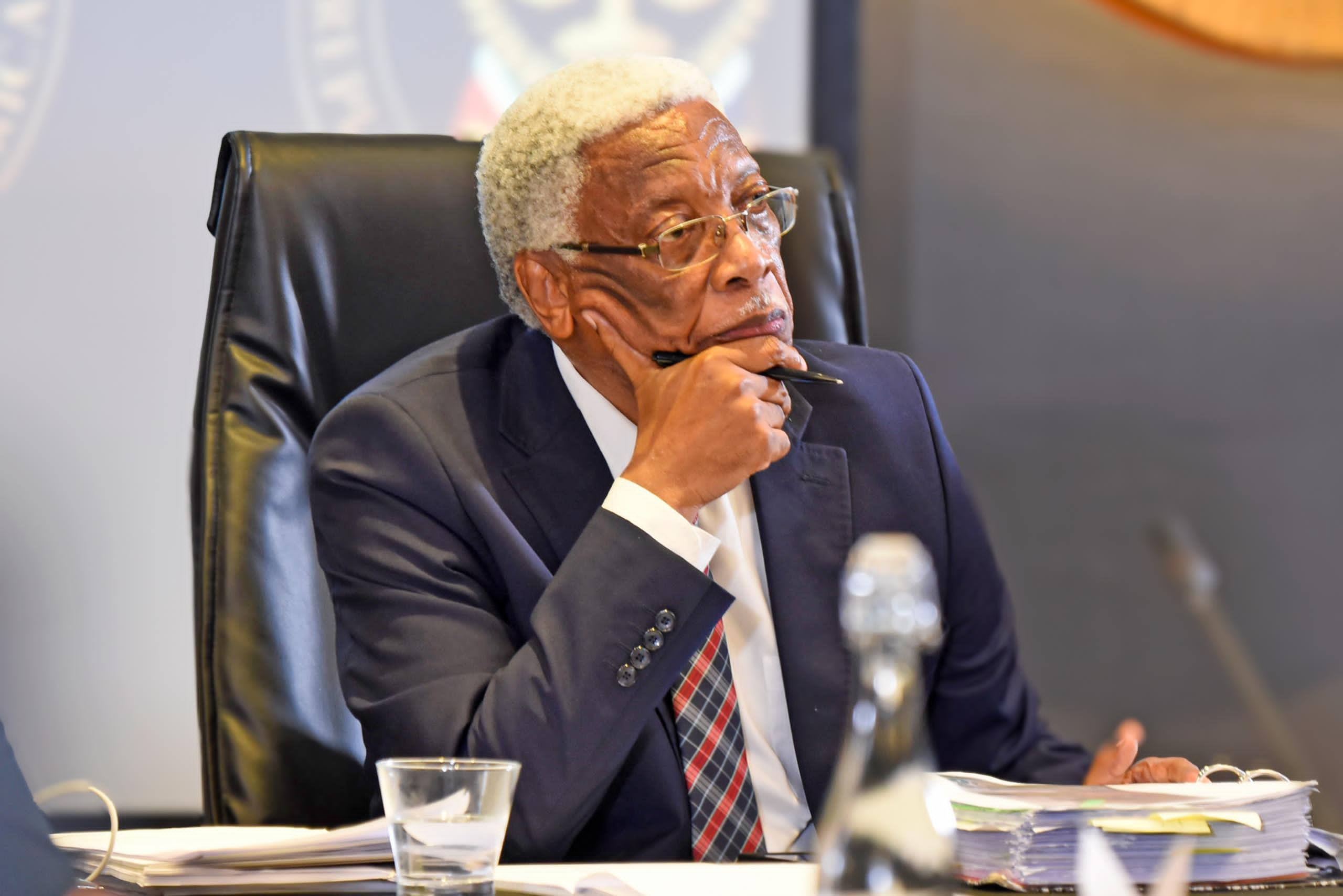
Eastern Cape Judge President Selby Mbenenge during his tribunal hearing. Archive photo: Office of the Chief Justice / N Mabusela
The Judicial Service Commission (JSC) has found Eastern Cape Judge President Selby Mbenenge guilty of gross misconduct, overturning a previous ruling that he was only guilty of misconduct in relation to allegations that he sexually harassed a junior secretary at the court.
In fact, the JSC has now found, he is guilty of sexual harassment.
GroundUp is not aware of any other such case, where the JSC (sitting without members of the National Assembly and National Council of Provinces) has so strongly disagreed with a Judicial Conduct Tribunal recommendation.
It now means that Mbenenge may well be impeached.
Following a public hearing characterised by salacious WhatsApp messages and sexually loaded emojis, the tribunal ruled that he was only guilty of a “degree of misconduct” in that he, at a place of work and during working hours, initiated and subsequently conducted a flirtatious relationship with Andiswa Mengo.

The ruling flew in the face of evidence by Mengo that she had been sexually harassed, that Mbenenge’s advances were unwanted, and she had only responded because he was a respected and most senior judge.
In its written ruling handed down late on Thursday, the JSC said prior to considering the matter it had called for written representations from Mbenenge and Mengo. Mbenenge argued that he should not even have been found guilty of misconduct. Mengo persisted with her claim of sexual harassment and said, in any event, the misconduct finding was inappropriate given the circumstances.
The JSC said in its deliberations, the tribunal had “excluded from its consideration” several pieces of evidence. It had also criticised Mengo for giving false evidence in some parts of her testimony.
The tribunal had concluded, after narrating the common cause and admitted WhatsApp exchanges, that these were not unwelcome on a balance of probabilities, and that the communication was consensual.
The JSC said it had deliberated on two questions: the first was whether to uphold the finding of misconduct, and the second was whether this conduct amounted to gross misconduct.
In consideration of these questions, the JSC disagreed with the tribunal in several key respects.
Firstly, the tribunal had limited its assessment of Mbenenge’s conduct to what happened at the workplace.
“On the admitted facts, the communications were not confined to working hours or the workplace but extended beyond both and included exchanges which, by their nature, bore directly on the standard of conduct expected of a judge and, more particularly, a Judge President engaging with a junior staff member.
“By characterising the matter principally as a flirtatious relationship at work and during working hours, the tribunal understated the significance of the admitted conduct.”
The JSC said that bearing in mind the nature and content of the communication, it was of the view that this was grossly inappropriate for a judge, let alone a Judge President, especially in relation to a person in the position of Mengo.
“It is conduct incompatible with the standard of honourable behaviour and proprietary required of judicial office.”
The JSC also said it did not endorse the finding that there was no sexual harassment.
The tribunal had not applied the appropriate standard of assessing a “balanced amalgamation of an objective and subjective standard” taking into account Mengo’s position and Mbenenge’s conduct in context.
It had failed to consider whether Mbenenge ought to have known that his conduct was unacceptable, “focussing almost exclusively on the conduct of the complainant [Mengo]”.
It had also failed to consider the power dynamic, instead approaching the matter on the basis that the parties were “consenting adults on equal footing”.
In concluding that Mbenenge was guilty of gross misconduct, the JSC took into account the sexual nature of the communications which were initiated by Mbenenge, his pursuit of Mengo, and his stated intention to pursue a sexual relationship with her.
It also took into account the power imbalance.
“The testimony of Mbenenge before the tribunal revealed that he does not appreciate the responsibility associated with his position and the power imbalance it creates in the environment. He showed no remorse for his conduct.”
The JSC said the offence was serious and an “affront to the propriety of judicial office and the values underpinning the Constitution”.
It said it would now submit its findings to the Speaker of the National Assembly.
It had also invited the parties to make submissions regarding whether or not it should advise the President to suspend Mbenenge pending a decision on his impeachment by the National Assembly.
Mbenege has been on “special leave” since 2024. After the tribunal ruling in January this year, he indicated that he was returning to work, but the Office of the Chief Justice clarified that he could not return until the JSC had deliberated on the tribunal’s report.
The Women’s Legal Centre, who represented Mengo, told GroundUp: “This is a historic moment and a victory for all women in the workplace. This case illustrated the lived experiences of women in the legal profession and beyond. And will set an important precedent that reinforces the principle of zero tolerance towards sexual harassment and violence in the world of work.”
Support independent journalism
Donate using Payfast

Don't miss out on the latest news
We respect your privacy, and promise we won't spam you.
Next: Company sold stolen and expired insulin to Malawi’s hospitals
Previous: Tongaat Hulett liquidation avoided after government provides R200-million lifeline
© 2026 GroundUp. This article is published under the GroundUp Republication Licence Version 1.0. Email [email protected] to request permission to republish.