
Corruption-accused Judge Portia Phahlane to face tribunal
Guilty in a criminal court or not, Phahlane could still be impeached
 Add GroundUp on Google
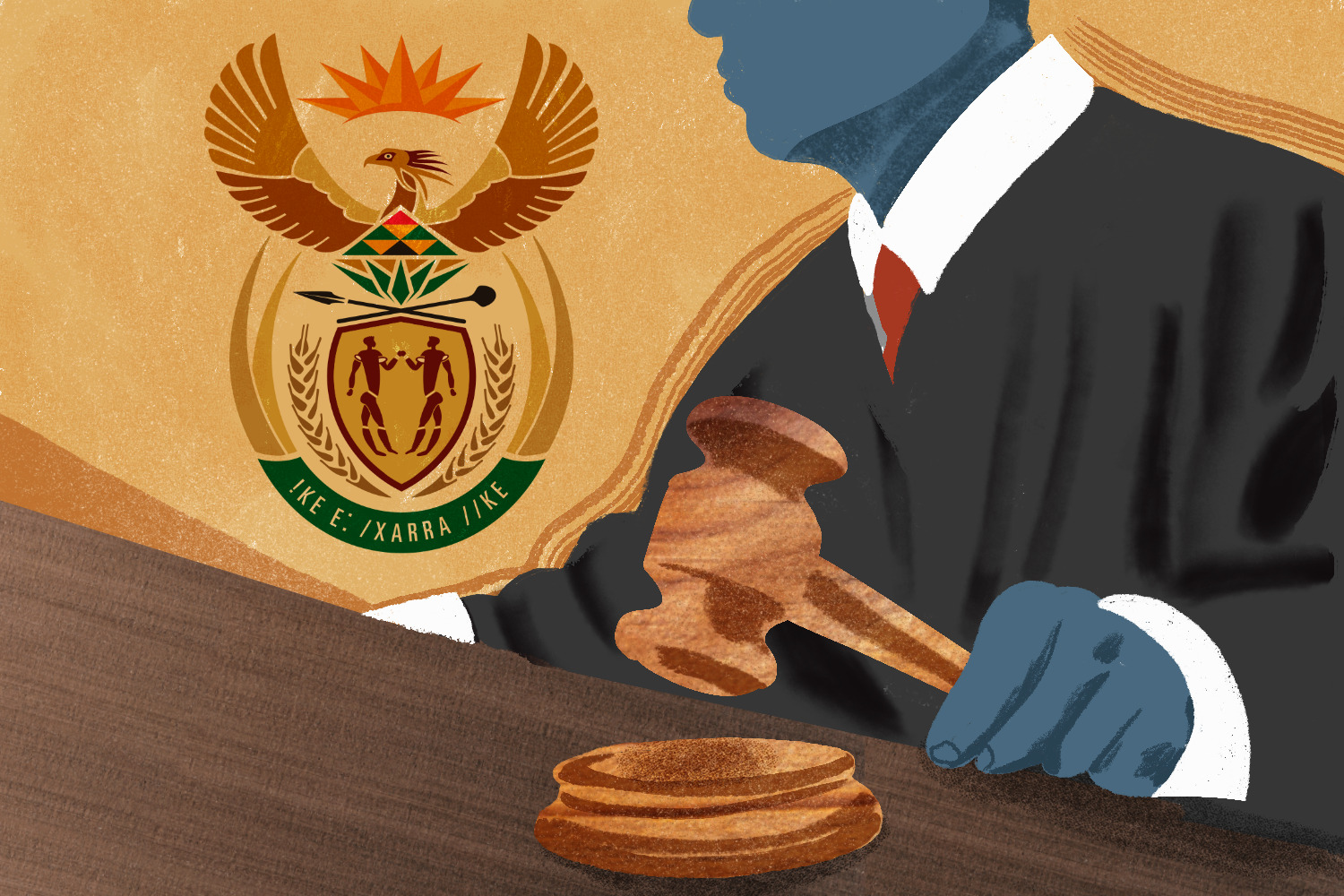
ISuspended Gauteng High Court Judge Portia Phahlane will face a Judicial Conduct Tribunal while her criminal corruption case proceeds. Illustration: Lisa Nelson
- Suspended Gauteng High Court Judge Portia Phahlane will face a Judicial Conduct Tribunal while her criminal corruption case proceeds.
- Phahlane is accused of accepting more than R2-million in bribes from a litigant in a church succession dispute.
- The Judicial Conduct Committee says the allegations, if proven, would amount to gross misconduct and could justify her removal from office.
Suspended Gauteng High Court Judge Portia Phahlane, who is facing charges of corruption for allegedly accepting more than R2-million in bribes from a litigant, will have to explain herself before a Judicial Conduct Tribunal.
No matter the outcome of the criminal case against her, a tribunal could still recommend that she be impeached.
Judge’s Matter researcher Mbekezeli Benjamin explained that the judicial misconduct system exists to safeguard the judiciary, its integrity, independence and public trust.

“The question before the Judicial Service Commission (JSC) and its substructures is whether a judge has committed an act of misconduct so gross that it threatens any of these.”
A judge could be acquitted of a crime in a criminal court, but still be found guilty of gross misconduct and be impeached by the JSC “because the nature of the conduct that gave rise to the crime is such that it falls below judicial standards, which are much higher and more exacting,” said Benjamin.
While prosecutors may fail “to prove beyond a reasonable doubt the strict definitional elements of corruption, bribery or other criminality,” the judge’s conduct “may still be a sufficient threat to judicial independence that it warrants a gross misconduct finding and impeachment.”
Corruption allegations
Phahlane, who was appointed to the bench in 2021, was arrested along with her son and International Pentecostal Holiness Church (IPHC) leader Michael Sandlana in November last year. They are facing 19 counts of corruption and money laundering.
The State alleges that Phahlane accepted over R2-million in bribes to secure favourable judgments in a bitter church succession dispute.
Phahlane, who was granted bail, was placed on special leave but was initially permitted to finish part-heard matters.
But in February this year, the JSC said she had been removed from hearing all matters.
The criminal case is pending before the Pretoria Specialised Commercial Crimes Court.
Gauteng Judge President Aubrey Ledwaba laid the complaint against Phahlane with the JSC, which referred it to a Judicial Conduct Committee (JCC), comprising Judge Chris Jafta, Halima Salduker and Nolwazi Mabindla-Boqwane.
In their ruling, the JCC said: “We have not imagined a day like this would ever come, where we are called upon to consider allegations of corruption against one of us, a fellow judge.
“If true, what is alleged here is profoundly shocking.”
Setting out the facts in the indictment, the JCC said Phahlane had been tasked with case managing two applications in the church’s succession dispute. Ordinarily, a case management judge does not hear the applications.
It was alleged that one of the litigants, Sandlana, had approached the judge through an intermediary, a member of the church who was also a court interpreter.
Sandlana allegedly offered the judge money in return for deciding the cases in his favour, which she accepted.
Cash was exchanged at several meetings. Finally, in February 2022, he offered to buy her house. In June that year, it is alleged, the judge made an offer to purchase a house for R6.5-million in Hartebeespoort. Shortly thereafter, R2-million was deposited into the trust account of a conveyancer by a company linked to the church. It is alleged that Phahlane issued instructions on how that money was to be used.
Jafta, who penned the JCC ruling, said Phahlane had been allowed to comment on these “damning allegations” but had declined to do so.
She had requested that the complaint be stayed pending the finalisation of the criminal case, that she intended to plead not guilty and “asserted a criminal conspiracy” against her.
“Last line of defence”
Jafta said the committee was not tasked with determining the merits of the complaint, but rather, to establish if the allegations could constitute a finding of gross misconduct (which could lead to impeachment).
“There is no denying that if the allegations are established, it would indicate that she is guilty of gross misconduct,” he said.
“They strike at the core function of the judiciary and destroy public confidence in the administration of justice,” Jafta said.
He said deciding a case in favour of a litigant who had secretly paid a judge was “egregious”, a serious abuse of judicial authority for self-enrichment.
“Despite numerous legislative measures put in place and the entities established to fight it, corruption continues to be rampant. Regrettably, if the current allegations are true, it has now breached the last line of defence, the judiciary.”
Jafta said there was a “glimmer of hope” that the allegations may be proved untrue. But if the complaint (to the JSC) is established, it warrants Phahlane’s removal from office because “there is no room for corrupt judges”.
“In all circumstances, it is necessary for a tribunal to be established,” he said.
Phahlane’s request that proceedings be stayed until the finalisation of the criminal matter will be dealt with by the tribunal.
In terms of the Judicial Service Commission Act, the JSC, if it accepts the committee’s recommendation, will instruct the Chief Justice to appoint a tribunal.
Benjamin lamented the delay in the process, saying a “cautious approach” adopted by the JSC when dealing with the complaint had yielded little more information than the JSC had in December 2025.
“We hope that the JSC will now act speedily to accept the JCC’s recommendation and immediately appoint a Judicial Conduct Tribunal that will undertake a swift investigation into these serious allegations and produce a report that will enable further action. Any delay comes at a grave cost to public trust in the judiciary. We hope this would be front-of-mind in all decisions taken in this case,” he said.
Support independent journalism
Donate using Payfast

Don't miss out on the latest news
We respect your privacy, and promise we won't spam you.
Next: 1976 student uprising leader still haunted by “rows of bodies in the mortuary”
Previous: Only one police van is operational in this Sundays River Valley town
© 2026 GroundUp. This article is published under the GroundUp Republication Licence Version 1.0. Email [email protected] to request permission to republish.