
Huge court victory in battle for affordable housing in Cape Town
ConCourt rules that Western Cape government and City of Cape Town are constitutionally obliged to provide affordable housing in the inner-city
 Add GroundUp on Google
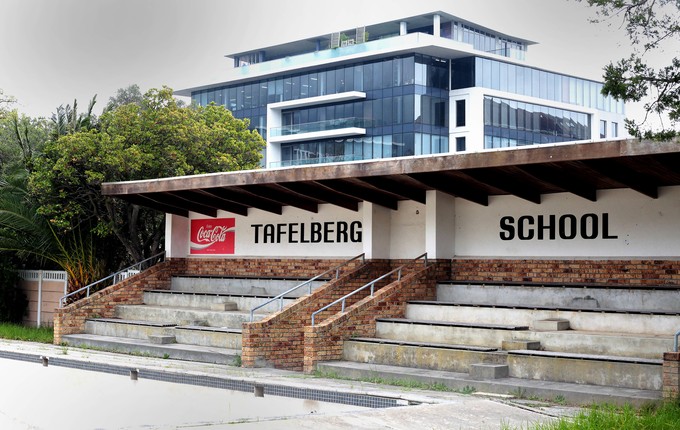
The site of the former Tafelberg School in Sea Point will be used for social housing as a result of a decade-long campaign by housing activists. Archive photo: Ashraf Hendricks.
- The Constitutional Court has ruled in favour of housing activists in the final chapter of an almost decade-long court case against the sale of the former Tafelberg School in Sea Point.
- The court ordered that the Western Cape government and City of Cape Town must submit to the High Court detailed plans on how they are reversing spatial inequality through affordable housing.
- High property prices and land scarcity, which are legacies from apartheid, are no excuse for the government to evade its constitutional duties, the court found.
The Constitutional Court has handed down a judgment which will impact how the government approaches affordable housing throughout South Africa.
Bringing to a close nearly ten years of litigation against the sale of the Tafelberg School site in Sea Point, the apex court put the City of Cape Town and the Western Cape government on terms to provide affordable and social housing within the inner-city.
Both the municipality and the province were directed to submit reports to the Western Cape High Court within three months, detailing their plans and projects to redress spatial apartheid and progressively realise the rights of poor and working-class people through affordable housing.
The government must take location into account when planning housing projects, as the City and the province have a constitutional duty to reverse “patterns of exclusion”, the court ruled.
Cape Town is divided along racial and class lines, and poor, working-class communities are excluded from “amenity-rich areas” such as the CBD and Sea Point, Justice Nonkosi Mhlantla said in the unanimous ruling.

“Location is not a peripheral consideration in housing policy. It is integral to the reasonableness inquiry,” said Mhlantla.
The court case was brought by Ndifuna Ukwazi (NU) and Reclaim the City, and centred on the site of the former Tafelberg School in Sea Point, which the province had in 2015 declared “surplus” and sold to a private school.
The legal battle was protracted and wound its way through the courts before reaching the Constitutional Court in 2025 (see a timeline of the case at the bottom of this article). The Socio-Economic Rights Institute of South Africa (SERI) acted as a friend of the court.
The Minister of Human Settlements also entered the fray, arguing that the national department should have been consulted before any decision was made to declare the site “surplus”. The minister sought an order reviewing and setting aside the decision.
The litigation resulted in the cancellation of the sale, and the Western Cape government, although it was still appealing the High Court judgment, has since announced that affordable housing will be built on the site.
Mhlantla said that despite the Tafelberg case being “moot”, the court had agreed to hear the matter nonetheless in the “interests of justice”.
“At its core, this case raises fundamental constitutional questions: how do we, as a society, in a free, democratic dispensation, address the enduring legality of spatial apartheid?”
She said every morning, thousands of Cape Town workers board buses, taxis and trains in pre-dawn darkness to travel from the city’s periphery to its centre.
“Their daily journey is not just a commute – it is a living testament to the enduring legacy of spatial injustice that this case glaringly exposes.”
In essence, she said, the housing activists cried foul over the sale of the site while there was a dire need for inner-city social housing. But the city and the province stuck to their guns.
The City had said it was doing what it could to fulfil its obligations and had a pipeline of projects.
The apex court said in its ruling that it could only determine the issue based on the record of the matter, which reflected that the City had, at that time, not implemented any projects for social or affordable housing within the CBD.
“There is no justification for this exclusion from well-located, amenity-rich areas for social, affordable housing.”
“There is no satisfactory evidence that the purported pipeline projects would materialise in the future,” Justice Mhlantla said, noting that several projects had been abandoned or stalled for more than a decade.
“Paper plans do not amount to constitutional compliance,” she said, and high market value or land scarcity – which were legacies from apartheid — were not excuses for the City and the Province to evade their constitutional duties.
While there may be budgetary constraints, the Province and the City had to take “reasonable steps” to overcome these, including seeking national government funding.
The City and the Province had “perpetuated spatial inequality” and had failed to take reasonable measures to progressively realise the right to adequate housing in Cape Town’s inner city areas.
With regard to the public participation in the sale of the Tafelberg site, the court found that the Province had “conducted a tick-box exercise”, with minimal indications that it was receptive to public input.
The court ordered that the Province and the City must submit reports to the High Court, within three months, setting out their current policies, projects and programmes for the provision of affordable housing within the CBD.
They must attach a schedule of what affordable housing projects have been completed, or are currently under construction, and what budgetary resources have been spent, and if national funding has been requested.
The reports must also include details of any intergovernmental coordination.
The court gave the parties leave to file further affidavits and, if necessary, enrol the matter again in the High Court.
It declared unconstitutional the regulations under the Western Cape Land Administration that provide for public participation to take place only after the conclusion of a valid contract for the sale of state land.
It suspended that order for 12 months, to allow the Province to remedy the legislative defect.
It also declared that the failure of the provincial government to inform and consult with the national minister of human settlements regarding its intention to dispose of Tafelberg was a contravention of the Province’s obligations in terms of co-operative governance.
The province was ordered to pay the applicants’ costs, including the costs of two
counsel, in the High Court, Supreme Court of Appeal and the Constitutional Court.
.
Support independent journalism
Donate using Payfast

Don't miss out on the latest news
We respect your privacy, and promise we won't spam you.
Next: Dial-a-Ride and MyCiTi commuters hit by major hike in fares
Previous: Immigrant families live in terror after being stoned by March and March crowds
© 2026 GroundUp. This article is published under the GroundUp Republication Licence Version 1.0. Email [email protected] to request permission to republish.