
How not to fix a corrupt and incompetent government
The Gauteng Department of Social Development is a masterclass in how not to deal with mismanagement and corruption
 Add GroundUp on Google
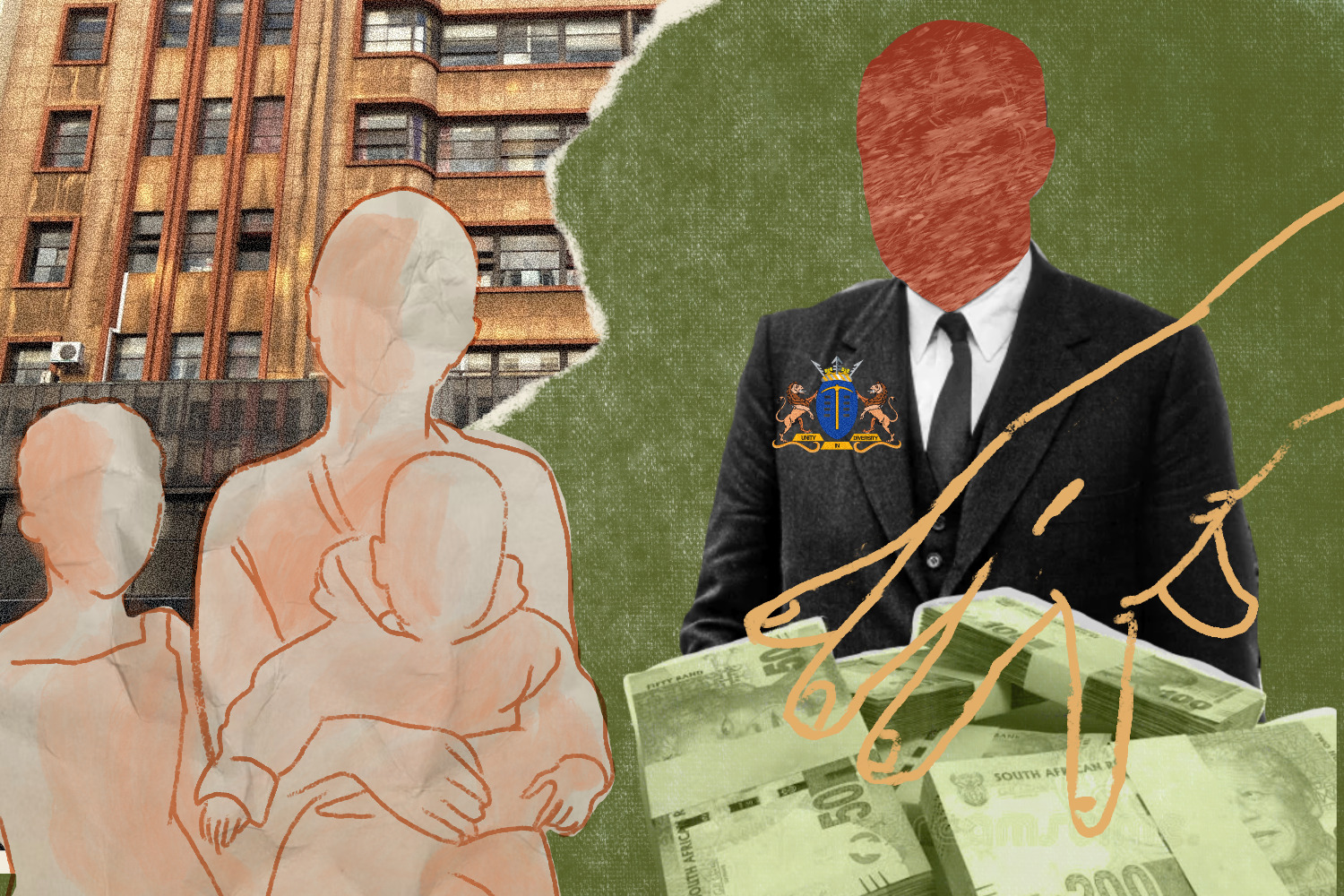
The Gauteng Department of Social Development has spent R3.2-million on forensic audits, with little to show for it. Illustration: Lisa Nelson
- At least R3.2-million has been spent on forensic audits by the Gauteng Department of Social Development.
- Action on an audit that exposed corruption in 2019 was not taken until 2023. Officials and a handful of organisations were referred to the Hawks, but the investigation has not progressed.
- Another audit in 2023 made significant findings about the department’s incapacity to properly monitor and evaluate the social welfare organisations it funds. As a result of the audit, dozens of organisations were unfairly punished, leaving vulnerable people stranded.
- The officials who were suspended in 2023 and 2024 returned to work. Some received written warnings, one resigned and became a senior official in another province, and several others are yet to be disciplined.
A large chunk of the Gauteng Department of Social Development’s (GDSD) budget is paid to social welfare organisations, among them old age homes, shelters for abused women, children’s homes, drug rehabs and soup kitchens.
Most of these organisations have relationships with the department going back decades, and they rely on the department for most of their funding. But in recent years, those relationships have become increasingly tenuous, with budget cuts and payment delays becoming commonplace.
Years of mismanagement and corruption have been identified in several forensic audits and by the Auditor-General.
Forensic investigations have cost the department at least R3.2-million, but attempts to act on them and to clean up the department and fix its systems have shown few results. Instead, they have resulted in widespread disruption of the non-profit sector.
Corruption investigation buried
In 2019, forensic audits found evidence of a corrupt relationship between officials at the GDSD and the directors of a handful of non-profit organisations and private companies.

One senior official, July Maphosa, was responsible for irregularly paying at least R500-million between 2016 and 2018 to for-profit companies via non-profit organisations. Some of these were connected to Maphosa.
Reports by law firm Bowmans and auditing firm BDO – completed while Panyaza Lesufi was acting MEC – recommended that the implicated entities be blacklisted and referred for criminal investigation. Disciplinary action was recommended against Maphosa and officials who broke procurement rules.
But no action was taken. Maphosa resigned for “personal reasons”. No officials were disciplined. The implicated organisations, including Godisang Development, continued to receive tens of millions in funding until the 2023/24 financial year. The reports were buried.
Then in 2022, Mbali Hlophe became MEC of both social development and agriculture. She dusted off the buried corruption reports and promised action.
In multiple media engagements and on social media, Hlophe said the department’s R2-billion in non-profit funding was not being spent properly. She condemned “dishonest NPOs who try to profit off the plight of the poor”.
The department funds hundreds of organisations a year; only eight were implicated in the Bowmans reports.
In 2023, auditing firm FSG Africa was appointed to conduct a new forensic investigation into 46 organisations. The move was heralded by Hlophe and Premier Panyaza Lesufi, who announced it in his 2023 state of the province address.
But then things started to go wrong. Finalisation of the audit at the start of the 2024/25 financial year coincided with a R223-million cut to the non-profit budget. But the department had already signed contracts with too many non-profit organisations, overcommitting its budget, and was hard-pressed to make cuts.
Meanwhile, Hlophe started to act on the audit’s findings. The previous region-based funding system was shut down. All funding decisions were centralised with the head of the department, Matilda Gasela.
The move was intended to improve compliance with procurement procedures. But it caused major delays and the system collapsed.
Gasela left the department in April 2024. She has since been accused of committing fraud during a previous stint at the agriculture department.
Hundreds of organisations went unfunded for months. The beneficiaries of old age homes, child care facilities, homeless services, and shelters for abused women were left stranded. Staff were retrenched and several organisations closed.
In May 2024, almost two months into the financial year, 51 organisations were told they had been flagged by the forensic audit and would not be funded that year. They had previously been told they would get funds, and had already committed funds for the new financial year, including for salaries and rental leases.
Two months later, their funding was reinstated after they took the department to the Gauteng High Court. Almost all were cleared of wrongdoing.
The Gauteng Care Crisis Committee (GCCC), a voluntary association of the non-profit organisations which took the department to court, was accused by Hlophe of misleading the public and spreading lies.
The audit report
GroundUp has now obtained a draft copy of the FSG Africa report. The findings in this report were used to withhold funding from the organisations — the report’s conclusions are almost identical to some of the suspension letters organisations received.
The report’s findings vindicate GCCC’s position that organisations were wrongfully punished for the department’s incompetence. We will be reporting on these findings in detail on Wednesday.
The forensic audit did not recommend defunding any organisations. Instead, it found the department incapable of responsibly funding and monitoring the organisations.
Most organisations were exonerated, or had findings against them that could be easily rectified. Only a few organisations were found to be wholly incompetent, and a handful warranted further investigation. We reported on one of these, The Beauty Hub Academy, on Monday.
One casualty of the department’s blundering is Mohau Centre, a home for terminally ill and HIV-affected children. The home was defunded for failing to produce building plans for a government hospital it does not own.
Mohau has not been funded since 2022, department spokesperson Motsamai Motlhaolwa confirmed.
Yet the forensic audit found no governance challenges and no significant compliance issues at the site inspection.
MEC Hlophe told GroundUp recently that she initiated the audit on Lesufi’s instruction, and had “no reason to doubt” there was corruption within the non-profit sector, given the findings of previous reports.
Funding was withheld from the organisations so as not to legally expose the department, she said.
“I do recognise, however, that the wider funding freeze affected organisations beyond that specific group, some of which were later cleared, but only after they had already suffered real harm,” she said.
As the crisis escalated in 2024 and media scrutiny increased, Lesufi swooped in to save the day. He promised to restore the department’s budget.
After the 2024 elections, Hlophe was left out of the new provincial cabinet. Faith Mazibuko became MEC, but was succeeded earlier this year by Nomantu Nkomo-Ralehoko.
Hlophe had suspended 13 officials between September 2023 and February 2024 based on the findings of the buried corruption report and the FSG Africa audit. The findings against them, Hlophe told GroundUp, included “various financial and administrative transgressions” and “questionable appointments of non-compliant NPOs who were subsequently paid millions, and a consistent lack of oversight and governance”.
Hlophe said “hostility was immediate” when she suspended the officials, and “the internal network they had built over years sought to sabotage departmental work, and bring the department to a stand still”.
A few weeks after Hlophe’s tenure ended, the officials returned to work because the department had failed to complete the disciplinary hearings in time.
Motlhaolwa told GroundUp that disciplinary processes are ongoing. Four officials received final written warnings, one was not recharged due to insufficient evidence, and eight are still involved in hearings. Another, Onkemetse Kabasia, resigned. Kabasia, then a deputy director-general, has since been appointed head of the KwaZulu-Natal Department of Social Development.
Meanwhile, the Hawks investigation into those flagged in the 2019 corruption audit has gone nowhere. The department said the matter is with the Premier. The Premier’s office said the Hawks still need to obtain an affidavit from Bowmans. The same response was given to us two years ago. The Hawks did not respond to our queries.
Complaints from organisations about late payments and mismanagement at the department persist, suggesting that the GDSD has not substantially improved its systems or capacity.
“The Department is always on continuous improvement efforts, which includes amongst others, adopting technology to manage applications and payments to NPO. The control environment of NPO operations has been improved with accountability strengthened,” said Motlhaolwa.
“There is more head office supervision and oversight in the selection and approval of NPO applications, the use of online application has also been introduced, both HOD and MEC hold regular meetings with officials, where NPO reporting and management are key in these meetings. Where NPOs feel aggrieved, they have an opportunity to appeal through the NPO Appeals Committee for reconsideration.”
This is the second of three articles about the Gauteng Department of Social Development’s 2023 forensic audits.
Part 1: Gauteng government’s R144-million gift to beauty training company
Tomorrow: Inside Gauteng’s welfare corruption investigation
Support independent journalism
Donate using Payfast

Don't miss out on the latest news
We respect your privacy, and promise we won't spam you.
Next: Spelling star, 13, needs funds to reach national final
Previous: Activists demand police action after 12th woman killed
© 2026 GroundUp. This article is published under the GroundUp Republication Licence Version 1.0. Email [email protected] to request permission to republish.