
SA may reach its emissions targets, but are they too easy?
If every country follows this approach, global warming could reach 3°C above pre-industrial levels
 Add GroundUp on Google
Urgently limiting greenhouse gas emissions is essential to avoiding the worst effects of climate change. South Africa is a party to the 2015 Paris Agreement. This required countries to set targets for greenhouse gas emissions in an effort to limit global warming to 1.5°C-2°C above pre-industrial levels. The targets set by most countries, however, are not sufficient and global emissions are still rising. Exceeding 1.5°C is very likely within the next decade.
The Paris Agreement only works if each country is doing its fair share. Even though South Africa produces about 1% of the world’s greenhouse gases, the Climate Action Tracker has rated South Africa’s targets as “insufficient”, projecting that if every country followed the same approach, warming would pass 2°C and could reach 3°C.
The tracker states that South Africa should cut its emissions by 40% between 2022 and 2035 to do its fair share of limiting warming to 1.5°C. The current target range represents a 16% to 29% cut.
Reaching targets
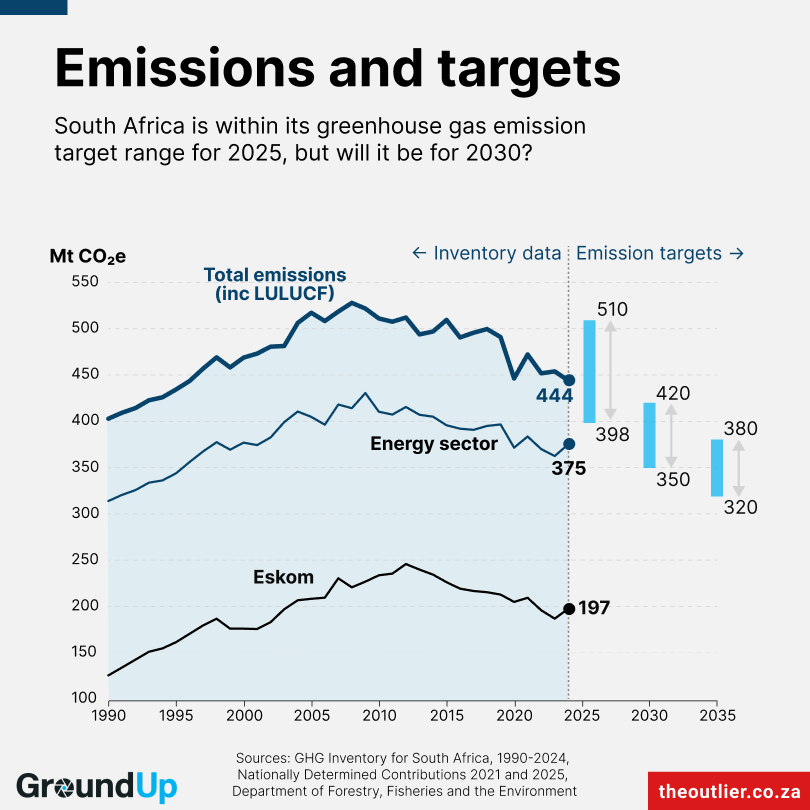
South Africa’s estimated net 2024 greenhouse gas emissions – of about 444-million tonnes (Mt) – fall within the range of the 2025 targets, according to the latest draft national inventory. While 477Mt were emitted, 33Mt were absorbed by the “land sink” (forests, thickets, grasslands, etc.).

The country’s emissions peaked in 2008 and have been decreasing unevenly since. This is not because of intentional greening efforts: the Presidential Climate Commission suggests the drop in emissions is likely due to economic stagnation and load shedding.
Since load shedding eased in 2024, energy sector emissions have increased as Eskom burned more coal. Total emissions fell only because the land is estimated to have absorbed more carbon. That estimate is uncertain. The inventory notes that some of the land changes it records may reflect rainfall rather than real change.
The energy sector alone emitted 375Mt in 2024, which is more than the whole lower target for 2030 (350Mt). In order to reach the top of the 2030 range, emissions must fall by another 24Mt. To reach the bottom of the range, they must fall by 94Mt.
It’s not guaranteed that this will happen. The government’s electricity plan, the IRP 2025, retires 8GW of coal by 2030, but only if 6GW of new gas power is running by then, which is uncertain. It also considers keeping five big stations open ten years past their 50-year life. Eskom has already moved the closure of five coal stations to 2030 due to delays in getting private power online.
Low bar
The country published its target for 2035 last year. The lower end of the 2035 target is 320Mt. Research by UCT, commissioned by the government, found that implementing existing policies, including the Renewable Energy Masterplan, could bring emissions to between 289Mt and 359Mt by 2035.
“The targets are so unambitious that we could hit them by doing what industry and government have already promised to do, without lifting a finger further,” said Déna Jansen, an analyst at Just Share. The upper end of 380Mt, she said, “is what tends to become the real operating target in practice”.
“A target that doesn’t ask anything of you isn’t anything more than a formality.”
Jansen points out that if South Africa cannot prove that it is serious about transitioning to clean energy, the country risks losing out on international finance and may be hit with carbon tax from importing countries.
Chart produced by The Outlier in partnership with GroundUp
Support independent journalism
Donate using Payfast

Don't miss out on the latest news
We respect your privacy, and promise we won't spam you.
Next: SIU asked to investigate farm worker equity schemes
Previous: Debate over new Makhanda wind farm
© 2026 GroundUp. This article is published under the GroundUp Republication Licence Version 1.0. Email [email protected] to request permission to republish.