
My two-hour “detention” while reporting on water challenges in Bronkhorstspruit
Nothing will deter me from doing my work and defending press freedom
 Add GroundUp on Google
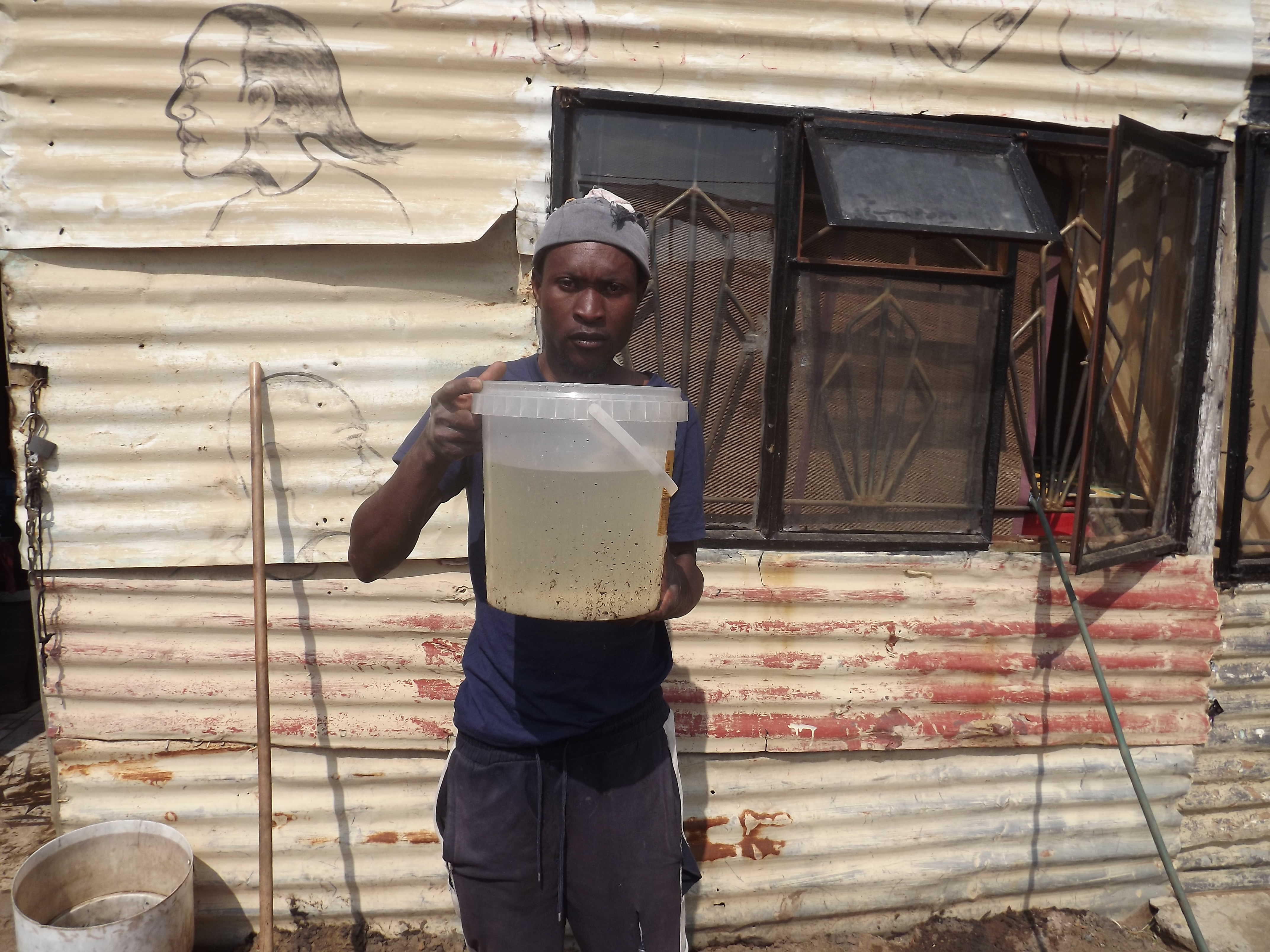
Juvenile Nahasse, who lives in Zithobeni in Bronkhorstspruit, shows a bucket of discoloured water he fetched from a tap in his home on 22 September. Photo: Warren Mabona
On 22 September, I visited the community of Zithobeni in Bronkhorstspruit after being informed about water challenges experienced by households there.
I arrived early. The residents welcomed me. They said their tap water had been discoloured for two weeks without any explanation from the municipality. I began interviewing them and taking photographs of the discoloured water.
At about 10:30am, as I was leaving the home of a resident I had just interviewed, I was approached by an angry man who said he was a Zithobeni resident “who wanted to make sure people in his community are safe”.
He demanded to know who I was, why I was talking to people and taking notes and photographs.

I gave him my full name. I explained that I was a regular freelance journalist for GroundUp and was working on a story about residents’ concerns about their drinking water. I told him that everyone I had interviewed and photographed so far had participated willingly and they fully understood the purpose of the interviews.
He demanded to see my press card. He said every journalist is required to get permission from the ward councillor and municipal office in central Bronkhorstspruit, about 15km away, before entering Zithobeni.
I told him I didn’t have a press card on me but we could call the GroundUp newsroom. I told him I was unaware that journalists had to obtain permission from the municipality to do a story in Zithobeni.
He started berating me. “Women are being killed all over here these days. Children are kidnapped and we don’t want criminals here,” he shouted. “Zithobeni is different from the other places where you worked without permission. You cannot come here without a press card. We will not allow criminals to pretend to be good people and commit crime.”
His outbursts drew the attention of other residents. Soon I was surrounded by about ten people. He demanded to see my ID and searched my bag. He took out my camera and ordered me to delete all the pictures, including the ones of the discoloured water.
Watching what was happening, a woman I had interviewed earlier asked me to delete her name and scratch out her phone number from my notebook, which I did.
The man then told me he was calling other residents on a community WhatsApp group to come and beat me. I have previously reported on such incidents where situations quickly turn violent, so I began to fear for my life.
I politely defended myself by repeatedly explaining who I was and why I was there.
Two community members then started looking up some of my recently published articles.
A few women I had interviewed earlier tried to defend me by saying that there was no need for anyone to call other residents to attack me. One stepped forward and said she believed I was a reporter from GroundUp.
“We are sick because of our tap water and I want him to publish his story about this,” she said.
Despite all the evidence the man insisted that I did not have permission to be there and phoned the Bronkhorstspruit police station to come and verify me. He also phoned another male resident, who soon arrived, wearing an ANC-branded T-shirt. They both interrogated me about my press card.
I later discovered that while this was happening, a police officer from the Bronkhorstspruit SAPS contacted the GroundUp newsroom and spoke to my colleague, Masego Mafata, and told her the community was threatening to assault a man who identified himself as a GroundUp journalist.
Mafata phoned me and I confirmed that community members were preventing me from leaving the area and they had called the police. I even gave the phone to one of the aggressive men to speak to her. Her attempts to reason with him and offer to send him the press card confirming my employment were futile.
Mafata then called the police, and after waiting for about 15 minutes, was transferred to the female officer who had called her. She told Mafata that the police were at the scene and that I had been released by the community.
Police never came but fortunately the aggressive men and the mob decided to let me leave. I assume the police must have informed them that they had confirmed my identity.
A man then escorted me to the taxi rank and threatened me, saying I was not to work in the area again or to publish what I had already gathered.
I went to the police station and tried to make a statement. The officer I spoke to said it was pointless opening a case.
I phoned ward councillor Fidel Phiri the next day. He said he was not aware of the incident and confirmed that I did not need his permission to work in Zithobeni.
“The only people who are normally stopped are the ones selling insurance [policies], as some are scamming the senior citizens. That is what we are promoting in our community, an active citizen to deal with crime,” he said.
Phiri apologised for the men’s behaviour but then accused me of “exaggerating the so-called detention”.
For years I have visited dangerous areas to do reports without carrying a press card. It was the first time I experienced such an ordeal.
I believe this incident was a blatant attack on press freedom. Nothing will deter me from doing my work.
Support independent journalism
Donate using Payfast

Don't miss out on the latest news
We respect your privacy, and promise we won't spam you.
Next: Cape Town roads blocked in electricity protest
Previous: State land must be used for housing, activists say
© 2026 GroundUp. This article is published under the GroundUp Republication Licence Version 1.0. Email [email protected] to request permission to republish.