
Xenophobia: what the government should have done - and can still do
State response to the covid emergency was much better
 Add GroundUp on Google
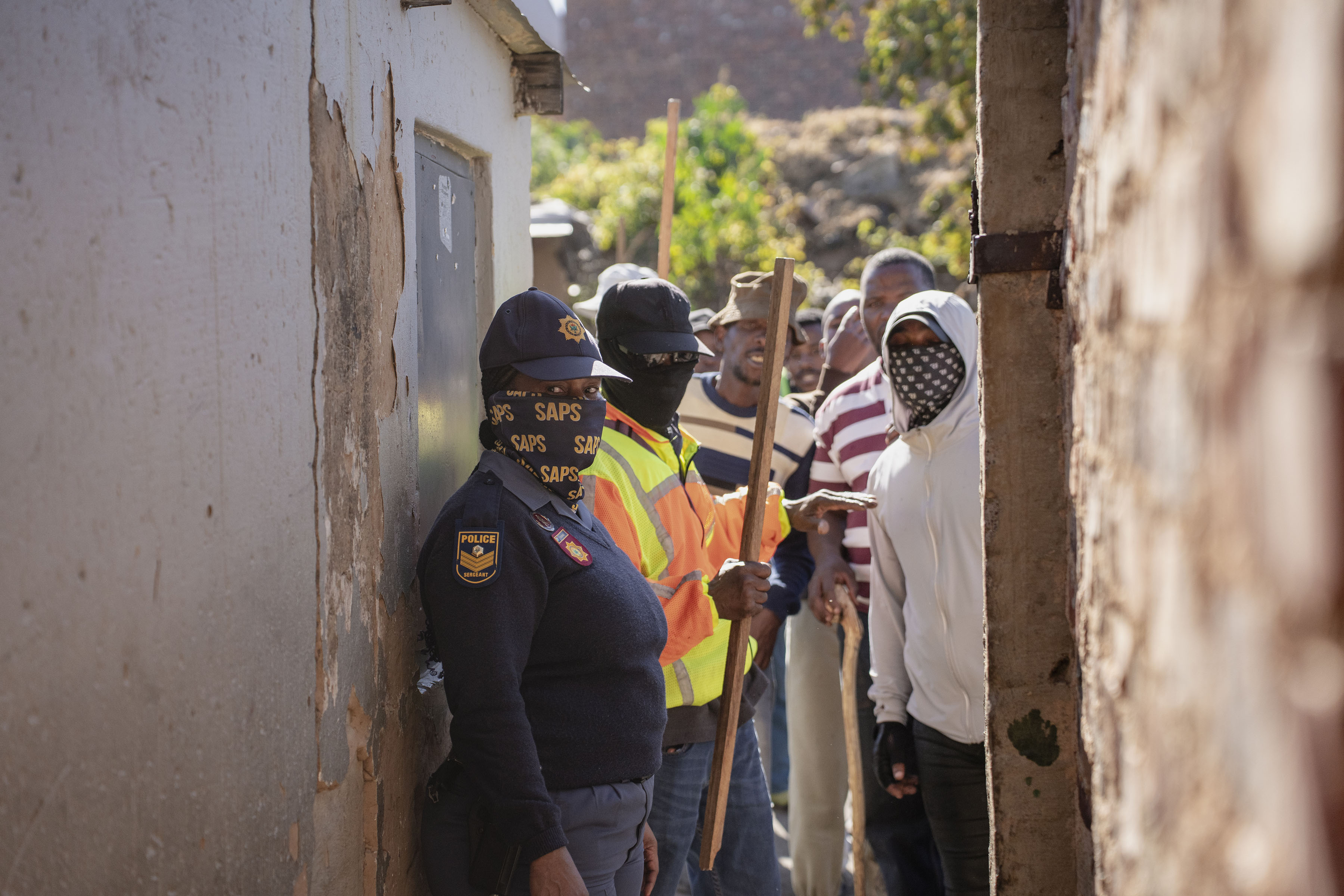
A police officer blocks masked vigilantes armed with sticks from entering a home to check for what they claim are undocumented immigrants in Alexandra last week. The government response to the outbreak of xenophobia has been slow and ambiguous, argues the writer. Archive photo: Ihsaan Haffejee
Compared to its response to the covid epidemic, the response of the government to the threats against immigrants has been slow and ambiguous, argues Alan Hirsch.
On 7 December 2025, anti-foreigner, or nativist, groupings set an ultimatum for all undocumented immigrants living in South Africa to leave the country by 30 June 2026.
Several other nativist organisations mounted the bandwagon. The campaign steadily snowballed, with several political parties indicating their alignment with the call.
The first official response from the government was a statement by President Cyril Ramaphosa over six months later, on 7 June, followed by a newsletter from the President on 8 June.
A flurry of government statements followed, with the government saying that it is already improving systems to weed out undocumented foreigners and that private individuals should not take the law into their own hands.

The President’s own statements had a similar tone.
While calling on the nativists not to break the law, he made statements that justified their anti-foreigner narrative: “We are responding,” he said, “to real concerns communities have about the effects of unchecked illegal immigration on jobs and economic opportunities.” He similarly justified anxieties about foreign-owned spaza shops and access to public services.
But, he said, ‘We must stand together against violence.’
The crisis in South Africa today is not a crisis of migration. It is a crisis of low growth over many years, high unemployment, poverty, a rising cost of living, and poor governance in many parts of the country. Yet, South Africa has followed a global trend of anti-foreigner mobilisation.
It is convenient for government to have a scapegoat for poor performance and for opposition groups to embarrass the government over its poor management of migration.
The United Nations estimates that there was a significant increase in migration into South Africa between 2000 and 2015 during the Zimbabwean crisis, but that since 2015, there has been a decrease in the number of immigrants (legal and illegal) living in South Africa. Remittance data shows that the total amount of money immigrants are sending home has not increased since 2015.
Immigrants make up just over 4% of the total population of South Africa. StatsSA puts the percentage even lower.
If we use the UN data for comparative purposes, since they use a similar methodology in all countries, there are eight African countries with higher proportions of immigrants to local-born than South Africa.
Compared globally, countries like the UK, the US, Germany, Canada and Australia have between three times and more than five times as large a proportion of foreigners to residents as South Africa.
At least four, and possibly 10, people were killed in the period leading up to 30 June, and many more injured. Close to 80,000 Zimbabweans alone have been forced to leave the country at short notice, and many immigrants remain in camps seeking protection and awaiting processing, often in dreadful circumstances.
The belated response of government to the crisis and the mixed messaging—justifying the anti-foreigner narrative while calling for peace—meant that responses were delayed and many events resulted in conflict. Protests became riots.
In the past, the national government has responded very promptly and decisively to crises. South Africa’s response to the COVID-19 crisis was exemplary. In the end, the response may have been excessive in certain respects (banning the sale of tobacco, for instance), but government acted swiftly and responsibly.
Lockdown was announced less than three weeks after the first covid case was reported in South Africa.
Contrast this with the UK, where Prime Minister Boris Johnson announced lockdown two months after the first UK cases were reported, after dithering for weeks over what to do.
But in contrast to South Africa’s response to anti-foreigner mobilisation, the UK government under Prime Minister Keir Starmer responded swiftly and decisively to anti-Muslim riots in the summer of 2024. Rioting broke out in Southport on 30 July, after the murder of three little girls by a man who happened to be a Muslim.
By 1 August, after stern, clear messages from the political leadership, hundreds of rioters had been arrested. By 8 August, more than 500 rioters had been arrested, and 149 had been charged. By mid-September, 1,511 rioters and people responsible for hate-mongering online had been arrested and 960 charged.
Aside from the three little girls, no one was killed, though several police, Muslims and rioters were injured. The rioting stopped as suddenly as it had begun.
So, what can we learn from our experiences in our own history and from the UK experience?
Firstly, the anti-foreigner agitators should have been confronted early and unambiguously, not six months after their ominous threats were made.
Secondly, action against agitators and rioters should have been timely and decisive. It should have been made clear to the police and the prosecution authority what their job is, and they should have met that responsibility with swift and effective action.
Thirdly, leaders should have marshalled and deployed evidence and intelligence from early on and throughout. As was the case in South Africa during the covid emergency, they should have set up a clear management structure and an expert panel to provide evidence and advice. Also, like the covid period, there should have been frequent, clear and unambiguous messaging from both the management team and the expert panel.
Because the issue had been politicised, government leaders seemed to be afraid to step out of line and make it clear that immigrants were not the main cause of the problems so many poor South Africans are facing. Had the government brought all the main political leaders together at an earlier stage, they could at least have attempted to take the issue out of the political arena.
There seemed to be very little coordination between the various spheres of government—national, provincial and local, or between government and civil society.
Had government reached out to civil society at an early stage—churches, trade unions, civic organisations—they might have been able to prevent the widespread inhumane and sometimes violent and murderous behaviour that escalated before 30 June and seems set to continue.
Some of these actions can still be taken, even if belatedly. If not, there is a risk of continuous conflict, undermining the social cohesion that has held our country together.
It is not too late.
Alan Hirsch is a senior research fellow at the New South Institute and an emeritus professor at the Nelson Mandela School of Public Governance at UCT. Views expressed are not necessarily those of GroundUp.
Support independent journalism
Donate using Payfast

Don't miss out on the latest news
We respect your privacy, and promise we won't spam you.
Next: Former PRASA board members challenge law on suing judges
Previous: Has the army deployment in Cape Town made communities safer?
© 2026 GroundUp. This article is published under the GroundUp Republication Licence Version 1.0. Email [email protected] to request permission to republish.