
We rode Metrorail in Cape Town to see if it has improved
While there are still problems, the service is much more reliable than a few years ago. And it’s much cheaper than any other commuter transport.
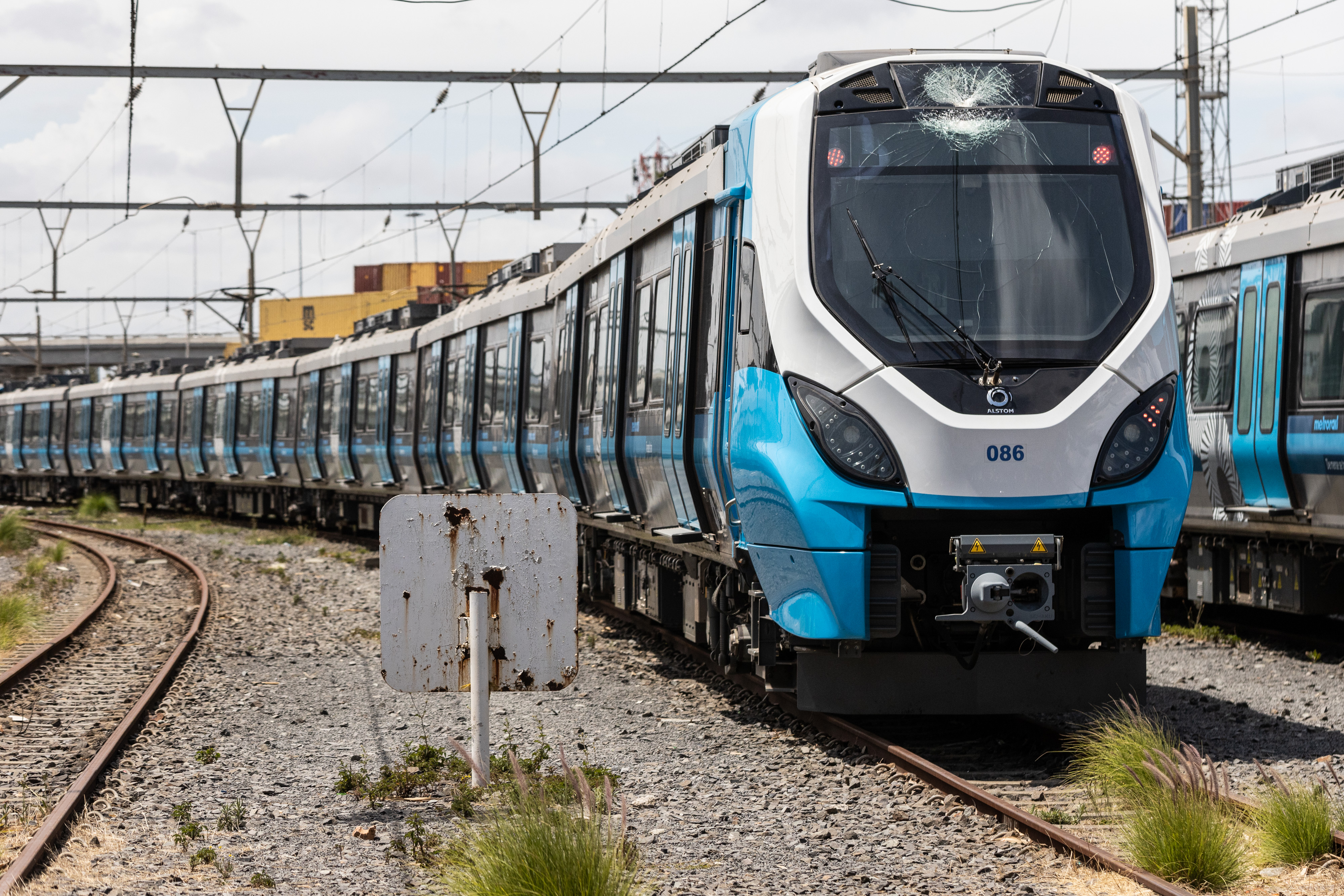
One of the new air-conditioned Metrorail trains. Archive photo: Ashraf Hendricks
GroundUp took the Western Cape’s Metrorail Northern and Southern lines to assess the quality of the train service since our last report in December 2024. Although the trains are safe and mostly on time, issues such as ticketing and a lack of visible security persist.
We took the Southern Line several times, as far as Fish Hoek, and the Northern Line several times from Cape Town to Stellenbosch via Eersteriver, a journey that typically takes over two hours.
At present, trains run every 15 to 20 minutes during peak hours (6am-10 am and 4pm-7pm) on the Northern and Southern lines and every 20 to 30 minutes during off-peak hours. Trains also run on weekends.
You can find schedules and plan journeys here.
Tickets can only be purchased in person with cash. This results in long queues at stations, although tickets are also sold on board the train.
If you time your journey well on the Southern Line, it is faster than going by car or taxi during rush hour. But travelling between Stellenbosch and Cape Town is probably faster by car (but not necessarily by taxi), because of the changeover at Eersteriver. However, travelling by train is cheaper than by car or taxi.
A Metrorail ticket costs R14 from Stellenbosch to Rondebosch for a single one-way trip. For R80, you can get a weekly return ticket.
Northern Line
On our journeys we often did not need a ticket to enter a station, as stations on both the Northern and Southern lines have no ticket access gates and sometimes there were no staff checking tickets. Often trains did not have visible security.
But there were spot checks by PRASA employees. On one trip between Eersteriver and Bellville, two male commuters were caught riding free and were removed from the train as they did not have money to purchase tickets.
There were digital displays and voice-overs on trains, but not at stations, except for Cape Town and Bellville.
The recent addition of a direct train from Du Toit (Kayamandi) to Cape Town at 5:30am has become a lifeline for some commuters. Kayamandi resident Abigail Makhawula, a domestic worker in Blackheath, said she used to have to change trains at Eersterivier and Bellville.
“I now arrive at work on time, not 10 or 20 minutes late, like I did before,” she said.
We were however left stranded at Stellenbosch on Friday, 28 November, when the 6:55am train was suspended until the afternoon, due to “delays in another station”.
And on Wednesday, 19 November, after departing Strand station, heading towards Eersterivier, the train stopped in the middle of nowhere for about eight minutes.
Giovani Stuurdom from Kuils River, who has been using the train for the past three years, told us that overall the trains are reliable these days.
Southern Line
At Rondebosch the ticket booths were often closed. On one trip, we boarded without a ticket. We could not buy a ticket even though we wanted to. When we got off at Kalk Bay, there was no one there checking or selling tickets either.
During peak hours (8am to 10am and 4pm to 6pm), the trains from Rondebosch to Cape Town were often at capacity, with many passengers standing or sitting on the floor. Some commuters even brought their own folding chairs.
At Fish Hoek, people exiting the train were funnelled into two lines: one for ticket holders and one for non-ticket holders (or “defaulters”) .
Those without tickets were directed to go and purchase one. However, the lines were not clearly marked, confusing some commuters, who found themselves in the wrong queue.
Apart from the ticketing issues, the trains running between Fish Hoek and Rondebosch were clean and safe, with guards patrolling the carriages.
We noticed several carriages had cracked windows and doors, with one having a warning sign not to lean on the glass. Another GroundUp employee noticed that the digital displays at Retreat, which is a major hub, had stopped working on the day he was recently there.
Cape Town to Century City
The Northern Line offers two routes from Cape Town to Bellville, one via Goodwood, the other via Century City.
Eyethu Dayimani, who works at Century City and commutes from Ysterplaat, said she went back to using trains when services were restored in recent years.
The new trains are safer and more reliable than the ones running before the Covid shutdown, she said.
Taking trains instead of taxis has saved her about R800 a month, she said. Also, the train is more direct. “When I take a taxi, I have to go via Nyanga, which is a harder trip,” she said.
Future plans
Metrorail, a PRASA service, remains a crucial service for commuters. From our experience the service has improved substantially since the lowpoint of several years back. But Metrorail has struggled to rebound to pre-Covid passenger numbers. In the Western Cape it currently transports over 150,000 passengers a day with just over 290 train trips, according to PRASA spokesperson Andiswa Makanda.
Makanda says PRASA is modernising its ticketing system to a cashless system and digital cards for validation.
We asked what the timeline was for the rollout of card machines and paperless ticketing, but this was not provided.
PRASA also intends to modernise its train signalling system, but this is on hold after an investigative report was recently completed following allegations that advance payments amounting to almost R2.7-billion had been fraudulently made to Maziya General Services, which had won a tender to automate the system.
According to Makanda, Maziya will not continue to install the modernised signalling system while the investigative report is under review by the Department of Transport.
“Currently, trains are being operated safely through an approved method, called Manual Train Authorisation, while the signalling systems are still being repaired,” he said.
PRASA plans to have the new signalling system fully operational in the 2029/30 financial year, said Makanda.
Support independent journalism
Donate using Payfast

Don't miss out on the latest news
We respect your privacy, and promise we won't spam you.
Next: In photos: St Lucia’s hippo celebrities
Previous: In photos: A walk in the night to mark the end of slavery
Letters
Dear Editor
In an era where the quality of reporting is often poor, I wish to compliment you on both being comprehensive and thorough. A very useful article. I hope PRASA continues their good work.
Dear Editor
Compliments to the existing train service where it was non-functional previously.
The person who wrote this article should be more grateful, and not mention an 8-min delay. Africa works on calendars, not watches.
Applause to the train service in Cape Town!
Dear Editor
Well done to the investigative team of journos. Well written, clear and concise.
It's encouraging to hear PRASA is getting their act together. It's just deflating to hear about the investigation about fraud or mismanagement about the ticketing tender process. Minister Creecy, I trust you can sort this out and nip it in the bud.
Great article, GroundUp!
Dear Editor
I enjoyed this article as it was informative because I don't travel by train anymore. One thing I noticed that the persons riding the trains did not mention, was the amount of stations closed. I know I would like to know specifically when De Grendel station will open again. Trains are not as reliable after Covid – we got trains every 5 to 10 minutes from Cape Town to Belville during peak hours, not so at all anymore.
Dear Editor
When will trains run on Sundays?
Sundays morning I have to walk on N1 highway for 2 hours to Century City from Avondale, yet it's a 10min walk from Avondale station.
Dear Editor
I have been using the Southern line every day to get from Lakeside to Kenilworth for work and back again since March.
My experience has generally been positive and the trains are reliable most of the time. Most of the time there are no security guards on the trains and I have had my phone stolen twice in the last six months. Once while on the train and once while getting on. Overcrowding is a problem – especially when a train is cancelled during rush hour, then everyone from that train piles onto the next train and it is so full you can't move. Another problem is no one every informs you if the train has been cancelled or is just delayed.
Apart from these issues and the ones mentioned in your article, the trains do work even if a lot of work is required.
Dear Editor
We think the Southern Railway route to Fish Hoek is generally reliable, but hasten to add that the damaged windows are caused by stone-throwing kids. We have witnessed this at St James/Kalk Bay. The kids' parents probably cannot fund schooling, and they are left to find alternative amusement without the rewards of a little discipline and respect for learning.
The new Alstom/Gibela six-car X'trapolis trains should be cherished by all as a major asset to Capetonians and those in its environs.
Dear Editor
It's value for money. Security is not visible anymore. People are seen eating and drinking occasionally. If ticket stations are not operating, the conductors should be aware and not accuse passengers of non-purchases.
Do the exteriors of the windows get cleaned? I use it with visitors to Kalk Bay. Most times you do not get a decent view of the outside and ocean. Hope this service continues to grow as the road volumes cannot cope.
Dear Editor
I'm using the train almost every to work. Yes, it's cheaper compared to the other modes of transport but it gets way too full – I mean squeezing on each other, full. If it happens that an airborne disease breaks out, it would be a disaster.
Please have a system to monitor how many passengers per trip because whatever is happening there is not safe.
Dear Editor
I am writing to express serious concern about the difficulties commuters are currently experiencing on the Northern Line. Since 1 December 2025, the regular 2502 train from Kraaifontein to Cape Town has been replaced by a train originating from Wellington. This change has caused commuters to miss the connecting train via Monte Vista, as the Wellington train is restricted to a speed of 30 km/h.
As a result, many commuters are forced to spend additional money on alternative transport to reach work on time. Unfortunately, this has led to late arrivals, with some employees even receiving written warnings from their employers.
Commuters have even resorted to taking earlier trains, which puts their safety at risk. Some have been robbed while trying to get to work on time, simply to avoid receiving written warnings and to ensure they can provide for their families.
By contrast, the Fish Hoek line operates trains every 20 minutes, thanks to its tracks and signals being in proper working order. We believe the same level of attention should be given to the Northern Line. Minister Sileku himself recently travelled on this line, and during the trip, he and Mr Maseko engaged directly with commuters while officially launching PRASA’s “50 Free Rides” initiative. This initiative, aimed at encouraging communities to return to rail, was activated on 14 October 2025 and made available to commuters on selected routes.
Our commuter community has been actively voicing these concerns through a social media group, where members go to great lengths to share updates and propose solutions. Sadly, our appeals appear to be ignored. While we have been informed of speed restrictions, signal problems, and track maintenance, no tangible resolution has been provided.
We respectfully urge your intervention to address these challenges and restore reliable service on the Northern Line. A dependable rail system is vital for the livelihoods and wellbeing of countless commuters.
Thank you for your attention to this matter.
© 2025 GroundUp. This article is licensed under a Creative Commons Attribution-NoDerivatives 4.0 International License.
You may republish this article, so long as you credit the authors and GroundUp, and do not change the text. Please include a link back to the original article.
We put an invisible pixel in the article so that we can count traffic to republishers. All analytics tools are solely on our servers. We do not give our logs to any third party. Logs are deleted after two weeks. We do not use any IP address identifying information except to count regional traffic. We are solely interested in counting hits, not tracking users. If you republish, please do not delete the invisible pixel.