
State spent R600m to contain 30 June xenophobic action - law enforcement could have prevented it
Kopanang Africa Against Xenophobia is taking the state to court
 Add GroundUp on Google
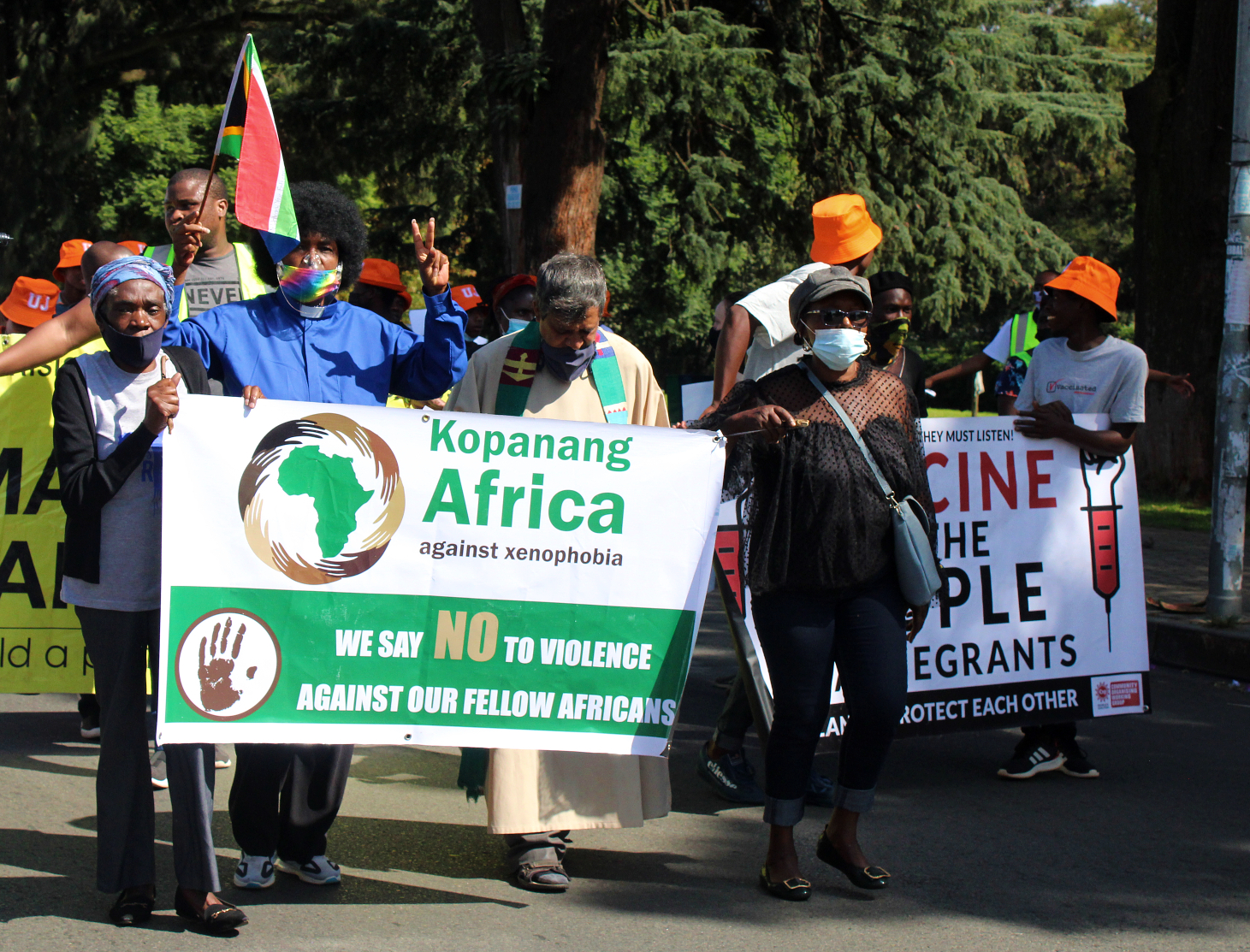
A protest against xenophobia in Johannesburg in March 2022. Archive photo: Masego Mafata.
For years, South Africa has watched the same warning signs appear – immigrants attacked, their businesses targeted, communities divided, and misinformation and fear used as tools for political mobilisation.
Each time, the country has promised that xenophobia will not become normalised.
Yet the events leading up to 30 June 2026 showed how quickly organised vigilantism can escalate when the state fails to act decisively.

Although the date had no basis in law, it created widespread fear and disrupted livelihoods. It exposed a dangerous reality - how private actors were able to assume powers that should be reserved for the state.
This is why Kopanang Africa Against Xenophobia (KAAX) is taking the state to court.
Not because South Africa lacks the law to stop xenophobic violence, but because the officials sworn to enforce that law have stood aside while private citizens enforce their wishes.
Across the country, self-appointed “inspectors” are conducting unauthorised raids on workplaces, shutting spaza shops, looting foreign-owned businesses, and stopping anyone who looks to them like a Black African immigrant and demanding their papers on the spot.
This is happening despite explicit, repeated statements from the Presidency and the acting police minister that immigration enforcement is exclusively a function of the state. It is also happening despite a high court judgment four months ago confirming that only immigration officers and police acting under section 41 of the Immigration Act may lawfully demand proof of identity or status.
Ahead of the 30 June deadline unilaterally declared by anti-migrant groups, a date government repeatedly and publicly rejected as having any official status, thousands of foreign-owned spaza shops shut their doors, some permanently, as owners weighed a day’s takings against the risk of a beating. Traders who remained open lost stock and income to these unlawful “inspections”.
The consequences were felt in homes where families lived in fear, in communities where mistrust has deepened, and among people who are afraid to go to their schools, workplaces, seek healthcare or be seen in public spaces.
R600-million for foreseeable lawlessness
The state budgeted more than R600-million for security operations for SAPS, SANDF, metro police, intelligence structures and private security to contain the violence. Were the rule of law functioning, such easily foreseeable lawlessness should not have been allowed in the first place.
Between our urgent application on this matter, the authorities have opened over 200 criminal cases and made some 350 arrests connected to vigilante conduct. That is not a sign the problem is being managed. It is a measure of how large the problem has already become.
Reckless media coverage in the days before 30 June gave the false impression of an official deadline, and the same disinformation ecosystem that fuels vigilante action online came close to repeating 2021, when looting and arson that year caused an estimated R50-billion in economic damage and cost approximately 353 lives, according to the South African Human Rights Commission (SAHRC).
That a repeat was avoided this time is not proof the system worked. It is proof of how much money and manpower it now takes to hold back a crisis that private vigilante groups manufacture and that the state has chosen, for years, not to confront at its source.
Racial profiling by xenophobes
Vigilante “verification” falls on people whose skin colour is being used as a proxy for legal status, sweeping up South African citizens in the same net as the people vigilantes claim to be targeting.
On 26 June, hundreds of members of Vatsonga Machangani Association of South Africa – Xitsonga-speaking South Africans from Limpopo — marched to the SAHRC to protest being repeatedly misidentified as undocumented foreign nationals and racially profiled because of the colour of their skin and the language they speak.
Add to that the undocumented immigrant, the asylum seeker without a final determination, the refugee whose permit renewal is delayed by a backlogged Home Affairs, the poor Black South African without an ID because the state itself failed to issue one, more than 4.4-million adults according to the department, and a pattern emerges. Vigilantism does not discriminate on the basis of paperwork. It discriminates on the basis of who looks poor, who looks foreign, and who looks Black.
Handing power to vigilantes
Nowhere is the collapse of due diligence by the state clearer than in eThekwini. A group of several hundred refugees, who fled vigilantes and sought protection at a SAPS station in Durban Central, were cleared by police using rubber bullets and tear gas.
The group ended up sheltering at the Diakonia Centre.
Rather than treat this as the humanitarian emergency it was, Home Affairs’ responded by seeking to verify the documentation status of people who had just been forcibly displaced and assaulted.
KAAX argued in court that this is clear evidence that immigration officers, Home Affairs and SAPS allowed their exercise of public power to be shaped by the demands of anti-rights groups, rather than by the law they are bound to apply equally to everyone living in South Africa.
The legal argument sharpens into more than a policy complaint. Section 7(1) of the Constitution enshrines the Bill of Rights for “all people in our country”, not only citizens. Section 9 prohibits unfair discrimination. Section 10 guarantees dignity to everyone. Section 12 guarantees freedom and security of the person. Section 205(3) imposes on SAPS a constitutional duty to prevent and combat crime and to protect the inhabitants of the Republic.
South Africa also has obligations under the International Covenant on Civil and Political Rights and the African Charter on Human and Peoples’ Rights.
In December 2023, the UN Committee on the Elimination of Racial Discrimination told South Africa in explicit terms to “take measures to effectively combat organised vigilante groups”, and to ensure accountability through “effective, thorough and impartial investigations”.
Anti-rights groups have built their campaign on a deliberate conflation: that being undocumented is the same as being illegal, and that being illegal is the same as being a criminal. It is not.
Being undocumented is, in the overwhelming majority of cases, an administrative status, often one caused by Home Affairs’ backlogs and its failures, not by any act of the person concerned.
South Africa does not have a migration crisis. It has a crisis of documentation, caused by the state, and a much older, much deeper crisis of inequality between a small wealthy elite and a majority still living in poverty after 32 years of democracy.
Neither crisis is solved by a man with a stick standing at a taxi rank demanding to see someone’s papers. Both are made worse by a state that lets him do it.
Relief sought
The relief KAAX seeks in this litigation is not radical.
It asks the state to do what the law already requires: confine immigration enforcement to lawfully authorised officials, protect everyone in the Republic from xenophobic violence, and convert that obligation into a concrete, monitorable, enforceable implementation plan with clear timelines.
It builds on the high court’s November 2025 order making the National Action Plan to Combat Racism, Racial Discrimination, Xenophobia and Related Intolerance, including its early-warning and rapid-response mechanism, a binding legal obligation rather than a policy aspiration.
If anti-rights groups genuinely believed the state was failing to address undocumented migration, the courts were open to them the entire time. Not one of these groups has taken the legal route. Instead they have chosen a way that leaves thousands of people, regardless of documentation status, too afraid to leave home, too afraid to work, too afraid to send their children to school. That is not border control. It is a humanitarian crisis manufactured by disinformation and tolerated by omission. In a constitutional democracy, tolerating this is itself a violation of the law.
Views expressed are not necessarily those of GroundUp.
Support independent journalism
Donate using Payfast

Don't miss out on the latest news
We respect your privacy, and promise we won't spam you.
Next: Relief for Lesotho as US tariffs expire
Previous: Air and water pollution harming Joburg’s poorest communities
© 2026 GroundUp. This article is published under the GroundUp Republication Licence Version 1.0. Email [email protected] to request permission to republish.