
Students carry the cost of NSFAS funding cap, Parliament hears
Calls for accommodation cap to be scrapped or redesigned
 Add GroundUp on Google
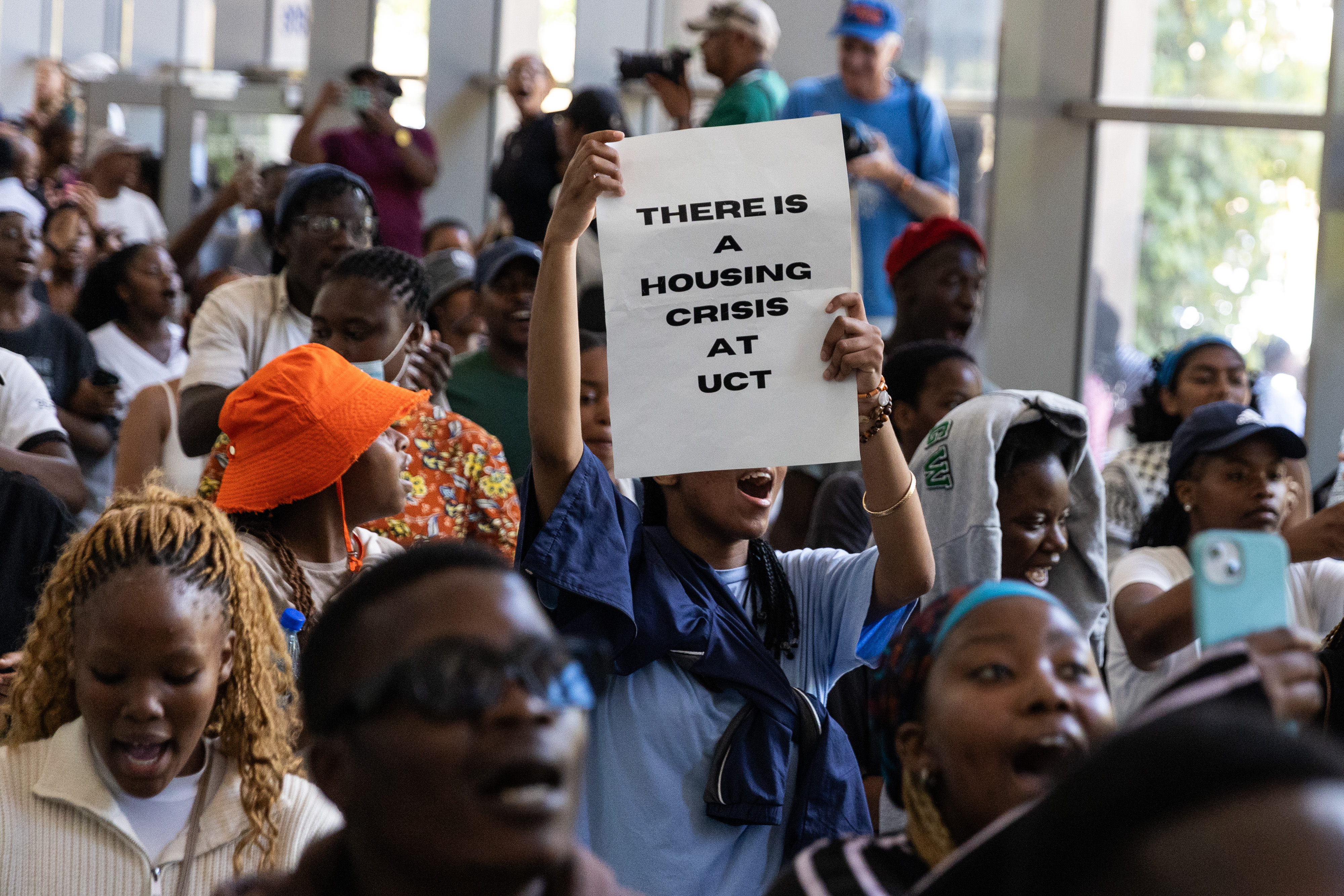
University of Cape Town students protested in 2025 about the National Student Financial Aid Scheme’s cap on accommodation costs. Students say they cannot afford to fund the gap. Archive photo: Ashraf Hendricks
The National Student Financial Aid Scheme (NSFAS) accommodation funding cap has not managed to curb high student housing prices. Instead, it has been used as a “price signal” for service providers to push up rents, Minister of Higher Education and Training Buti Manamela told Parliament’s portfolio committee for higher education on Friday.
The briefing follows protests and calls by University of Cape Town (UCT) students that NSFAS scrap the cap because students can’t afford to cover the difference.
NSFAS introduced the cap in 2023 to manage unregulated and increasing costs of student accommodation. It was also concerned about price collusion among student accommodation providers.
The cap varies depending on whether the accommodation is catered or not, or whether it is in a metro area. The annual cap for non-catered private accommodation is R52,000 in metros and about R43,000 elsewhere.

The portfolio committee met Friday to discuss challenges around student accommodation and the NSFAS cap. The colloquium was attended by representatives from government, universities and the private sector.
MPs heard that the accommodation cap has failed to keep prices low. It has left students saddled with the shortfall between the NSFAS cap and actual rental fees. It has forced students into debt.
Manamela said, “The accommodation cap was introduced because public money could not become an open cheque.”
He said they were also dealing with a legacy of high demand for student housing, unsuitable and unsafe accommodation, and inconsistency in standards for off campus rooms.
Committee chairperson Tebogo Letsie said, “Some students have argued that the cap does not always reflect market realities in different cities.”
Letsie raised concern about reports from students across the country living in buildings of poor quality with inadequate sanitation and fire hazards.
He said “access to safe, affordable and dignified accommodation has not kept pace” with the significant expansion of access to higher education over the past 30 years.
Waseem Carrim, NSFAS CEO, told MPs that NSFAS did not have “rate-setting powers” and could not dictate what landlords charge.
Carrim acknowledged that costs are “being passed down to students”, who were incurring debt or using their meal and personal care allowances to pay rent.
NSFAS senior manager for student accommodation Heena Valjee said that accommodation funding grew by 50% between 2023 and 2026. For this year, NSFAS is projected to spend nearly R19-billion on university accommodation and about R3.5-billion on TVET student housing.
The department recommended that the accommodation cap be “reconceptualised” and that an “urgent investigation into accommodation accreditation and costing practices be initiated”.
Phethiwe Matutu, CEO of Universities South Africa, called for an “evidence-based” cap, informed by the cost of utilities, maintenance, security, compliance, inflation and regional cost differences.
The colloquium was still in session at the time of publication.
Support independent journalism
Donate using Payfast

Don't miss out on the latest news
We respect your privacy, and promise we won't spam you.
© 2026 GroundUp. This article is published under the GroundUp Republication Licence Version 1.0. Email [email protected] to request permission to republish.