
Draft Bill on evictions puts tenants at risk
A new Bill proposes to criminalise land occupation and strip away eviction protections
 Add GroundUp on Google
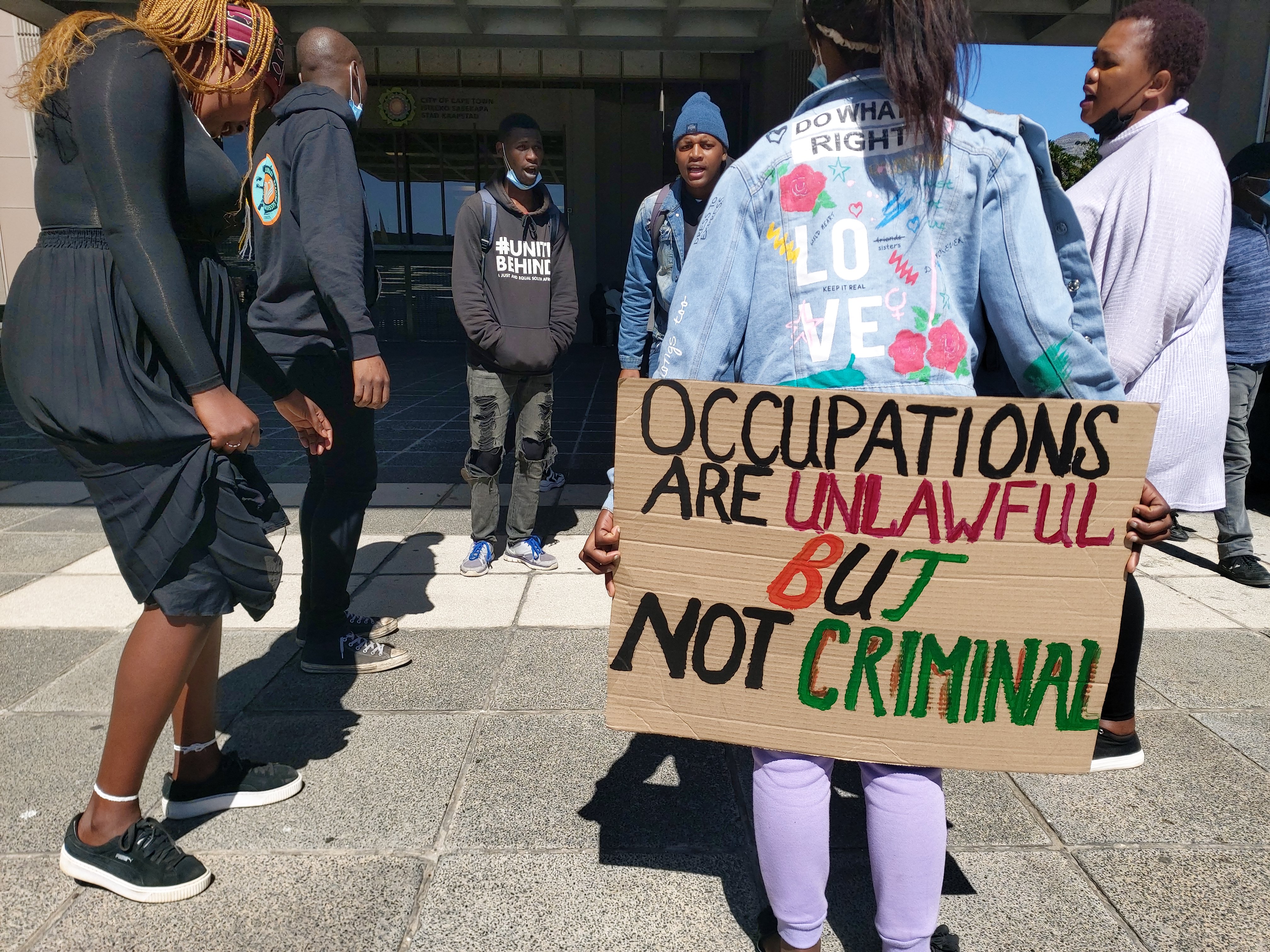
Housing activists protesting at the Cape Town Civic Centre in 2021. Archive photo: Liezl Human
A new Bill proposes a R2-million fine or two years’ in prison for anyone who allows another person to occupy land or a building without the owner’s permission.
In April, the Department of Human Settlements published a Bill proposing amendments to the Prevention of Illegal Eviction from and Unlawful Occupation of Land Act (PIE). PIE was adopted in 1998 to repeal apartheid laws criminalising “squatting” and to prevent unlawful evictions. The Act sets out procedures for eviction and ensures people are not left homeless.
The proposed amendments attempt to do away with some hard-won protections. The Bill proposes to criminalise land occupation, give courts the power to grant evictions without ensuring alternative accommodation, and set time limits on relief measures.

Criminalising land occupation
One of the main issues with the Bill is that its provisions for criminalising occupation are overly broad. Part of section 3 reads: “No person may incite, arrange, organise or permit any person to occupy land without the consent of the owner, organ of state or person in charge of that land.”
“Land” here includes buildings or structures, and “person in charge” means a person with legal authority to administer or control the land. Anyone in breach of this provision is liable to a fine of up to R2-million or a two-year prison sentence – or to both a fine and imprisonment.
What this means is that anyone who occupies a property or allows others to do so could be found guilty of an offence. This ignores the fact that people who occupy land often do so because their only alternative is living on the street.
Criminalisation would affect a parent who is desperate to put a roof over their child’s head and cannot afford accommodation. Furthermore, because the provision is so broad, it could also affect someone who believes they are paying rent to the owner of a building when in reality the property has been “hijacked” and the real owner has absconded.
At the very least, this places an additional burden on tenants to verify that their landlord has permission to rent the property to them.
No alternative accommodation
Another major issue with the Bill is that it tries to do away with an important constitutional protection. Subsection (14) of section 4 reads: “If the court determines that the occupier is an unlawful occupier, as defined in this Act, the court may choose to grant an eviction order without requiring the municipality or any organ of state to provide alternative accommodation or land.”
An “unlawful occupier” is anyone who does not have the permission of the owner or person in charge of the property. An exception would be labour tenants whose rights are protected under other legislation.
This provision is clearly unconstitutional since the Constitutional Court has found that municipalities have the duty to provide alternative accommodation to anyone who would be left homeless by an eviction. This right is not limited to “lawful” occupiers, but is open to anyone who would otherwise be forced to live on the street.
This marks a regression in the country’s attempts to incrementally fulfil the right to housing.
The Bill further defines alternative accommodation as “temporary” and compels courts to “stipulate the period for which such alternative accommodation or land must be made available”. There is no guidance as to what would constitute a reasonable time period for providing alternative accommodation.
In the current housing crisis, we cannot blame people for “taking up space” in alternative accommodation and leave them homeless in order to “make way” for others who also need the service. Rather, municipalities should be adequately resourced and funded to provide alternative accommodation following an eviction, as well as long-term housing solutions.
Conclusion
Far from the stated purpose of PIE to protect against unlawful evictions, the Bill seeks to relieve municipalities of the “financial burden” of the constitutional obligation to provide alternative accommodation. Instead of addressing the root causes of the ongoing housing crisis and historical deprivation of land, the Bill proposes to remove access to housing and deter occupation through criminal punishment.
The Bill remains open for public comment until 15 June 2026.
Views expressed are not necessarily those of GroundUp.
Support independent journalism
Donate using Payfast

Don't miss out on the latest news
We respect your privacy, and promise we won't spam you.
Next: Hundreds of families face eviction from “hijacked” social housing estate
Previous: TVET students demand funding for workplace training
Letters
Dear Editor
Noticeably absent from this article is the fact that PIE has increased homelessness.
By increasing the risks and costs to landlords (who also should have their human rights), the legislation disincentivises the building of homes-to-rent or letting out of idle property.
Dear Editor
I welcome the new Bill with both hands as a former landlord who struggled for four years because of tenants who were occupying my house and refused to pay despite the signed lease agreement. People work hard to make a living out of accommodation, while others want to stay for free, that's unfair. They don't even have pride. Imagine a whole husband with kids and grandkids refusing to leave someone's house, that's absurd. You must benefit from your sweat, be a responsible father and husband.
© 2026 GroundUp. This article is published under the GroundUp Republication Licence Version 1.0. Email [email protected] to request permission to republish.