
CPUT’s chaotic second semester ends
EFF-led SRC made several allegations against CPUT management, which the university rejects
 Add GroundUp on Google
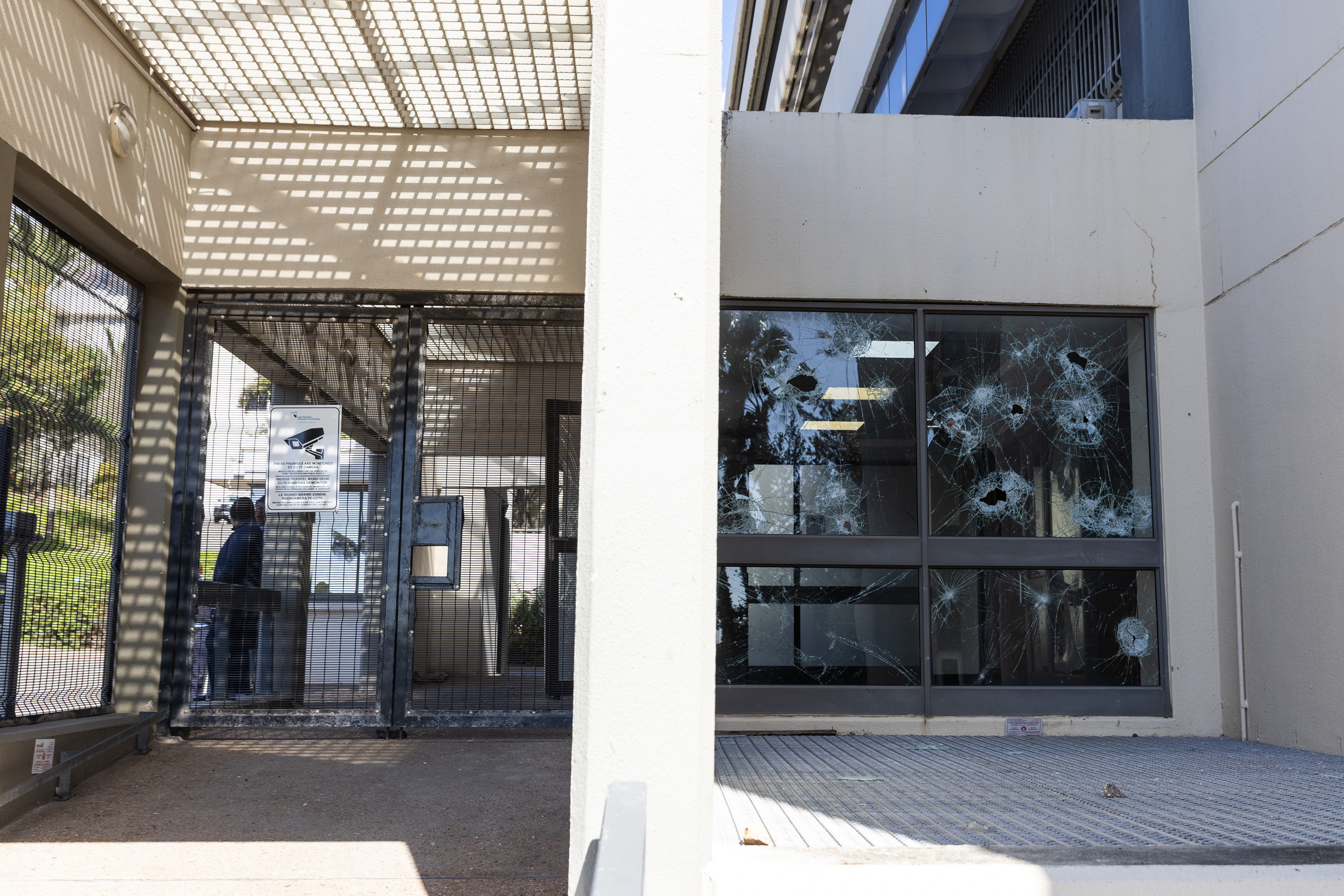
Windows at CPUT’s Cape Town campus, damaged by rocks thrown by protesting students. Archive photo: Ashraf Hendricks
- Violent protests in August forced CPUT to suspend classes and ask students to vacate its residences.
- The second semester has now officially ended and students are expected to return on 14 September.
- The academic year will be extended to 14 December to make up for weeks lost.
- The Student Representative Council is calling for investigations into the university’s alleged mismanagement. The university has rejected the allegations.
The Cape Peninsula University of Technology (CPUT)’s second semester, marked by weeks of violent protests, ended on Friday.
CPUT suspended lectures almost three weeks ago, on 18 August, and gave students 24 hours to vacate its residences. Most students stayed, but all classes stopped. The university said classes would only resume when it is safe.
Students told GroundUp they have been able to complete their internships and have been given assignments to submit over the next few weeks.
The CPUT Senate resolved this week that students will return as planned on 14 September and that the academic year will be extended to 14 December.
The university has since agreed to withdraw its proposed Financial Recovery Plan, under which students who are not NSFAS-funded would be required to pay up to R7,000 to register for the new academic year.
It was also decided that students affected by university residences charging more than the maximum amount NSFAS pays for accommodation will graduate without paying their bills.

CPUT had proposed a plan to recover some of its R2.1-billion student debt.
Accusations “without merit”
Since the withdrawal of the Financial Recovery Plan, protests have shifted to governance at the institution. The Student Representative Council (SRC), led by the EFF’s student arm, is calling for investigations into allegations about how the university has been run.
On Tuesday, about 100 students marched to the Special Investigating Unit’s offices in Pinelands to hand over a memorandum, giving the SIU two weeks to respond. The SRC said it has also sent its concerns to Parliament, the Presidency and the Department of Higher Education and Training.
The central claim concerns a R565-million public infrastructure grant. The SRC alleges that about R304-million of it cannot be accounted for in buildings, because two buildings were put up at a cost of about R260-million. It wants a line-by-line reconciliation of the balance.
CPUT spokesperson Lauren Kansley disputed the allegation. “The biggest portion of these funds is allocated to two student residences to be built on Bellville and District Six campuses. The two projects collectively account for R274-million. The balance relates to smaller projects in security infrastructure, project management and the balance of the applied sciences building. All the funds have been ringfenced and used accordingly.”
“Any investigation, whether by the SIU, SAPS, Public Protector, or Hawks, will find what we already know: That the funds at CPUT are tightly administered and has been subject to the necessary regulatory stakeholder oversight,” said Kansley.
“We have consistently maintained clean audits since CPUT has existed. If there was the mass maladministration as alleged, this would not be possible,” she added.
Kansley said whistleblower reports of misappropriated funds are often lodged by people positioning themselves to benefit from university accommodation and resources.
The SRC has also raised allegations about the appointment of vice-chancellor Chris Nhlapo, procurement and tender processes, disputes with trade union leaders, and bribery within the university’s leadership. They want the Nhlapo to resign.
“The SRC are not qualified to make assertions on complex Human Capital processes for appointments,” said Kansley. “This is a strictly governed protocol which requires strategic alignment to appoint the correct candidate. The process is tightly managed from candidate selection, interview panel selection and qualification verification.”
The SRC says whistleblower complaints have been closed without investigation.
“It is not true that the matters were closed with no investigation. In fact the contrary is true,” said Kansley. “A very thorough investigation by a respected external legal firm resulted in a report after combing over contracts and documents. Ultimately, the independent assessment found that there was no merit to these matters and Council accepted this assessment.”
Support independent journalism
Donate using Payfast

Don't miss out on the latest news
We respect your privacy, and promise we won't spam you.
© 2026 GroundUp. This article is published under the GroundUp Republication Licence Version 1.0. Email [email protected] to request permission to republish.