
Cape Town leads metro housing race
Here’s how the major cities are doing on housing delivery
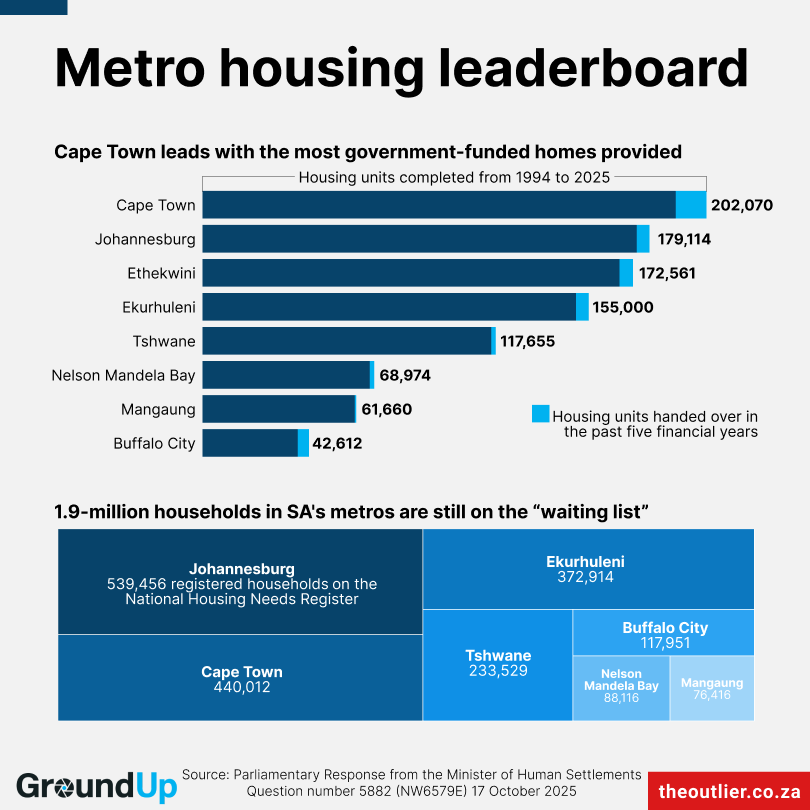
Of South Africa’s eight metropolitan municipalities, the City of Cape Town has provided the most government-funded homes since 1994, according to a parliamentary response by human settlements minister Thembisile Simelane in October last year.
Cape Town has also handed over more homes in the past five financial years – between 2020/21 and 2024/25 – than any other metro:
-
City of Cape Town: 12,401
-
Ethekiwni: 5,355
-
Ekurhuleni: 5,167
-
City of Johannesburg: 4,932
-
Buffalo City: 4,360
-
Nelson Mandela Bay: 2,017
-
City of Tshwane: 1,811
-
Mangaung: 613
What stands out is how much housing delivery has slowed in recent years. There was a big push in the early years of democracy to provide state-subsidised houses. But this funding has largely dried up, and new emphasis has been placed on upgrading informal settlements instead.
Housing developments are also threatened by extortion mafia, and opposition from neighbouring communities.
Simelane did not comment on the quality or type of homes provided (there are various government housing models), or whether the completed homes have been well-maintained and are still occupied. Information on where the homes are located was also not provided. While Cape Town leads in total houses completed, the city has unique challenges that limit access to well-located affordable housing
About 1.9-million households in metro municipalities are still on the National Housing Needs Register, said Simelane. Johannesburg, Cape Town, and Ekurhuleni have the most people on this housing “waiting list”.
But this is probably not an accurate representation of the housing need. In addition to the national register, there are also provincial and municipal housing “waiting lists”, which do not necessarily correspond.
The housing lists can also be outdated and flawed. People may have died or already found alternative housing, while others have been allocated housing on the list but never actually received a house.
According to the 2022 national census, about 88% of households in South Africa live in formal brick-and-mortar houses (up from 58% in 1996), while the rest live in informal, traditional or other forms of housing. But the quality of the 2022 census was very poor and this statistic must be treated with caution.
Chart produced by The Outlier in partnership with GroundUp.
Support independent journalism
Donate using Payfast

Don't miss out on the latest news
We respect your privacy, and promise we won't spam you.
© 2026 GroundUp. This article is licensed under a Creative Commons Attribution-NoDerivatives 4.0 International License.
You may republish this article, so long as you credit the authors and GroundUp, and do not change the text. Please include a link back to the original article.
We put an invisible pixel in the article so that we can count traffic to republishers. All analytics tools are solely on our servers. We do not give our logs to any third party. Logs are deleted after two weeks. We do not use any IP address identifying information except to count regional traffic. We are solely interested in counting hits, not tracking users. If you republish, please do not delete the invisible pixel.