Opinion and Analysis

National minimum wage part two: What will happen to jobs?

Deputy President Cyril Ramaphosa is hosting a social dialogue between business, labour and other constituencies over setting a national minimum wage (NMW). This is the second of a three part series by two University of Cape Town professors. Part one looked at South African minimum wage-setting in comparative context. Here they discuss the relationship between minimum wages and employment.

Nicoli Nattrass and Jeremy Seekings

Analysis | 25 November 2015

The rabbi, the president and the Palestinians

On 23 November, Geoff Sifrin's book Chief Rabbi Cyril Harris – How humanity, morality and humour helped lead a community was launched at the Great Synagogue in Johannesburg. Judge Edwin Cameron delivered this speech. He addressed Harris's commitment to reaching out across the divides in the South African Jewish community as well as perhaps the most vexing question facing many Jews: the Israeli-Palestinian conflict.

Edwin Cameron

Opinion | 24 November 2015

National minimum wage part one: Comparing South Africa to other countries

Deputy President Cyril Ramaphosa is hosting a social dialogue between business, labour and other constituencies over setting a national minimum wage (NMW). Minimum wages currently vary from sector to sector. A NMW would set a national wage floor applying to all workers irrespective of existing collective agreements and sectoral wage determinations. What level should the NMW be? This is the first of a three part series by two University of Cape Town professors.

Nicoli Nattrass and Jeremy Seekings

Analysis | 24 November 2015

Time to get tough with schools which discriminate against pregnant schoolgirls

A total of 20,833 school-going girls fell pregnant in South Africa in the 2013-14 year, according to official statistics. A staggering 717 of them were at primary school.

Chandre Stuurman and Demichelle Petherbridge

Opinion | 19 November 2015

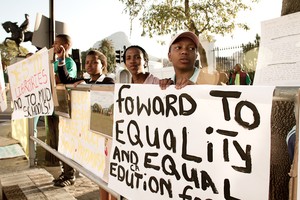
Time to demand equal rights for blind people

Being blind or visually impaired means many things in life are simply much more difficult than what they are for other people. Some of these things we can do something about, others we can’t. There are two fundamentally different ways for society and governments to respond to this unpleasant reality. The one option is pity and non-integration - the other is to forget about pity and to take practical steps to make things as equal as possible so that blind people can integrate into society.

Marcus Low

Opinion | 18 November 2015

The damning evidence against Phiyega and SAPS leadership

Suspended Police Commissioner Riah Phiyega has had a difficult year. Suspended by President Jacob Zuma following the Farlam Commission report which called for an investigation into her fitness to hold office for among other things tampering with evidence and lying, she now faces significant findings against her from an inquiry by the Minister of Police Nathi Nhleko.

Craig Oosthuizen and Zackie Achmat

Analysis | 13 November 2015

The debt machine and the politics of 0%

The current wave of student protests in South Africa has been mostly analysed from a national and local perspective.

Achille Mbembe

Opinion | 13 November 2015

Fees should not fall for all

Free higher education for all privileges the rich, argues Nico Cloete of the Centre for Higher Education Trust (CHET).

Nico Cloete

Analysis | 8 November 2015

DA’s shadow bill misses the key point

On Wednesday, the Democratic Alliance's (DA) new shadow minister of police, Zakhele Mbhele, will brief parliament's police committee on the DA's Bill to replace the National Key Points Act.

Murray Hunter

Opinion | 3 November 2015