
What Cape Town is spending on homes, roads and the N2 wall
The municipality’s plans have been hotly debated
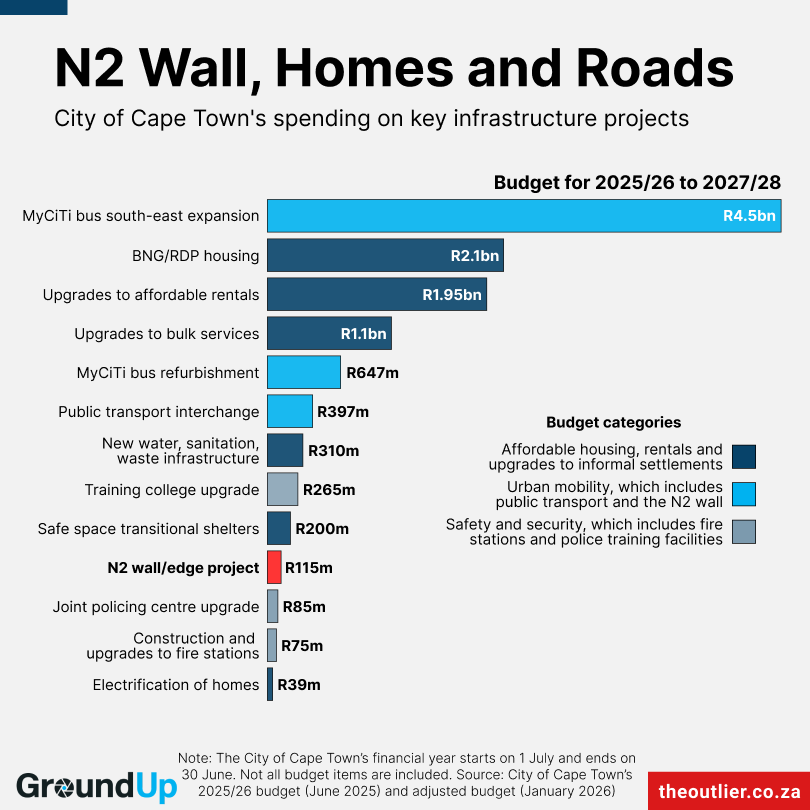
Our chart this week looks at how the hotly debated N2 Edge wall project stacks up against some of the City of Cape Town’s other planned infrastructure projects over the next three years.
According to the municipality’s adjusted 2025/26 budget, which includes projected spending until 2027/28, the N2 Edge upgrade will cost a total of about R115-million: R7-million to design and about R108-million to build.
The City’s entire budgeted capital expenditure for urban mobility, which includes public transport and the N2 Edge project, will be R8.2-billion over three years, more than half of which is for massive roadworks to expand the MyCiti bus service. The N2 Edge project makes up about 1.3% of this budget.
The City’s total planned capital expenditure on housing over three years is R3.5-billion, most of which will be spent on Breaking New Ground (BNG) formerly known as RDP housing. The City’s safety and security capital expenditure over the same period will be about R1-billion.

Little is known about what the N2 Edge wall will look like or where it will start and end.The City has provided scant details. A 9km stretch of the vandalised existing boundary fence along the N2 will be rebuilt, lighting will be improved, and safety barriers will be placed around play areas, City officials have said.
The proposal is still in its “infancy stage”, mayco member for urban mobility Rob Quintas told GroundUp. Public participation is yet to take place.
Some Cape Town residents have opposed the wall, arguing that it will entrench apartheid spatial planning and will effectively hide poor communities from the view of N2 users.
Others have stressed the need for safety measures along the N2’s “hell run”, where smash-and-grab incidents, hijackings, and gun crimes are common. As a major economic artery for the City, the N2 needs to be protected, proponents argue.
Safety concerns along the N2 have endured longer than a decade, says safety and security mayco member JP Smith. He said there has been a lack of meaningful intervention from other government entities, and the City has deployed highway patrols.
But without a proper boundary wall, it is challenging to police the area. For example, in a recent incident, a person armed with a semi-automatic rifle held up vehicles on the N2. As soon as law enforcement arrived, they disappeared into an informal settlement.
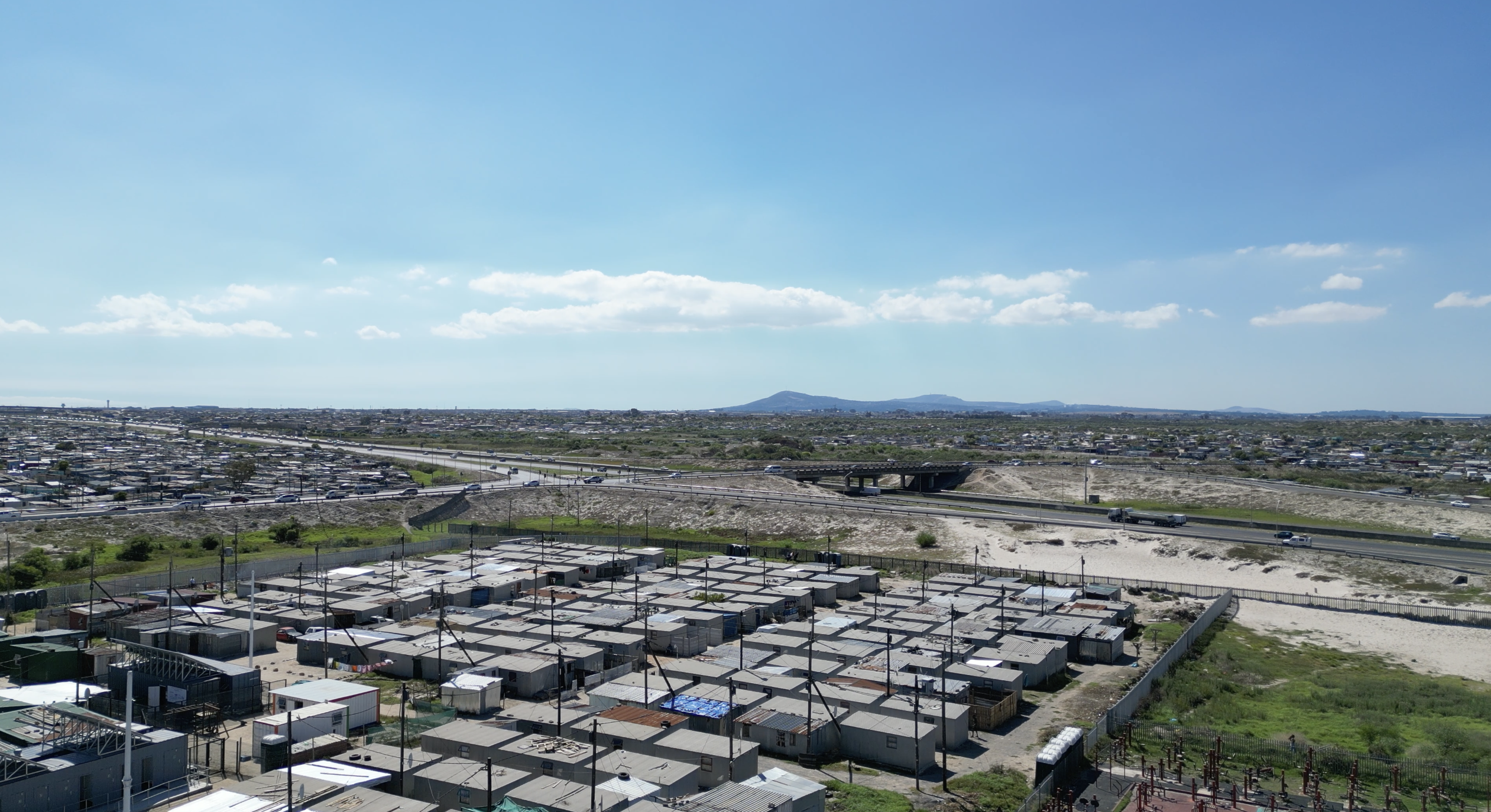
An aerial view of Khayalam informal settlement in Khayelitsha beside the N2. Photo: Peter Luhanga
GroundUp spoke to residents of several settlements along the road. They had mixed reactions to the wall proposal.
Asive Kanamtu, who lives in a shack in the Joe Slovo informal settlement, believes the wall will prevent criminals from accessing the highway and will also make it more difficult for people committing crimes in the settlement to escape the police.
“The thieves will be able to be caught … The wall is right for our informal settlement,” said Kanamtu.
Sibongile Masembatha, a mother of two who has lived in the area for 21 years, agreed that the wall may be beneficial. Police presence in the settlement should also be increased, she said.
In Khayalam informal settlement in Khayelitsha, residents said they had not known that a new wall was being proposed. Nomande Ndzeku, who lives in a one-room shack, said she hoped the wall would protect both residents and motorists.
“They must also consider us. While protecting motorists they must also patrol our informal settlements to reduce the crime they want to prevent with the wall,” said Ndzeku.
Zukiswa Maqakalana said the wall will also stop people from running across the road and being run over.
Babalo Dunywe said the City should spend its money differently. “There is a lot of things that can be done with that money. We are staying in hokkies and a lot of people are unemployed,” said Dunywe.
Cowen Buyambo said the wall will protect those on the N2, but not help prevent the hijackings that happen in townships and informal settlements.
“They should address the root of the crime,” he said.
Support independent journalism
Donate using Payfast

Don't miss out on the latest news
We respect your privacy, and promise we won't spam you.
Next: Cederberg municipality battles to keep up with sprawling informal settlements
Previous: Progress at last on Khayelitsha sewer line repairs
© 2026 GroundUp. This article is licensed under a Creative Commons Attribution-NoDerivatives 4.0 International License.
You may republish this article, so long as you credit the authors and GroundUp, and do not change the text. Please include a link back to the original article.
We put an invisible pixel in the article so that we can count traffic to republishers. All analytics tools are solely on our servers. We do not give our logs to any third party. Logs are deleted after two weeks. We do not use any IP address identifying information except to count regional traffic. We are solely interested in counting hits, not tracking users. If you republish, please do not delete the invisible pixel.