
We tried to take the train with a wheelchair user. Here’s what happened
PRASA has promised to make trains accessible but it is taking a long time
 Add GroundUp on Google
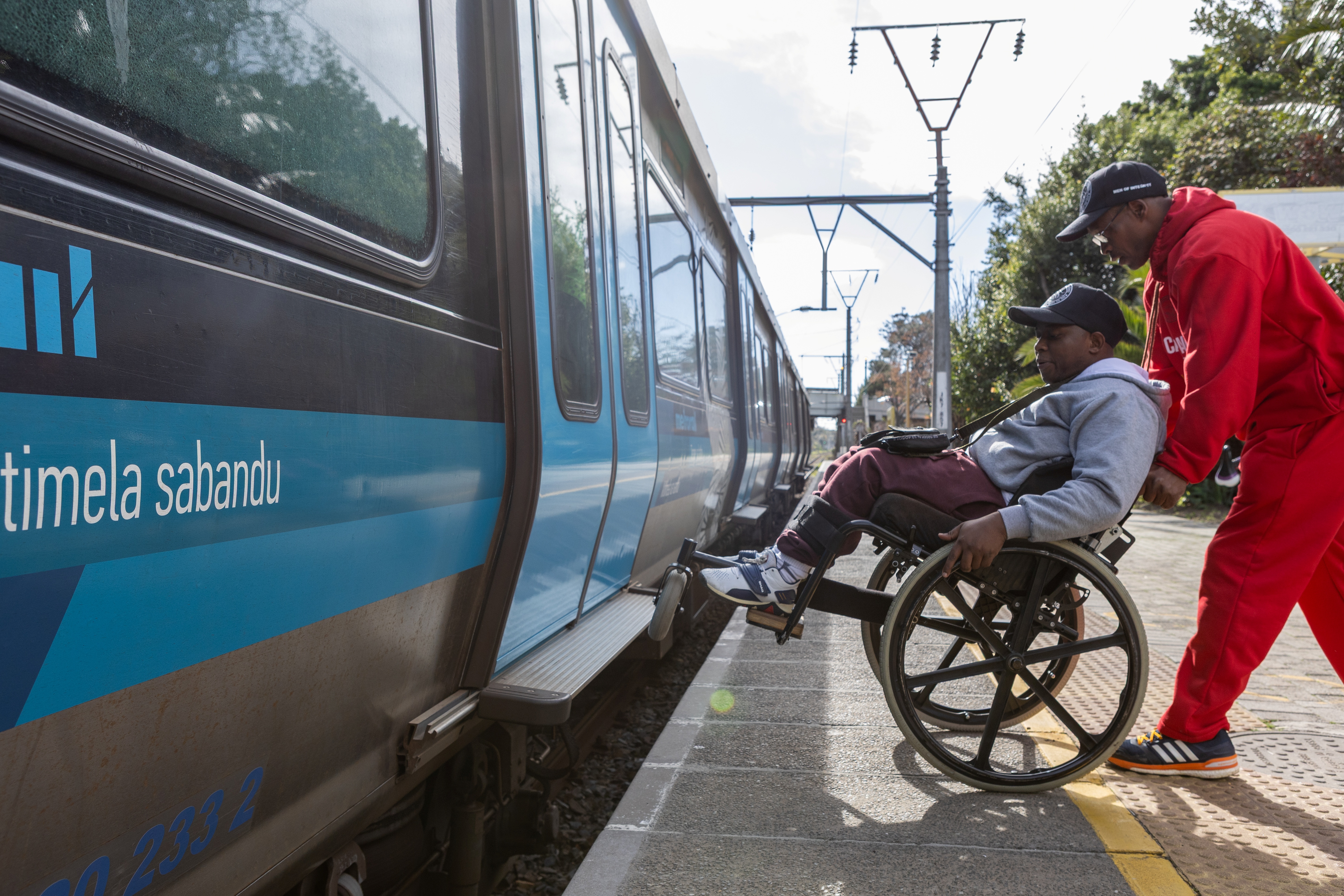
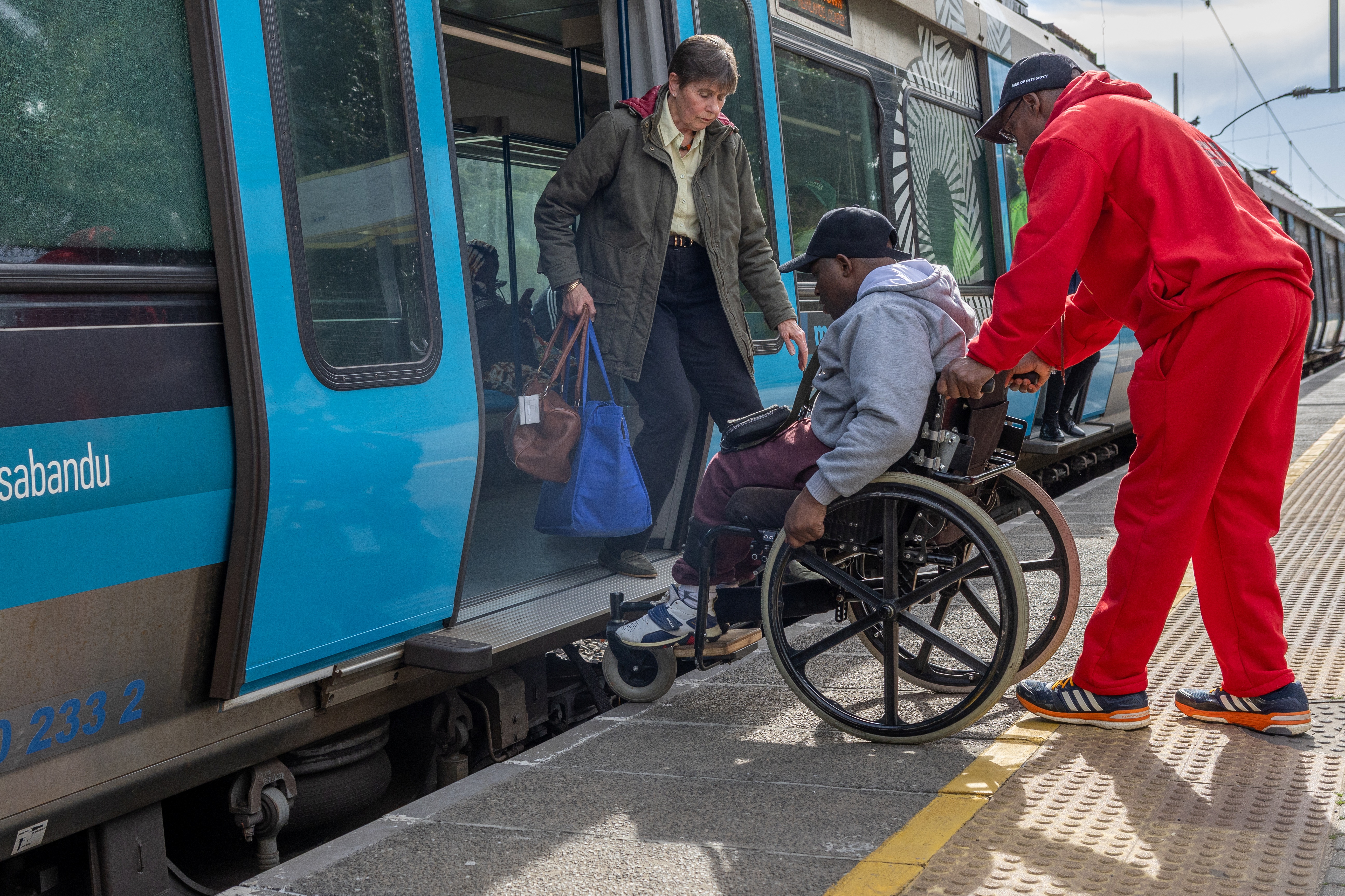
Khanyo Mantshi would not be able to board a train with his wheelchair because of the gap and height difference between the platform and the carriage. Photos: Dave Fisher
- PRASA has been promising for ten years to make all its stations and its trains accessible to wheelchair users.
- But when GroundUp tried to take the train last week with Khayelitsha activist Khanyo Mantshi, who uses a wheelchair, we found several stations were not accessible.
- And even when Mantshi could access the platform, he couldn’t get onto the train because of the gap between the platform and the carriage.
- PRASA says it is working to fix this and other problems to make its services universally accessible.
In 2016, the Passenger Rail Agency of SA (PRASA) promised to make all its stations accessible to wheelchair users. Ten years later, this is an empty promise, as GroundUp found when we accompanied wheelchair user Khanyo Mantshi on a journey in Cape Town.
Mantshi, a 32-year-old Khayelitsha resident, was born with cerebral palsy and uses a wheelchair.
As an activist with Disability Revolution and Amadoda Aqotho (Men of Integrity), a men’s movement in Khayelitsha, Mantshi says he has to move around a lot.
“As activists we are constantly doing something. Meeting, mobilising and organising. I also have clinic and hospital appointments. A taxi is not an option for me, because I always feel like a burden to people who are forced to help me to get on and off the taxi, and the taxi drivers are not particularly patient or friendly.”
“The bus (Golden Arrow) I don’t even consider because they do not cater at all for people in wheelchairs. Dial-a-Ride has its own issues, with a long waiting list among them. So, the only option I have is using e-hailing services,” said Mantshi.

Last week, Mantshi decided to let GroundUp join him in trying to use a train.
We drove to four stations, Chris Hani station in Khayelitsha which is closest to where Mantshi lives, Kuyasa station also in Khayelitsha, Langa station and Rondebosch station.
Chris Hani station
The station has no ramps or stairs and Mantshi has no problem getting on to the platform. But once on the platform, he is stuck. The space between the train and the platform is too wide. The entrance to the train carriage has no ramp, just a small step.
“It would be impossible for me to get on the actual train,” he says.
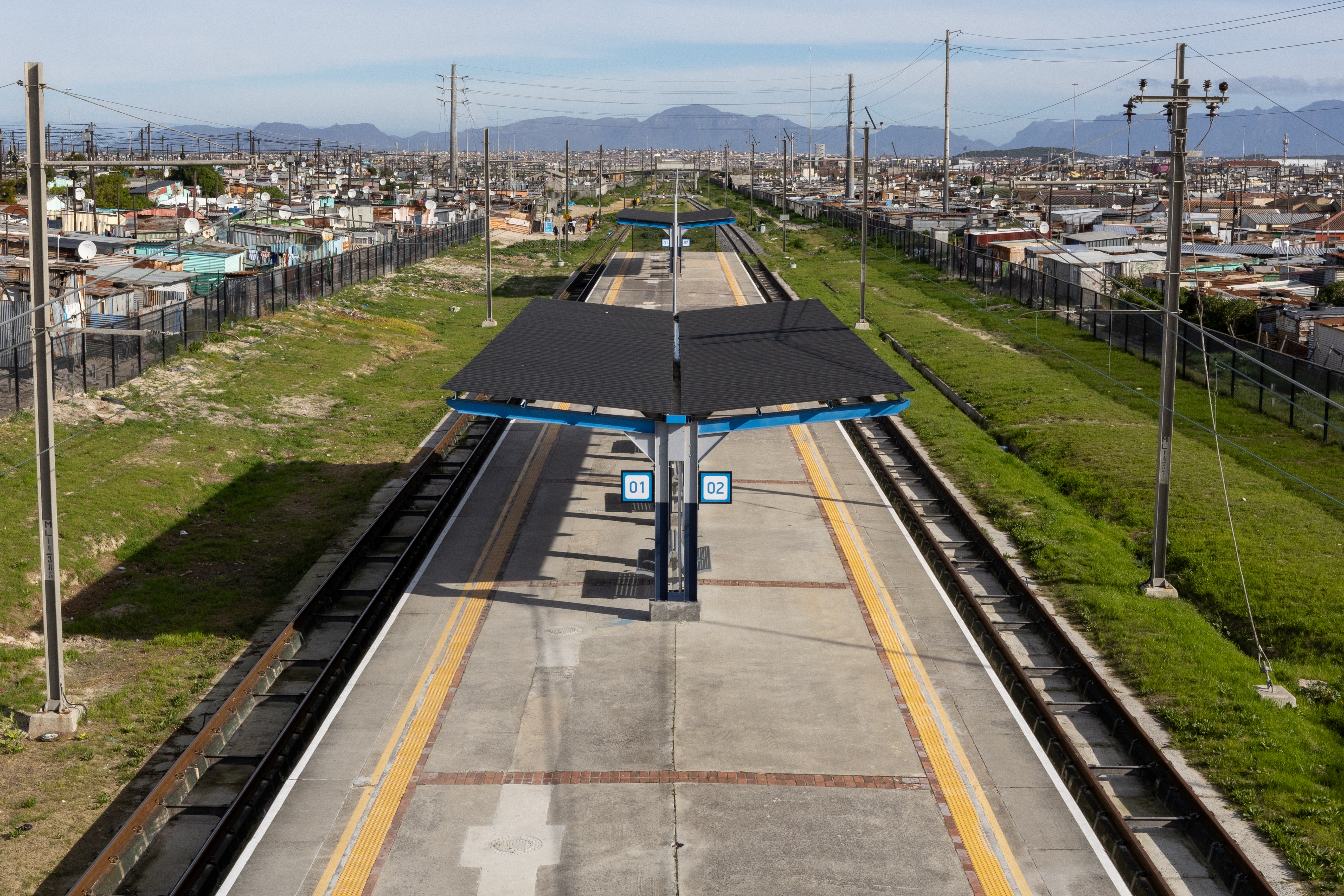
Khanyo Mantshi had no problems getting onto the platform at Chris Hani station. But he couldn’t get on the train.
Kuyasa station
Kuyasa station has a ramp and stairs. When Amadoda Aqotho coordinator Lumkile Sizila wheels him up the ramp to the station, Mantshi is hopeful. But when he gets to the ticket office, a PRASA employee warns him that there are no ramps leading to the platform, only stairs.
“In cases like these, we usually gather some of male security guards to help carry the person to the train,” says the employee.
Some security guards who are listening prepare to help Mantshi to the platform. He politely refuses.
“Why do I have to be treated like a cabbage? Having people carry me around as a grown man for a simple thing like getting on to a train?” he says.
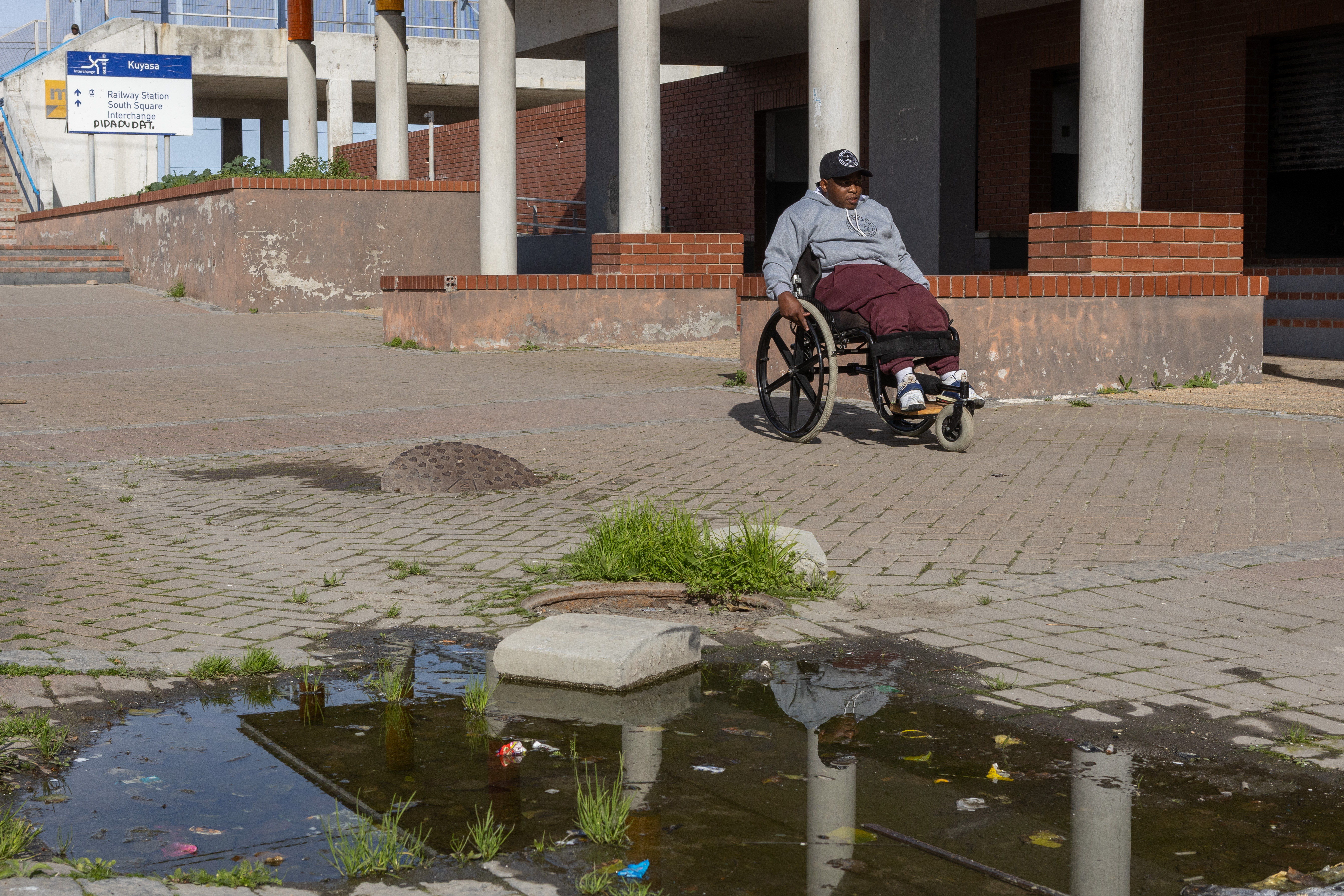
There is a ramp as well as stairs to the ticket office at Kuyasa station.
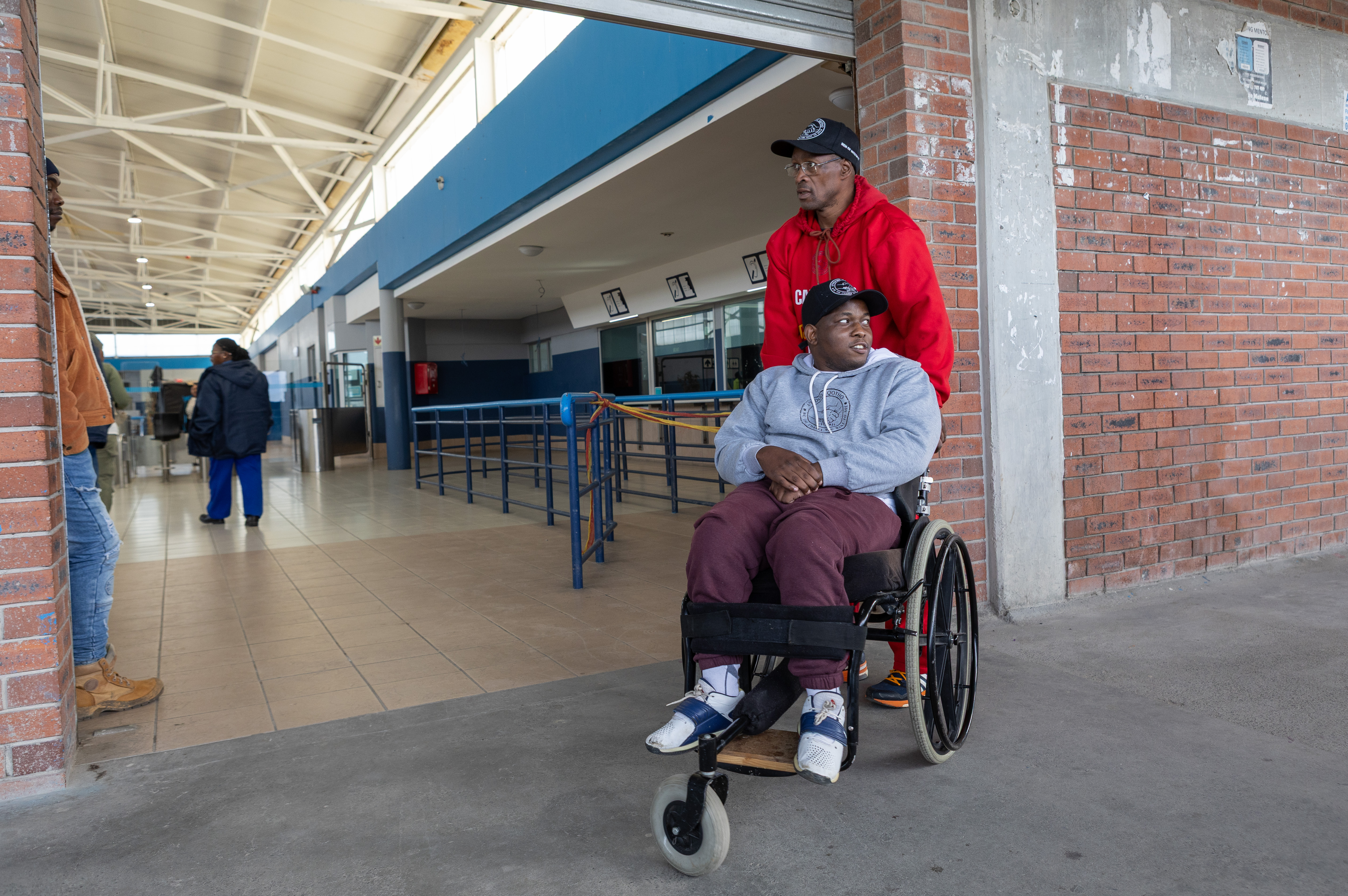
From the ticket office, Mantshi cannot reach the platform at Kuyasa station.
Langa station
At Langa station, there is a very long flight of stairs and a long ramp to the ticket office. At the top, Mantshi is told that the only way down to the platform is a long flight of stairs. He will not be able to get there.
“This station has two lifts, but it’s been a month now that they have not been working,” says a PRASA employee. “They break down a lot. It is one of the biggest problems we have because there are many people with disabilities who depend on those lifts. We usually ask the security guards to help get a person to the platform, but it is not easy because the stairs are too much.”
Sizila says, “We had a meeting about this exact issue years ago when Fikile Mbalula was still Minister of Transport. Even then these lifts were not working.”
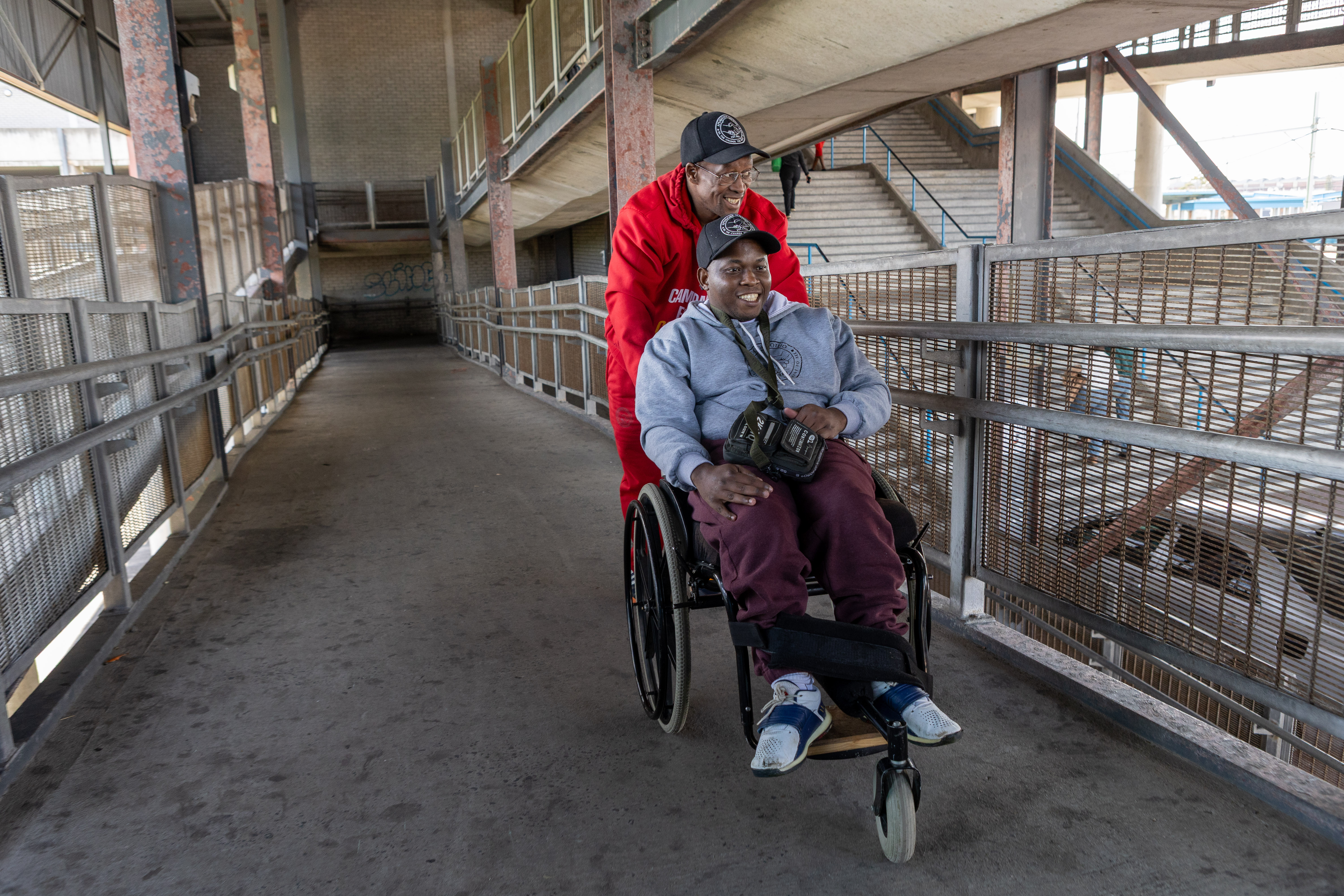
At Langa station, there is a long ramp to the ticket office.
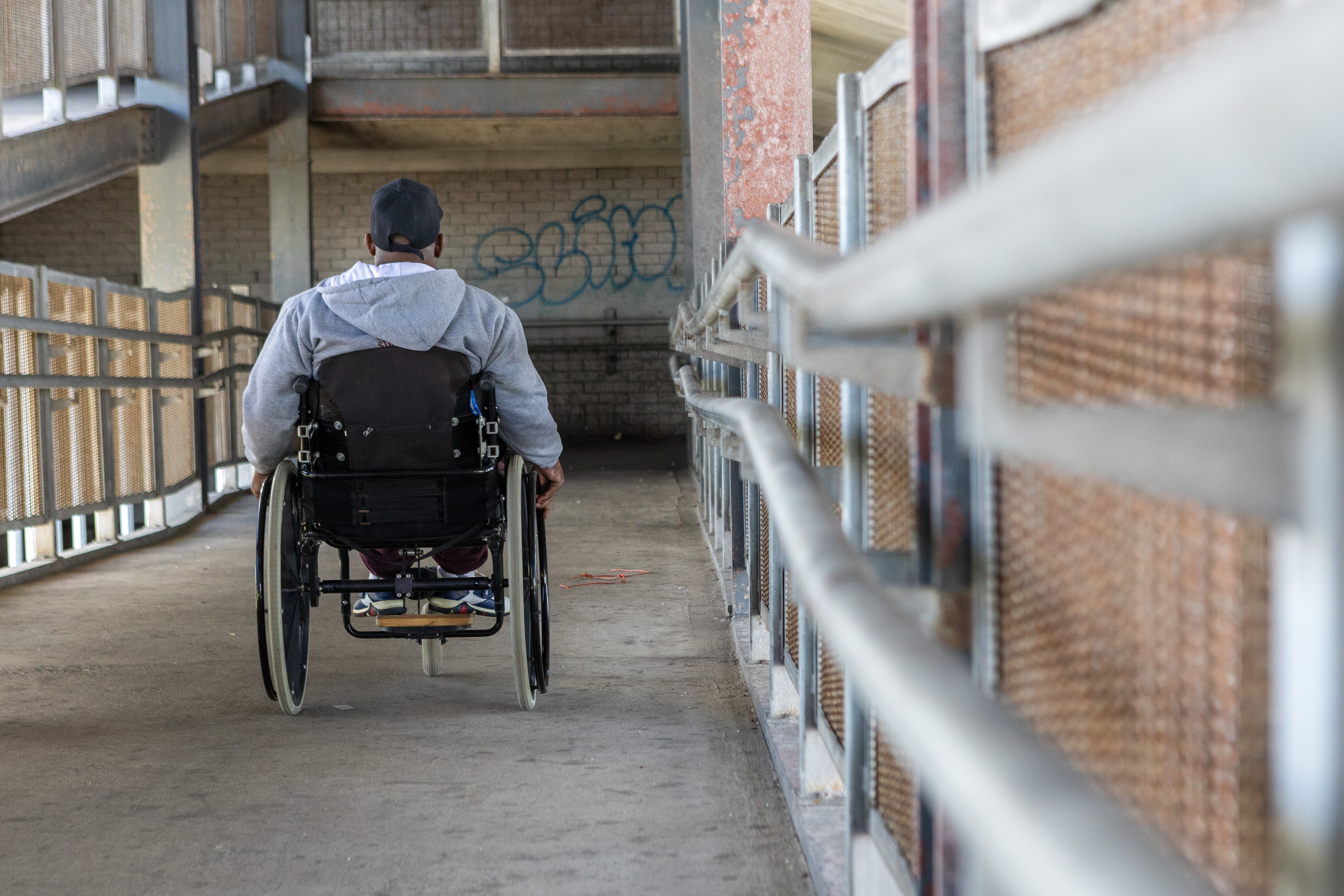
Mantshi leaves Langa station. He cannot access the platform from the ticket office because there are only stairs, no ramp.
Rondebosch station
Entrance one to Rondebosch station only has a staircase, so Mantshi can only use entrance two on the other side of the station.
Waiting for a train that should arrive in ten minutes, Mantshi needs to use the toilet. Sizila takes him to the two mens’ toilets. Both are locked.
They turn around and go to the other side. On the way there is a women’s toilet, also locked. Next to it is a staff toilet. None of them are adapted for people with disabilities.
“All of the toilets do not work unfortunately, and it has been weeks,” says one of the cleaners. “Even staff must walk all the way to the mall in Main Road to use the toilets.”
However, the cleaner offers to let Mantshi use the staff toilet and says they’ll find a way to clean it. “No, thank you, I’ll be fine,” says Mantshi.
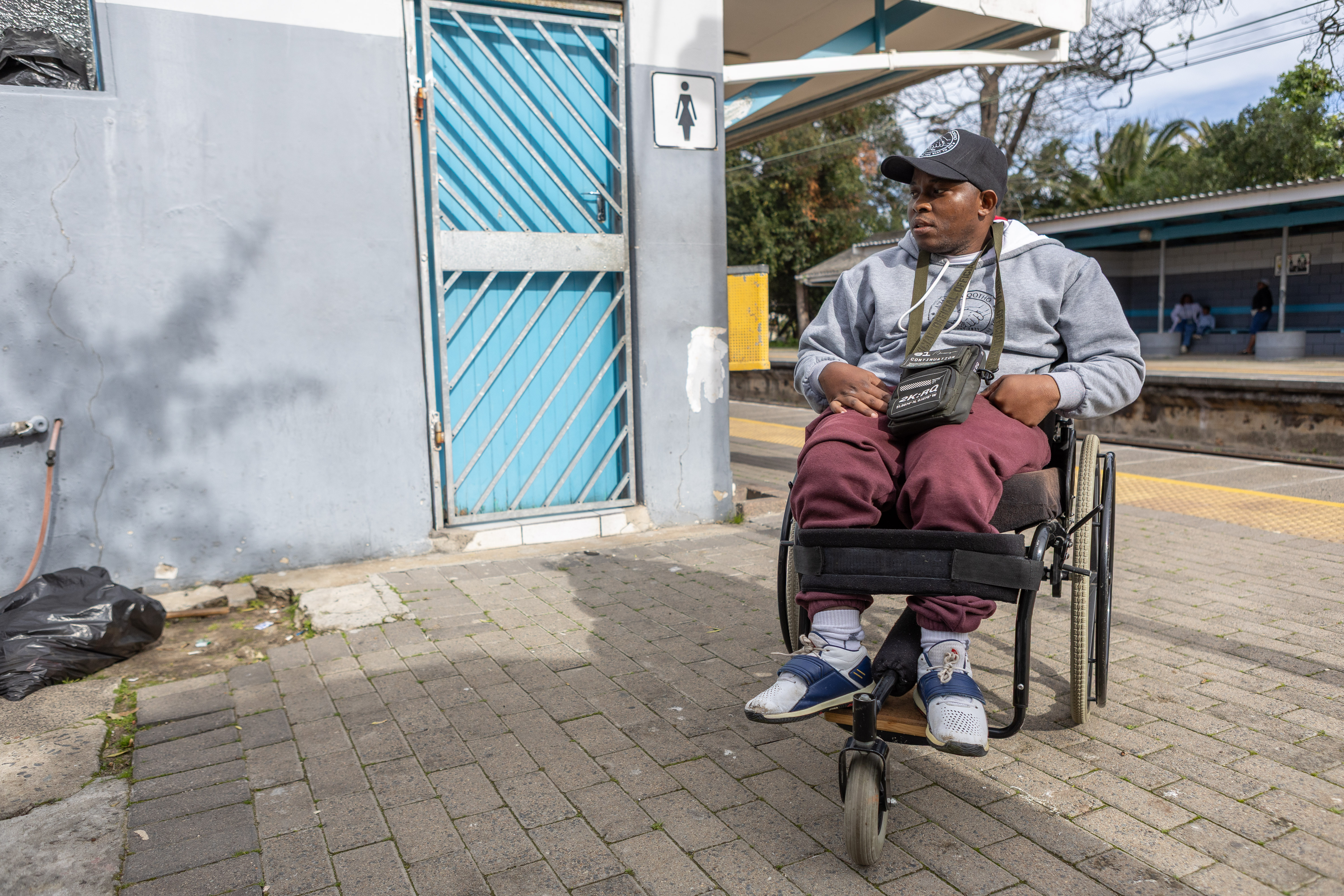
None of the toilets at Rondebosch station are adapted for people with disabilities, and in any event they have not worked for weeks, say staff.
When the train arrives at the platform, Sizila tries to get Mantshi into the carriage, but even with help it is too difficult to negotiate the step from the platform to the carriage.
“Well, I guess using a train is another option I do not have,” says Mantshi.
Sizila says to make public transport available to people with disabilities “is a difficult journey.”
In 2016, spokesperson for Metrorail Riana Scott told GroundUp that universal accessibility was one of PRASA’s “acknowledged priorities”. “A universal access policy inclusive of design, norms, standards and guidelines is virtually complete,” she said. “PRASA’s new trains will take into account special needs of passengers.”
But ten years later, though the new trains do have space for wheelchairs, getting a wheelchair onto a train is nearly impossible. That is, if a wheelchair user can even get to the platform.
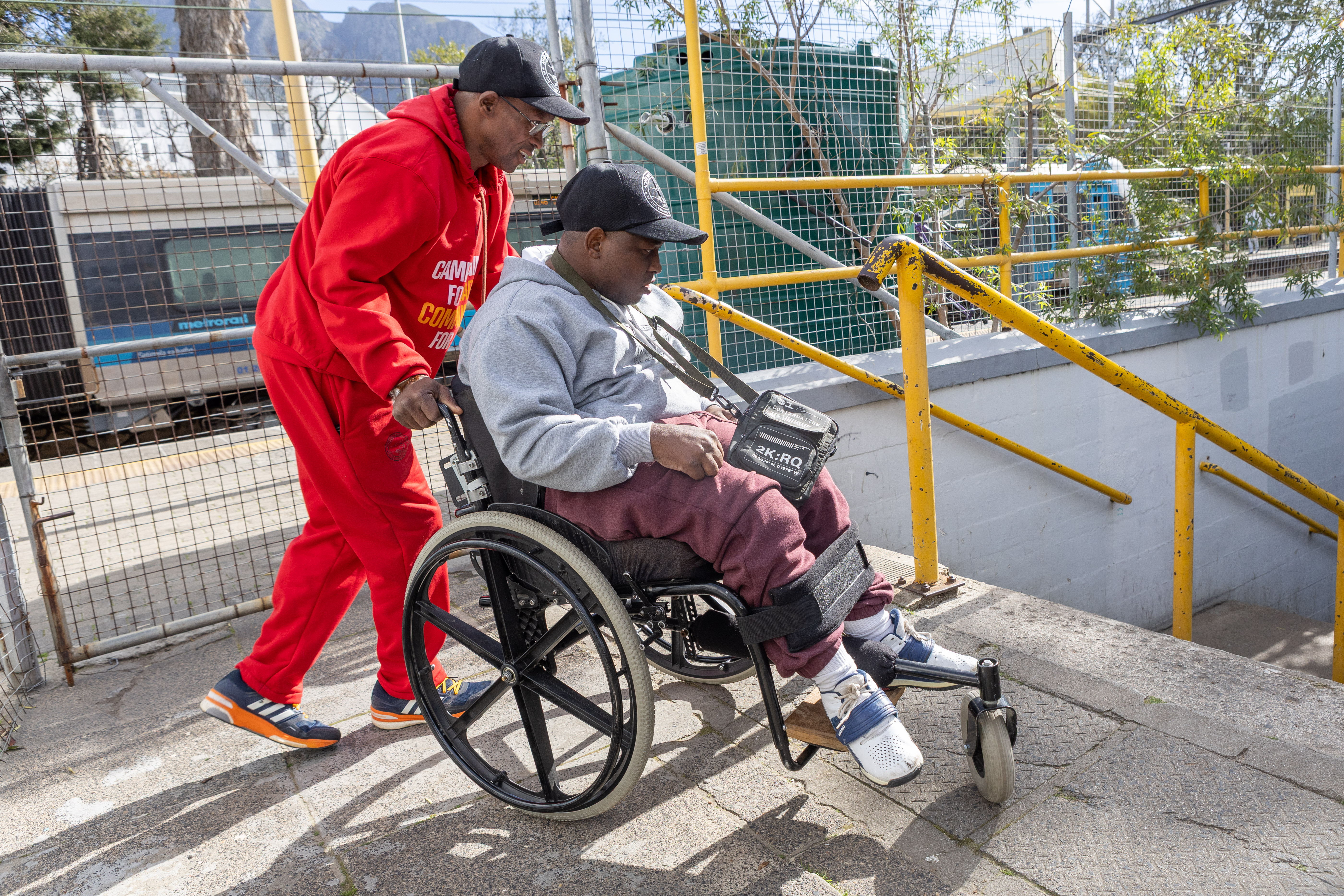
The steps and no ramp at Rondebosch station.
PRASA response
Asked to comment, Zinobulali Mihi, acting head of marketing and communications, reiterated that PRASA “is firmly committed to advancing universal accessibility and has identified it as a key priority within its infrastructure modernisation and station upgrade programmes”.
To strengthen this commitment, Mihi said, PRASA had established a Universal Access and Design Committee, to make sure accessibility was incorporated into planning, design and implementation. In addition, PRASA had set up the PRASA Disability Sector Forum, which included organisations representing people with disabilities, as a platform for consultation and collaboration.
Asked to comment on the stations, we visited, she said: “Both Kuyasa and Langa stations are equipped with lifts, enabling commuters, including persons with reduced mobility and persons with disabilities, to access the train platforms directly from the ticket office level.
“Rondebosch Station is currently not fully universally accessible. However, the station forms part of PRASA’s broader Universal Accessibility Programme, which seeks to progressively improve accessibility across the rail network. The required infrastructure upgrades will be implemented as part of future station enhancement projects, subject to the availability of funding and the approval of the necessary capital budget.”
On the gap between the platform and the train, Bulali said PRASA acknowledged the problem and had set up a Platform Rectification Programme. A total of 988 stations across the country had been audited and PRASA estimated that an investment of R10-billion would be necessary.
Meanwhile, PRASA was exploring interim measures and consultants had been appointed to find ways to reduce the gap between platforms and train carriages. She expected a solution to have been found by October, after which a programme would be developed.
Asked which stations in the Western Cape were fully accessible to people using wheelchairs, she said at seven stations - Salt River, Chris Hani, Cape Town, Woodstock, Century City, Strand and Mutual - wheelchair users could navigate the station independently (though not board the train).
A total of 85 stations (including Rondebosch) had accessibility features but did not yet provide full access.
A total of 29 stations “currently do not provide the infrastructure required to support universal accessibility for persons using wheelchairs and other passengers with reduced mobility”.
“Achieving full universal accessibility across PRASA’s rail network is a significant and long-term undertaking, given the scale of the infrastructure portfolio, the age of many station facilities, and the substantial capital investment required. PRASA operates 495 stations nationally, of which 121 are located in the Western Cape.
“Accessibility improvements are being progressively incorporated into station upgrade and refurbishment projects, subject to available funding and approved capital budgets.”
Read PRASA’s full response.
PRASA has promised to make the trains accessible.
Support independent journalism
Donate using Payfast

Don't miss out on the latest news
We respect your privacy, and promise we won't spam you.
Next: Community that lived decades in harmony shattered by anti-immigration vigilantes
Previous: Children of immigrants forced to leave South African schools
© 2026 GroundUp. This article is published under the GroundUp Republication Licence Version 1.0. Email [email protected] to request permission to republish.