
SAPS and Hawks snub Parliament on lottery probe
Special Investigating Unit is probing corruption totalling over R2-billion

The SA Police Service and the Hawks failed to turn up on Tuesday to brief Parliament’s Trade and Industry Portfolio Committee on progress in dealing with lottery corruption. Graphic: Lisa Nelson
- The Hawks and SAPS failed to turn up for a portfolio committee hearing on lottery corruption on Tuesday.
- But delegations from the National Prosecuting Authority and the Special Investigating Unit (SIU) briefed MPs.
- The SIU is probing cases totalling more than R2-billion and is expected to complete a third phase of investigations by 30 June. A fourth phase, involving 690 matters, will be completed by 31 March 2027.
- MPs were told that 44 non-profit entities and trusts related to kingpins and their families were used to launder hundreds of millions of rands intended for projects to uplift poor people.
- The Hawks have failed to appoint specialised audit accountants to help them with complicated, lottery-related financial investigations.
The South African Police Service and the Hawks failed to turn up to a portfolio committee meeting to report back on progress with their investigations into lottery-related corruption.
High-powered delegations from the National Prosecuting Authority (NPA) and the Special Investigating Unit (SIU), which is investigating over R2-billion in looted lottery funding, gave presentations on their progress in holding those involved to account.
The NPA explained some of the reasons for long delays in prosecutions.
The meeting was originally set for 29 January, but postponed to 24 March and scheduled on Parliament’s programme of 2 February, yet SAPS and the Hawks failed to appear or offer an apology or explanation.
Andre Hermans, the secretary of the Trade and Industry Portfolio Committee, told MPs that he had tried to contact SAPS to confirm its attendance, but “I could not get hold of them”.
Some MPs have called for acting Minister of Police Firoz Cachalia and national police commissioner General Sehlahle Masemola to be summoned to appear before the committee to explain their absence and the delay in finalising investigations into lottery corruption.

The NPA placed much of the blame for delays at the door of SAPS. A key reason is a failure by the Hawks to appoint forensic accountants in almost all cases of complicated lottery fraud and corruption they are investigating. The role of these accountants is to guide investigators and also analyse the financial evidence collected.
The Hawks are an elite independent division within the South African Police Services.
Andy Mothibe, until recently the head of the SIU and now the head of the NPA, said it was SAPS’s duty to appoint the auditors.
The NPA’s Nkebe Kanyane said the Hawks had promised that a firm of forensic accountants would be appointed by the end of April.
“There was a firm that was identified a year ago, but because of internal supply chain management issues [at the Hawks], that appointment lagged and was not finalised,” Kanyane told MPs. “We have now been given undertakings that by April it will be done, and we are hoping that will be so.”
Brigadier Athlenda Mathe, SAPS head of communications, did not respond to a WhatsApp message from GroundUp asking why the police had failed to pitch for the meeting, and why forensic accountants had not yet been appointed.
Other reasons for the delay in finalising cases, Mothibe said, were court applications to stop the inclusion of properties in preservation orders granted by the Special Tribunal, as well as a review application brought by former National Lotteries Commission board chair Alfred Nevhutanda, challenging President Cyril Ramaphosa’s authorisation of the SIU’s probe into corruption involving the NLC.
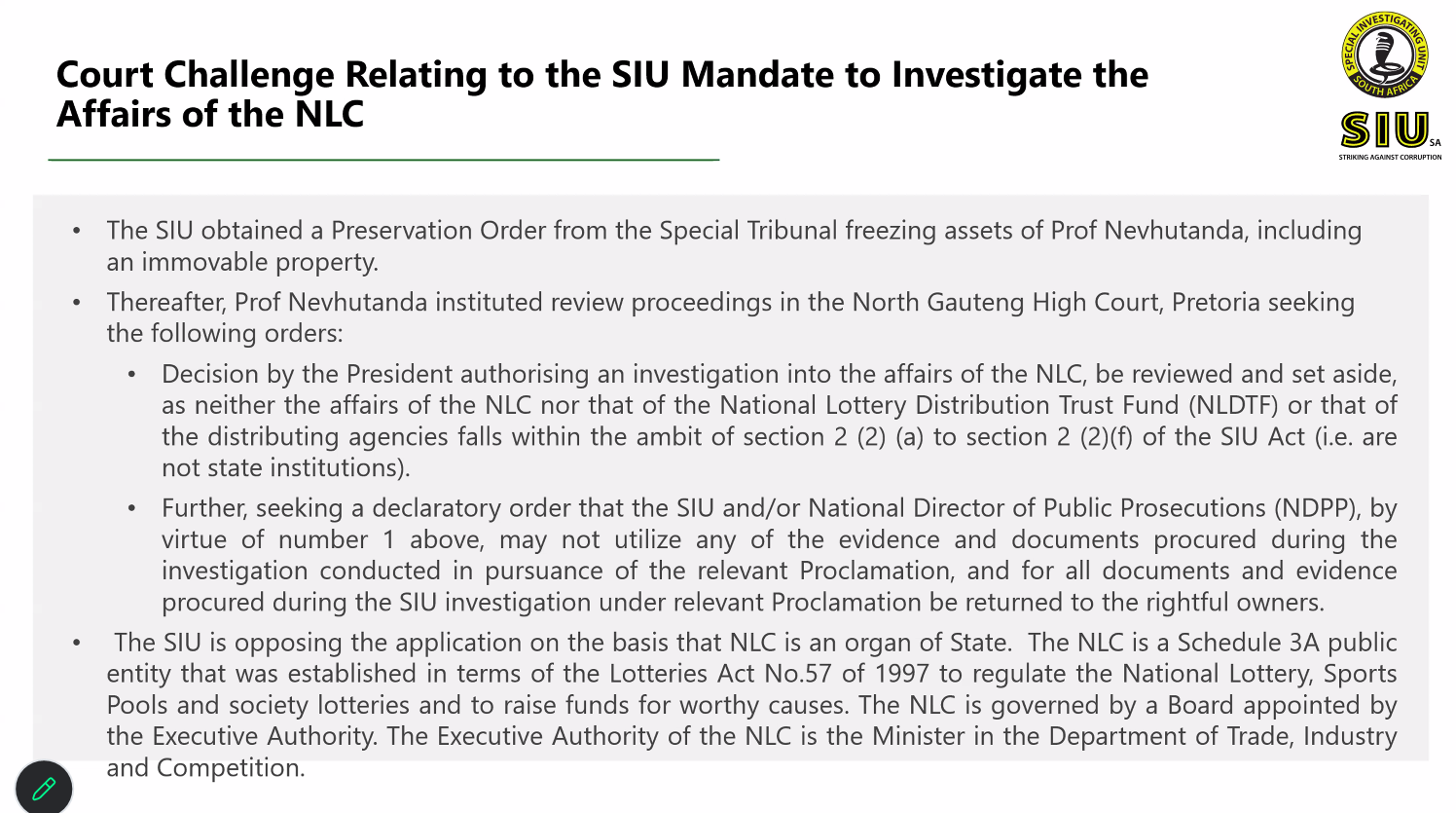
“All interlocutory applications aimed at obstructing asset forfeiture proceedings will be opposed with determination and resolve,” Mothibe told MPs.
The Hawks are currently investigating 14 cases of fraud, corruption, racketeering and money laundering, which were referred for investigation by the SIU, which does not have prosecutorial powers.
The SIU said it was investigating hundreds of cases worth over R2-billion involving dodgy lottery funding. But only one person has been convicted and jailed for lottery-related fraud. Of 25 criminal referrals by the SIU to the NPA, which, in turn refers these to the SAPS to investigate, only two cases are currently in court. Both were investigated by the Northern Cape division of the Hawks and are before courts in Kimberley.
Several MPs expressed their frustration at the slow rate of prosecutions since lottery investigation began in earnest in 2020, after a Presidential Proclamation mandated the SIU to investigate lottery corruption.
But while the SIU investigations and freezing of assets bought with lottery money have made progress, the Hawks have dragged their feet, and the NPA has largely been missing in action.
ACDP MP Wayne Thring said lottery corruption had been exposed years ago and “this lag in terms of time in prosecutions” gave the people involved “time to engage in ‘Stalingrad-type tactics’”. It also gave “the guilty time to disappear or to relocate”.
DA MP Toby Chance said, “Things are not moving ahead at the required pace. Individuals are disappearing, and the evidence is being played around with, and this presents a huge problem. What occurred is being referred to as money laundering, but it’s not, it’s just blatant theft.”
Instruments of corruption
MPs heard how non-profit entities and trusts related to kingpins involved in the looting of 44 projects - many of them hijacked from their lawful owners - were used to launder hundreds of millions of rands intended to uplift poor people and support marginalised communities.
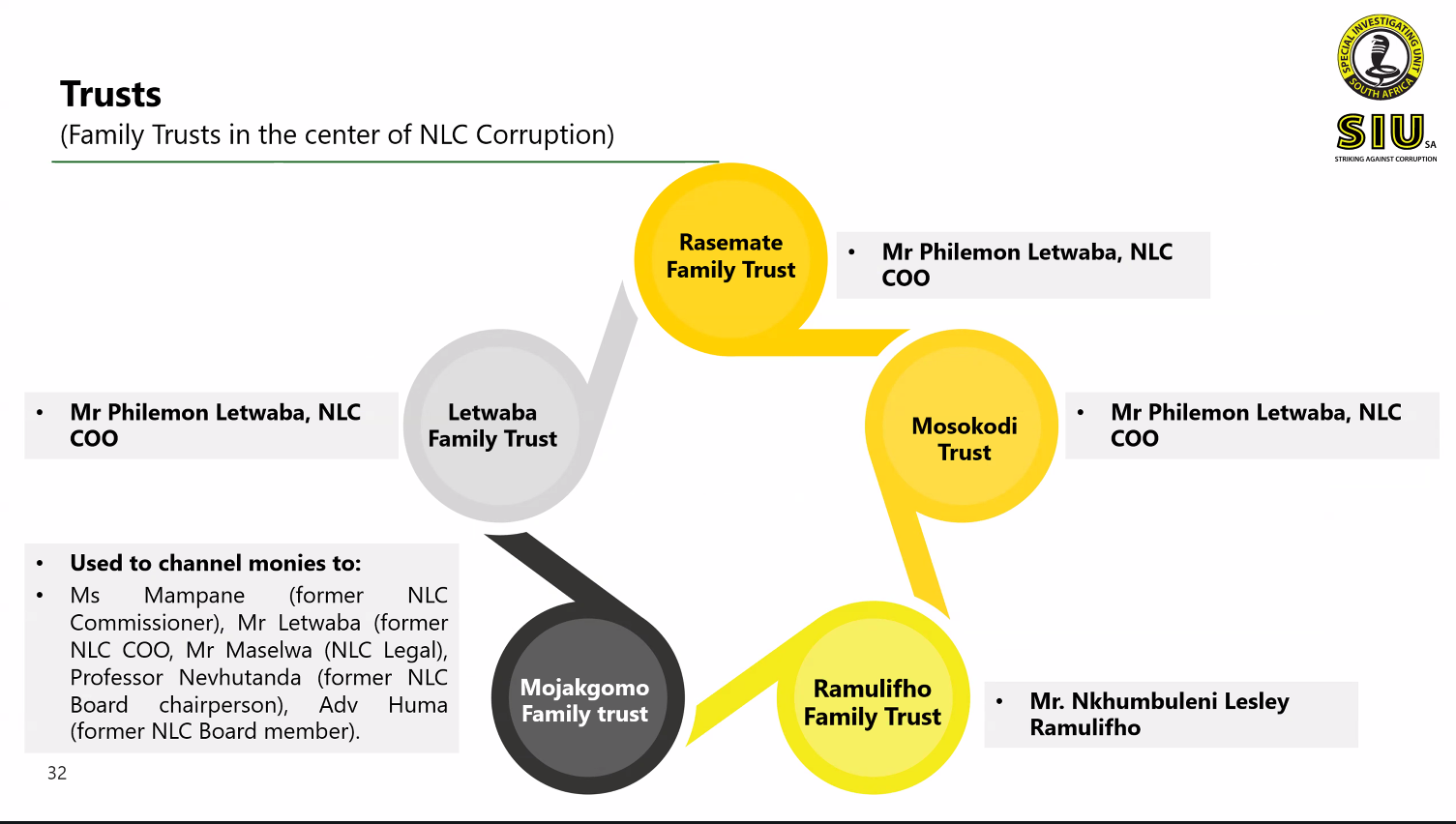
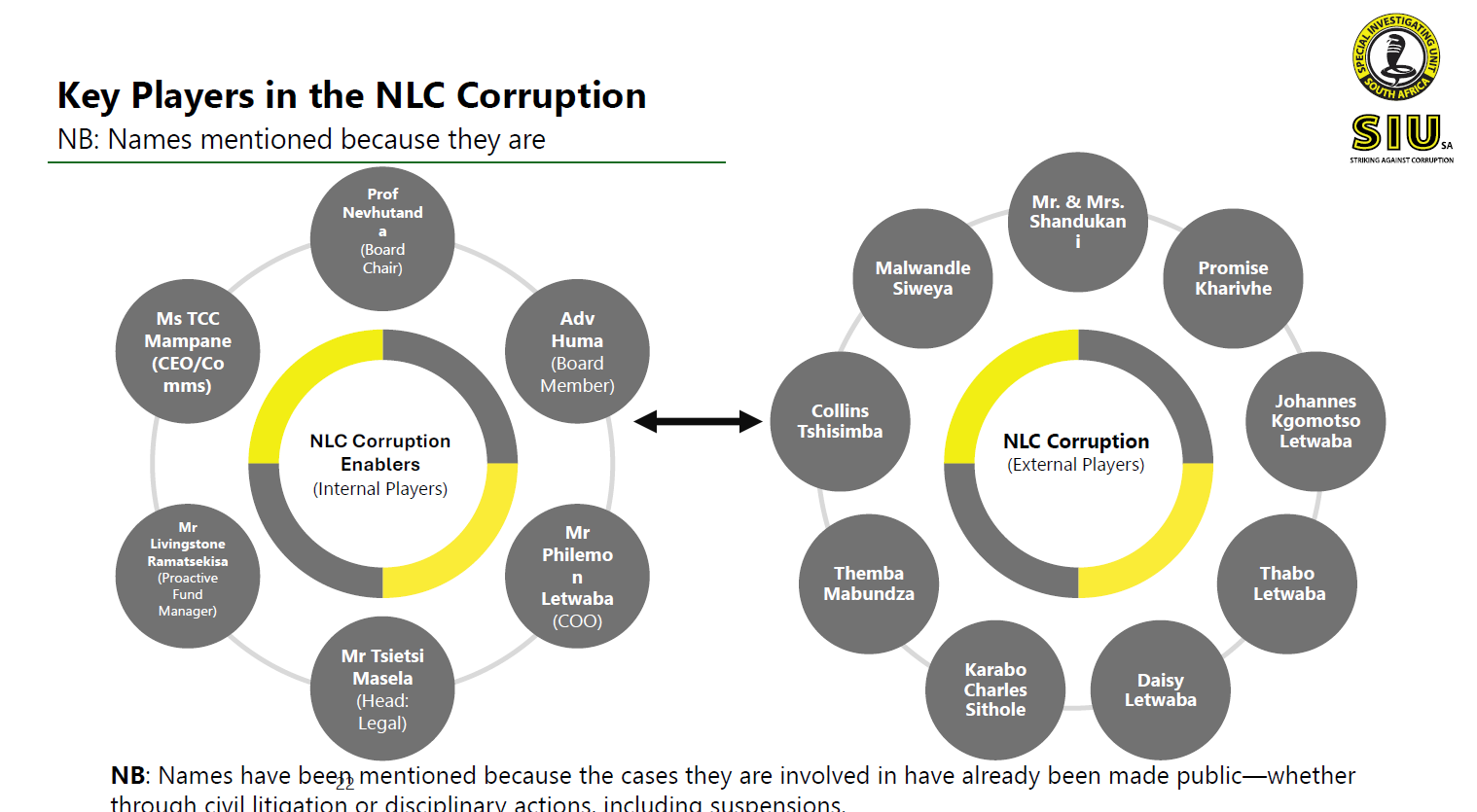
In a majority of cases, these companies are related to former National Lotteries Commission (NLC) executives and board members, their families and cronies, as well as lower-level NLC staff, MPs were told. In other cases, senior NLC staff and board members received kickback payments in the form of payments from grants, as well as contributions towards luxury vehicles and homes, farms and properties from the recipients of these grants.
Among those who benefited in this way were the scandal-ridden former NLC board chair Alfred Nevhutanda; former NLC Chief Operations Officer Philemon Letwaba, who resigned under a cloud in 2022; former NLC Commissioner Thabang Mampane, who resigned just weeks before her term was due to end; and former NLC board member William Huma.
NLC acting head Leonard Lekgetho explained the modus operandi of the lottery corruption. He said it included:
- The exploitation of the now-discontinued “proactive funding”, which allowed the NLC Board to fund projects and select non-profit companies to oversee them without requiring a grant application. This led to wide-scale looting under the previous NLC administration;
- collusion by NLC officials and some board members with non-profit companies to siphon money from lottery grants, often using hijacked companies;
- inadequate project management;
- lack of monitoring and evaluation;
- ineffective auditing of projects;
- “general maladministration” in the approval of grants; and
- systems not designed to detect abuse.
Lekgetho said that two phases of the SIU’s investigation had been completed, and a report on the first phase, involving R279.7-million, had been submitted to President Ramaphosa. A report on the second phase, involving R246.6-million, has also been completed and will be submitted to the President soon.
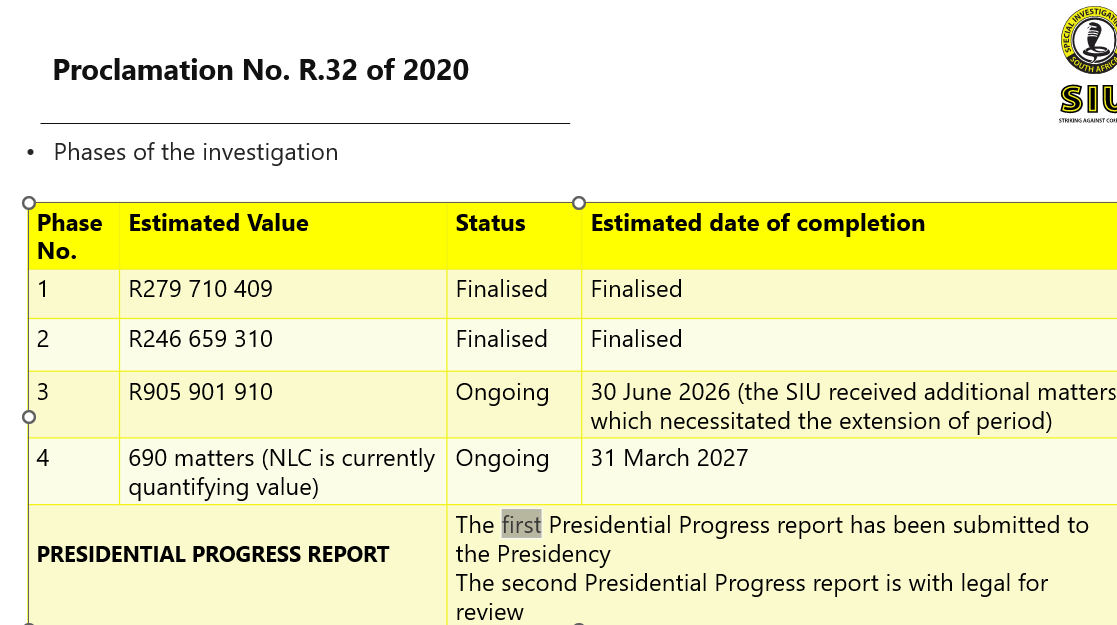
A third phase of the investigation, involving grants totalling R950.9-million, was expected to be completed by 30 June, while a final phase involving 690 matters so far, the value of which the SIU is still quantifying, is expected to be completed by 31 March 2027.
Support independent journalism
Donate using Payfast

Don't miss out on the latest news
We respect your privacy, and promise we won't spam you.
Next: Stellenbosch backyarders demand housing on golf course
Previous: Court strips abusive deadbeat dad of parental rights
© 2026 GroundUp. This article is licensed under a Creative Commons Attribution-NoDerivatives 4.0 International License.
You may republish this article, so long as you credit the authors and GroundUp, and do not change the text. Please include a link back to the original article.
We put an invisible pixel in the article so that we can count traffic to republishers. All analytics tools are solely on our servers. We do not give our logs to any third party. Logs are deleted after two weeks. We do not use any IP address identifying information except to count regional traffic. We are solely interested in counting hits, not tracking users. If you republish, please do not delete the invisible pixel.