
Public gets three more weeks to comment on Eskom nuclear site — but critics say it’s not enough
The deadline for public comment on the 2,700-page draft environmental scoping report and appendices has been extended to 25 May
 Add GroundUp on Google
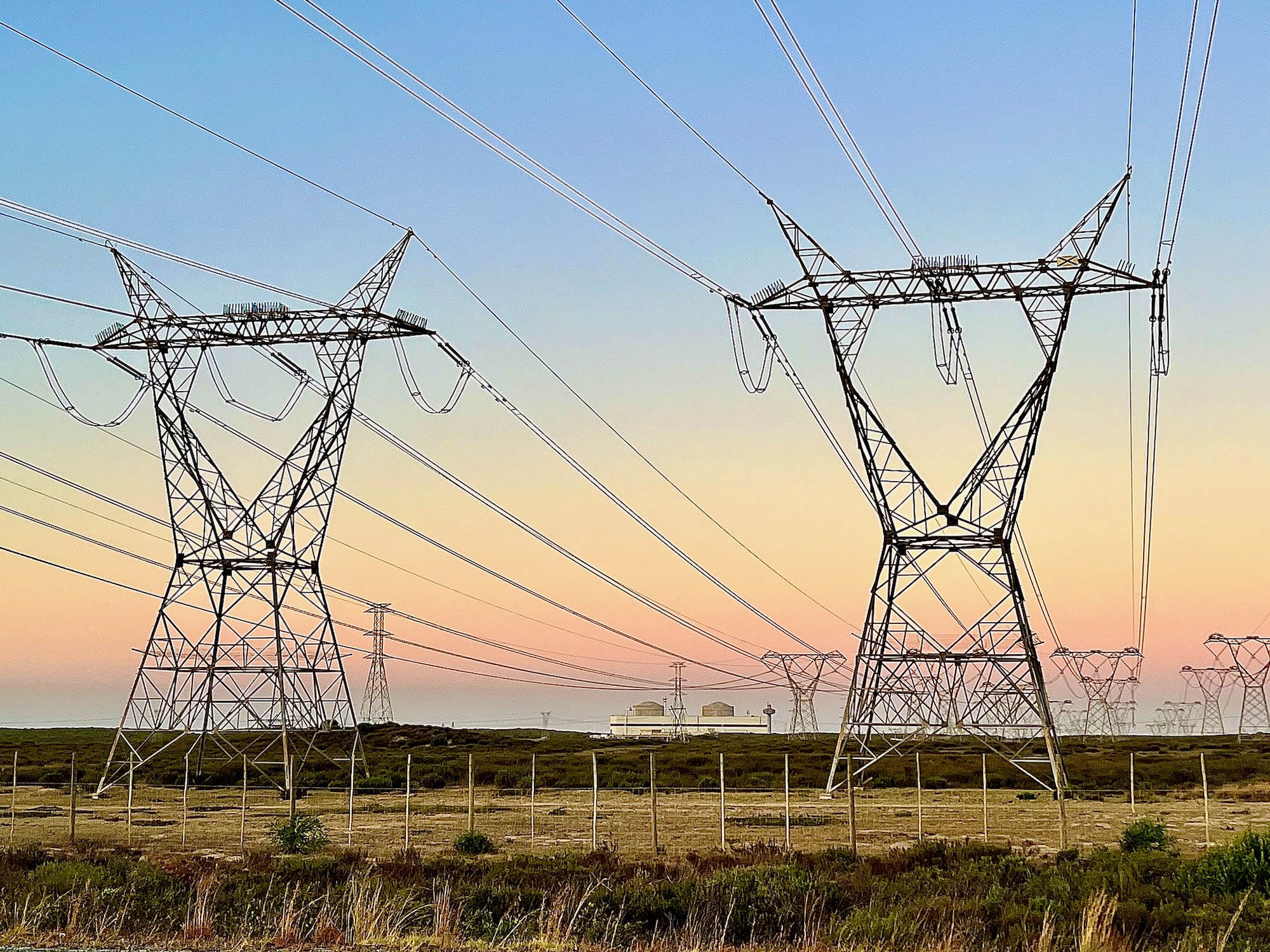
Eskom’s current and only nuclear power station located at Koeberg, Western Cape. Archive photo: Brent Meersman
- Eskom has extended the public comment period on its new nuclear site scoping report by three weeks to 25 May, after intense public interest.
- But participants at a virtual meeting said even this was inadequate given the volume of documentation.
- Critics also raised concern that Eskom has not yet determined the technology, funding model, or cost of the proposed plant, with one participant asking how an environmental impact assessment can be done without these specifics.
Intense public interest and an overwhelming volume of documentation tabled for the site selection of Eskom’s proposed new 5,200MW nuclear power station has led to a three-week extension of the public review period.
The original 5 May closing date for comment on the Draft Environmental Scoping Report has been pushed out to Monday, 25 May.
The scoping investigation relates to two possible sites for the new 5,200MW nuclear power plant: Thyspunt, between Oyster Bay and Cape St Francis on the southern Cape coastline, and Bantamsklip near Pearly Beach on the Overberg coastline.

Eskom says it wants “to listen carefully” to all concerns and suggestions from its close to 12,000 stakeholders. These will be formally recorded, considered and responded to by specialists undertaking a wide range of studies making up the full environmental impact assessment (EIA) of the project.
But the 21-day extension has been criticised as inadequate by several people at a virtual meeting on Tuesday that had about 100 participants. The meeting was one of a series of public engagements in venues and online. The public participation process is being managed by environmental and sustainability consulting company WSP Group Africa, which was appointed by Eskom Holdings as Environmental Assessment Practitioner (EAP) for the new nuclear build project.
One participant in the webinar, who identified herself only as Jane, wrote in the chat section: “How can Joe Soap be expected to read 2,700 pages plus the additional documentation that will be posted? WSP and Eskom have unlimited resources, we do not. WSP & Eskom must allow the public more review time going forward irrespective of which (if any) site is selected.”
Gary Koekemoer, a non-executive director of non-government conservation group Wildlife and Environment Society of SA, wrote: “Given the complexity of this process, the number of specialist reports, there is no way ordinary I&APs [Interested and Affected Parties] can process and respond to the information. And given past responses it’s highly unlikely the decision-maker [the national Department of Forestry, Fisheries and the Environment, or DFFE] can fulfil their own obligations.
“Can the EAP please approach the decision-maker to set reasonable timelines in place, and provide us with the basis of how such a time is calculated?”
He was supported by Anthony Reed, who challenged revised timelines for the EIA decision-making process, recently promulgated under the National Environmental Management Act (NEMA).
“Expecting citizens to read the thousands of pages just in the scoping report, and then to consider them and give meaningful input, with tight timelines CANNOT be considered either JUST or FAIR,” Reed commented.
“Extending tight timelines suggests that the practitioners had not considered the nature of this process at the planning phase. Each step needs to be slowed down so that we can be given a fair opportunity.”
Although the draft scoping report favours the Thyspunt site, Eskom’s public participation consultant and meeting facilitator Antoinette Pietersen stressed in her opening remarks that no decisions about either of the two proposed sites had yet been taken.
“Our purpose is to listen carefully and to record all inputs … The heart of public participation is really to listen to various concerns raised by the public,” she said.
Previous questions about the still unquantified cost of the proposed new nuclear build arose again. Michele Rivarola stated that the EIA only considered the lifetime costs of the actual infrastructure. “But what about the decommissioning and rehabilitation costs which are equal if not greater than the capex [capital expenditure] costs, as many countries decommissioning the nuclear reactors are finding out? We are talking of trillions, not just a few millions,” he said.
“In a country that needs housing and basic infrastructure to support a decent living standard, committing this amount of expenditure on a pipe dream has no place and cannot be justified in any way … The technology is old and ageing and costs keep on escalating, whereas renewables with storage costs keep on dropping to a point where renewables with storage are a fraction of any other large-scale energy generation cost with very short procurement and implementation timelines – unlike nuclear.”
Responding to questions about Eskom’s funding partners for the project and what benefit these funders would derive from investing, Eskom’s senior manager nuclear engineering Sadika Touffie said Eskom was still considering funding models for the new nuclear build and that no figures were available yet.
“We are looking for partners to come in and support us with that… We don’t have the cost as yet,” he said.
Touffie also told the meeting that while Eskom had some preliminary routes for transmission lines from the proposed sites, these needed to be updated and re-surveyed.
“We have not yet purchased any agreements for powerline servitudes,” he said.
Earlier in the meeting, Touffie had explained briefly how nuclear power facilities work and said that Eskom had not yet taken a final decision on the exact technology to be used for the proposed new plant.
Koekemoer expressed concern about this, saying Eskom appeared to want a “blank cheque” in the EIA process for whatever technology it might decide to use. For example, it could decline to use thorium in place of conventional uranium as a fuel source, even though thorium is hailed in some quarters as a promising clean energy source of the future, but might then also include SMRs (Small Modular Reactors), a nuclear technology that is not yet widely in use.
“Is what is commercially available the standard?” Koekemoer asked. “How can an EIA investigate a theoretical option when the specifics are unknown and cannot be investigated nor mitigated for?”
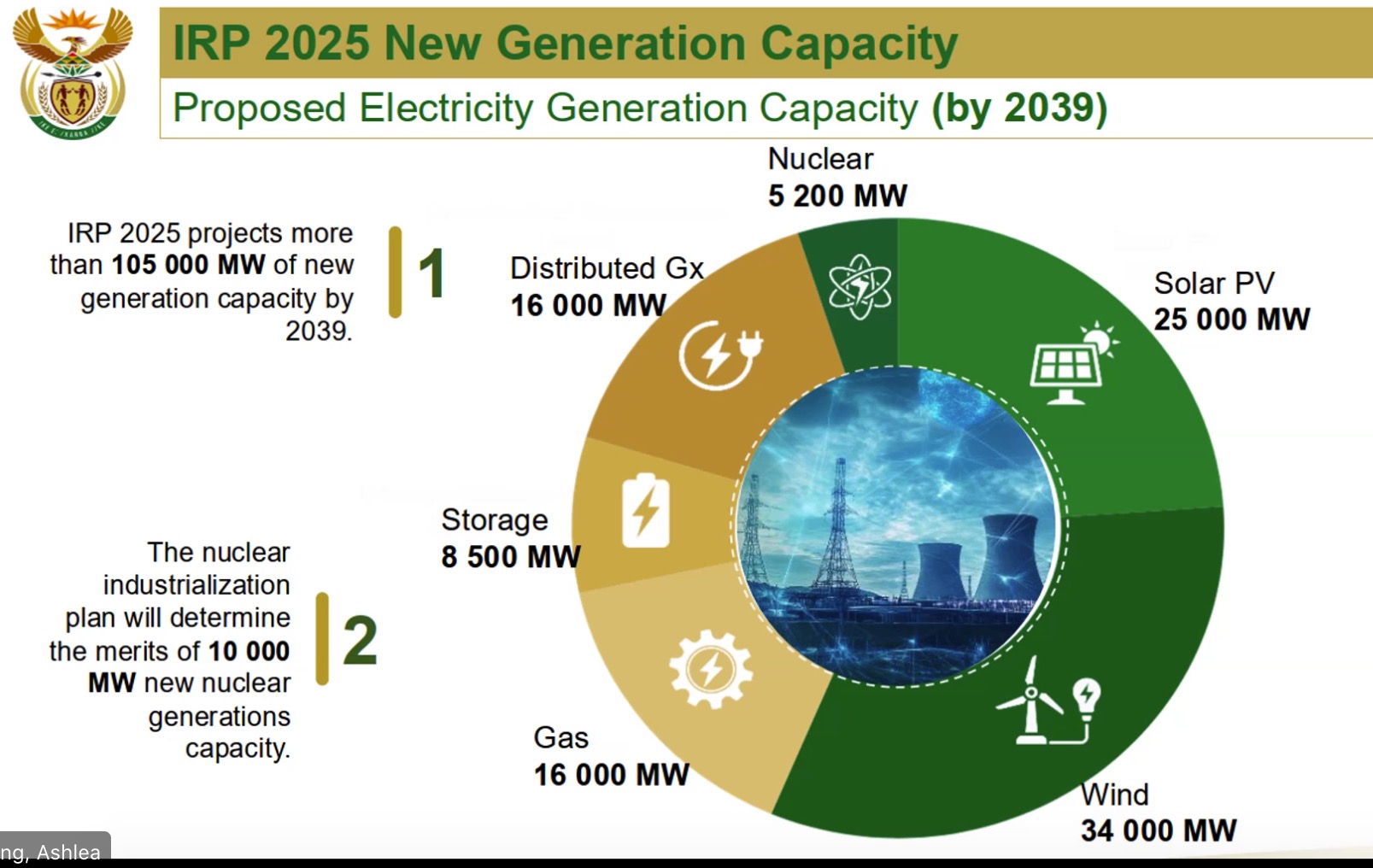
A graphic guide to South Africa’s R2.23-trillion Integrated Resource Plan 2025: the strategic roadmap that aims to generate more than 105,000 MW of new capacity by 2039, including 5,200 MW of new nuclear power. Source: WSP Group Africa online roadshow for Eskom.
Support independent journalism
Donate using Payfast

Don't miss out on the latest news
We respect your privacy, and promise we won't spam you.
Next: Mogale City pumping raw sewage into rivers in the Cradle of Humankind
Previous: Khayelitsha families relocated at last after weather delays and protests
Letters
Dear Editor
Open letter to Minister Kgosientsho Ramokgopa and Mr Velaphi Ntuli, Chief Nuclear Officer, Eskom
As members of the Koeberg Public Safety Information Forum (KPSIF), we welcome the assurance that the radiation detected during three incidents at Koeberg was contained and reportedly not dangerous. However, serious questions remain.
1. Why did the incidents on 30 June, 2 July and 7 July only receive public briefing nearly two weeks later?
2. Why were civil society stakeholders not urgently notified?
3. Why the emphasis on Koeberg’s historical safety record rather than the specific incidents and the workers potentially affected?
A breach of safety norms demands immediate, transparent communication — not reassurance, defensiveness or marketing.
At the next KPSIF, we request verifiable details of the incidents, licence-condition progress, risks identified and mitigated, duration, consequences, and measures preventing recurrence.
Trust is earned through timely, transparent disclosure—not repeated assurances that everything is “fine-fine”.
The authors write in their own capacities.
Dear Editor
Across the Western Cape, a troubling procedural trend has emerged in environmental applications. Environmental Assessment Practitioners increasingly conduct an initial “dry-run” public participation process with incomplete or preliminary information, then describe the later round as the “first round in process.” This has no basis in NEMA, the EIA Regulations, or the Public Participation Guidelines. Public participation must be properly advertised, based on complete documentation, and open to meaningful comment. Relabelling a second round as the first deprives interested and affected parties of a genuine opportunity to engage with the full and accurate record.
A second trend compounds the problem: developers are increasingly breaching environmental and land-use laws, apparently confident that municipalities will allow retrospective applications instead of enforcing compliance. NEMA is clear that no listed activity may commence without prior environmental authorisation, and section 24F makes unlawful commencement an offence. Yet breaches are too often treated as oversights that can be regularised later. This undermines NEMA’s preventative purpose: impacts must be assessed before development proceeds, not rationalised after damage has occurred.
A third concern is the administrative burden placed on interested and affected parties. Residents are required to submit sworn affidavits before some municipalities will even acknowledge or process complaints. Nothing in the Municipal Systems Act authorises such a barrier. Section 4(2)(c) requires mechanisms for community participation that are appropriate and accessible. An affidavit requirement is neither. It is an invented hurdle that suppresses participation and conflicts with PAJA’s requirement that administrative action be lawful, reasonable, and procedurally fair. Municipalities must enforce the law at the point of transgression, not after the fact. Public participation is a constitutional right, not an administrative favour.
© 2026 GroundUp. This article is published under the GroundUp Republication Licence Version 1.0. Email [email protected] to request permission to republish.