
Kimberley: A provincial capital sunk in sewage
Salt pans and lowlands around the town are lakes of filth
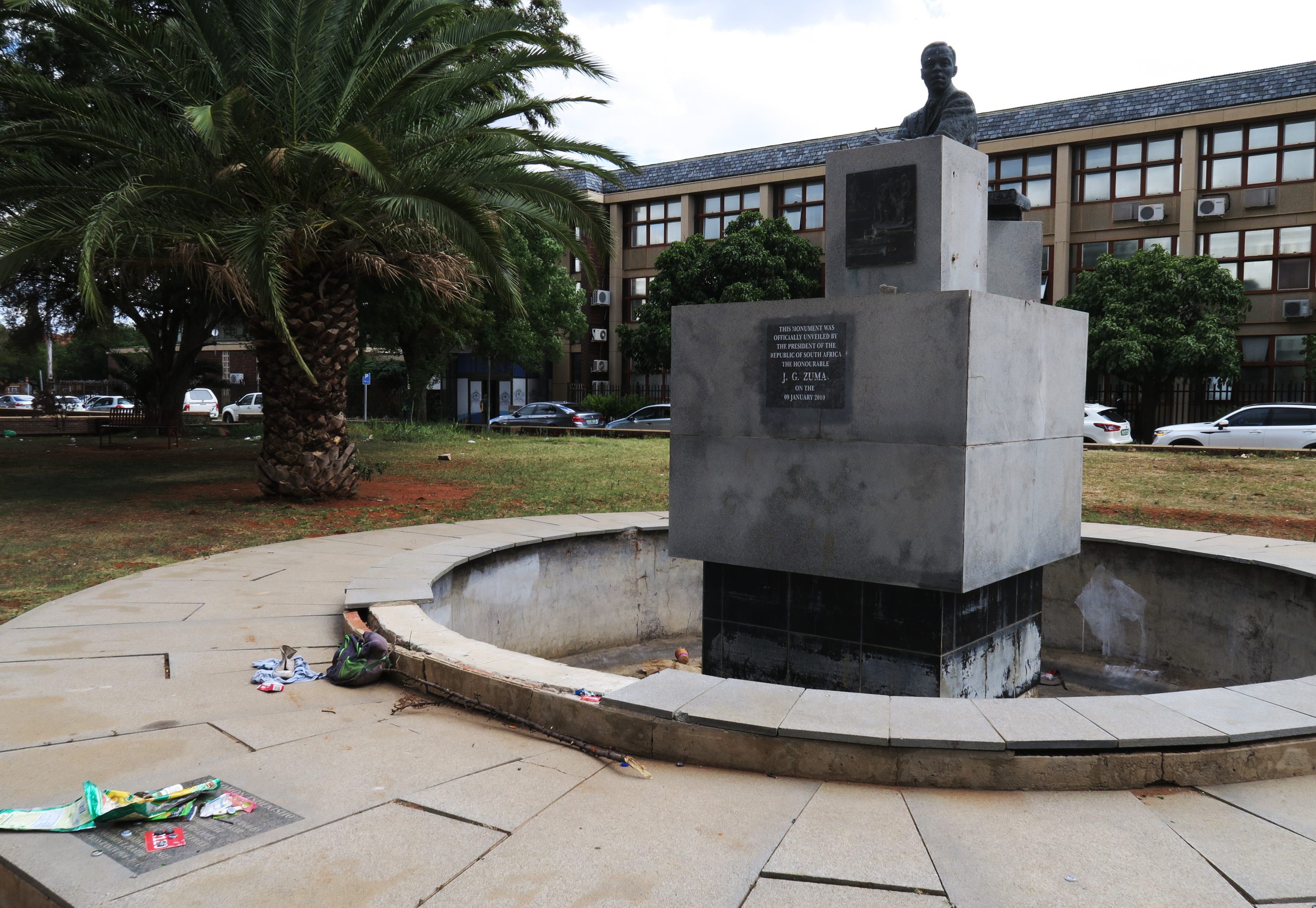
Outside the Sol Plaatje municipal offices, a statue of intellectual giant Sol Plaatje, who was a founder of the South African Native National Congress which later became the ANC, sits in a dry moat littered with human waste. Photos: Steve Kretzmann
- Tens of millions of litres of raw sewage are flowing into the environment in Sol Plaatje municipality because of the municipality’s failure to maintain and repair infrastructure.
- Salt pans and lowlands around Kimberley are perennial lakes and vleis of untreated sewage in a semi-arid region.
- This is in spite of court cases and directives from the Northern Cape provincial government, which is headquartered in the city.
Failure to maintain and fix sewerage infrastructure over several years has caused a score of Kimberley families to lose their homes, flooded a vulnerable community’s communal land, threatened national infrastructure, and slashed what was southern Africa’s largest permanent population of lesser flamingos.
Thousands of residents have to live with stench and filth on a daily basis because of sewage spills and failing pump stations in the Sol Plaatje Local Municipality.
In January 2021, 26 families on Ravel and Von Weber streets in Kimberley’s Roodepan suburb had to abandon their homes which were flooded with sewage when a pump station broke down.
The flooding, which lasted for months and led to the homes being uninhabitable, occurred a year after the municipality had been warned to fix the pump station and sewage holding dam at Von Weber Street.
According to the local Diamond Fields Advertiser, a directive was issued on 20 January 2020 by the provincial Department of Environment and Nature Conservation to immediately address the sewage spills in Roodepan or face a fine of R10-million. Exactly a year later, the Roodepan homes were flooded. Previous stories show the crisis had been developing for almost a decade.
It appears the R10-million fine has not been enforced, but neither the municipality nor the provincial Department of Agriculture, Environmental Affairs, Land Reform and Rural Development responded to GroundUp’s questions on the matter.
Kimberley resident and DA MP Delmaine Christians said some of the 26 affected families were accommodated by the municipality at the Riverton Resort chalets about 6km away, while others managed to move in with family.
After the families moved out, thieves moved in during covid lockdown and stripped 19 houses along Ravel Street. The houses were demolished, and the families, some of whom had lived there for 20 years, were moved into municipal flats in neighbouring Lerato Park.
Former policeman Errol van Ade was one of the Ravel Street home owners who were flooded. Van Ade said he managed to prevent his house from being stripped by renting a house elsewhere in the suburb to accommodate his wife and children, while he returned to sleep in his house every night.
Being on slightly higher ground, he wasn’t knee deep in sewage like his neighbours, but he still had to wade to his front door in gumboots, and the sewage was initially high enough to destroy all his furniture.
Van Ade said it took nine months for the sewage to subside. He said most of the residents, like himself, had bonds of more than R100,000 on their state-subsidised homes, which were built just more than 20 years ago.
But the families whose homes were stripped and destroyed were never paid out by the municipality. Instead, they received R90,000 for damage to furniture and household items.
However, Van Ade said, the houses should never have been built there, as it was a low-lying area without drainage. Part of the reason the flood of sewage didn’t subside, he said, was because there was no storm water drainage.
With the pump station still not fixed, there is now a permanent vlei of sewage amongst the rubble of former homes, with the levels rising and falling depending on rainfall.

In Roodeplaat, Kimberley, 19 family homes are now piles of rubble amidst a vlei of sewage flowing out of a pump station which has not worked since January 2021.
Christians said continuing pipe blockages and seepage are now putting more houses in Roodepan at risk.
Alice Badenhorst, who lives two blocks back from Ravel Street, said sewer pipe blockages force sewage back up the line, and a friend at the lower end of the block has had sewage rising up in her toilet and drains.
“Sewage is still all over the place. When there’s a blockage, the municipality takes three to four weeks to clear it.”
Even after the line was cleared, it didn’t take long before it was blocked again, Badenhorst said.
Community land polluted
On the other, western side of Roodpan, failing pump stations, along with sewage spills from blockages and broken pipelines, create an approximately five-square kilometre vlei of sewage in the veld. This adds to streams of sewage flowing out of neighbouring Galeshewe which flood a vast swathe of land and what are supposed to be seasonal pans on communal land owned by the !Kun and Khwe people in nearby Platfontein.
The apartheid-era defence forces used !Kun and Khwe trackers in northern Namibia and southern Angola during the bush war in the 1980s, sometimes forcing them to work. After the disbandment of their units, they were housed first in a camp in Namibia, and then at Schmidtsdrift in the Northern Cape before the purchase of land at Platfontein through a government grant, where they settled in 2003.
The community have for years had their land flooded by the sewage flowing out of Roodepan and Galeshewe. Ironically, although potable water is supplied to Platfontein via standpipes, the community has no waterborne sewage. Instead, they have pit latrines fitted with large bags for the excrement, which is occasionally carted away.
Speaking to the Human Rights Commission during its recent provincial inquiry into Northern Cape municipalities, Platfontein community leader Markus Jetembu said that a Cape Town company had been interested in mining gypsum on their land, which would have provided income and jobs for the community. But Jetembu said the company withdrew because the land was permanently flooded with sewage.
He said attempts to get the municipality to fix the infrastructure had been fruitless.
“We’ve had many meetings with the municipality to stop the flow of sewage, but it has become a river on our land at Platfontein … it pollutes the land very badly.”

Ward councillor George Joseph looks at a stream of sewage from a broken pump station on the edge of Galeshewe flowing towards communal land at Platfontein a few kilometres away.
Broken water treatment plants
So much sewage leaks into the environment that it is also damaging national infrastructure. The R31 – a major iron ore and manganese trucking route from the north – is occasionally flooded by sewage flowing from Galeshewe.
Not only is sewage streaming out of non-functional pump stations and pouring out of manholes, most of the sewage reaching Kimberley’s Homevale waste water treatment works is not properly treated before it is released into the Kamfersdam on the north-eastern side of the city.
The Homevale works is made up of two sewage treatment plants: an older plant designed to treat 33-million litres of sewage per day, and a newer plant that receives 15-million litres of sewage per day. The larger plant has not functioned since electricity cables and pumps were stolen during covid lockdowns.
A municipal business plan dated May 2023 stated the older, larger sewage treatment works was “not in operation due to aged infrastructure and vandalism”. The municipal document stated it was receiving 21-million litres of sewage per day, which was passing through the plant without being treated, before being released into the Kamfersdam.
When GroundUp was taken on a tour of the Homevale water treatment works last month, the situation was unchanged.

Untreated sewage is released into the Kamfersdam after flowing through the larger, non-functioning treatment works at the Homevale waste water treatment works.

The clean effluent after sewage has been treated at the smaller, operational treatment works at the Homevale waste water treatment works. All effluent should be of this quality before being released into the surrounding environment.
A lake of sewage
Before being used to hold what is supposed to be treated sewage – which according to national standards should be clean enough for recreational activity such as canoeing and windsurfing – Kamfersdam was a salt pan. Like many such pans across the Northern Cape, it would fill up in the rainy season, and evaporate in the dry season.
Now, it is a permanent lake of pollution. So much sewage is discharged into it that the level has risen to cover a Transnet railway line, and threatens the N12 national highway.
In response to GroundUp’s queries, Transnet confirmed that the railway line next to Kamfersdam is periodically submerged. It is a “key part of the manganese export corridor, and any disruption has a direct impact on the efficiency of freight operations and the broader economic activities supported by this route”. Transnet has had to close the line at times, which affects “operational continuity”.
Transnet said the problem has developed “over several years” and it was working with the municipality to find “technical solutions”, including “improvements to local wastewater infrastructure and measures to reduce overflow into the dam”.
Early last year, the owners of the farm on which Kamfersdam is situated, Northern Cape Ranchers, took the Sol Plaatje municipality to court over the rising water levels encroaching on up to 700ha of the 1,000ha farm.
There is a deed of servitude between the farm and the municipality, allowing the municipality to discharge treated sewage into the pan since the 1960s. But ten years ago, court records show, the level of effluent in the pan covered just 15%, or 150 hectares, of the farm.
Northern Cape Ranchers approached the Northern Cape High Court on a semi-urgent basis, asking the court to order the municipality to provide a report within 60 days setting out how it would ensure no untreated or partially treated sewage was discharged into the pan, and to limit the volume of the discharge to a maximum of 30-million litres per day to allow the levels to return to those of 2015.
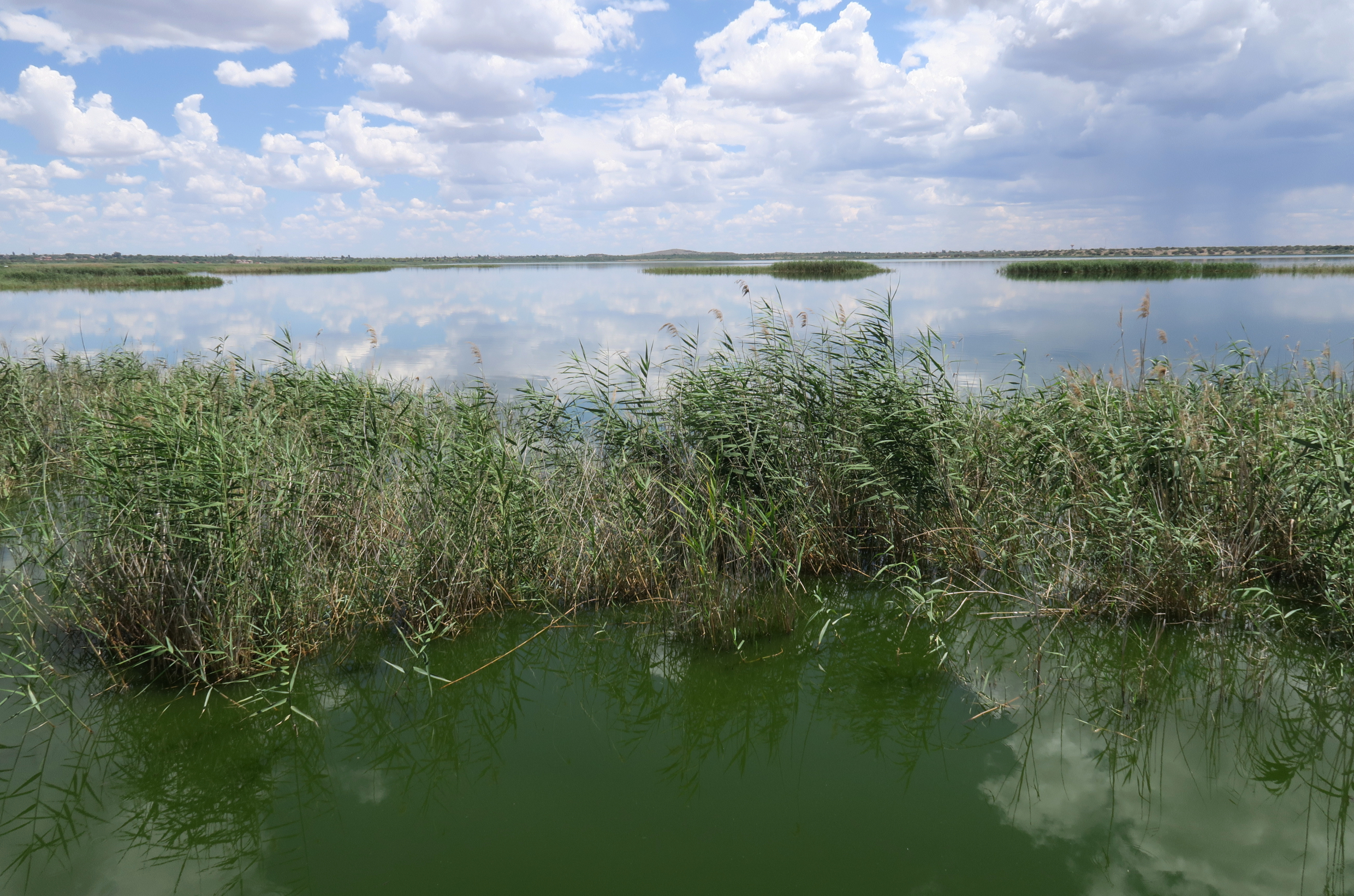
Kamfersdam should be a seasonal pan and a breeding oasis for flamingos. But it is a stinking pea-green soup of partially treated sewage which floods adjacent Transnet railway lines.
The order was granted by Judge Almé Stanton, but the report was not submitted by the due date. Subsequently, the landowner brought an application for contempt of court, but in March this year Stanton ruled it could not be proved the failure on the municipality’s part was wilful or mala fide (in bad faith).
However, she ordered the municipality to file a detailed report on the progress made in treating the sewage before discharging it into the pan, and how the discharge volume was to be reduced, along with budgets and timelines. This report was to be updated and supplied to the court every four months.
GroundUp could not reach the court registrar to find out if the reports were being submitted.
In her ruling, Stanton slammed the municipality for its “careless and negligent disregard to the importance of the matter, not only to the applicant but also to the City of Kimberley and the members of their community”.
The volume of the discharge is supposed to be reduced by supplying some of the treated effluent to the golf club for irrigation, and for use by the Ekapa mine in Kimberley. When GroundUp visited the sewage treatment plant, this was not being done.
Transnet is also assisting with a pipeline to divert treated effluent to the Vaal River. Although the pipes have been supplied, they are yet to be laid.
Meanwhile, the flocks of lesser flamingos that used to breed on Kamfersdam and were a tourist attraction for the town, have all but disappeared as their breeding nests have been submerged. The flamingos, and other water birds, have also been found to be dying of botulism, believed to be as a result of the pollution from the sewage treatment works.
The municipality did not respond to GroundUp’s questions, sent via email.

Lesser flamingos wade through vleis fed by raw sewage running out of Galeshewe in Kimberley. Trucks can be seen on the R31, which has in the past been flooded due to the volume of sewage flowing from the city.
Support independent journalism
Donate using Payfast

Don't miss out on the latest news
We respect your privacy, and promise we won't spam you.
Next: Police foil mugging during anti-crime march
Previous: Rent control not only fails, it entrenches inequality
© 2025 GroundUp. This article is licensed under a Creative Commons Attribution-NoDerivatives 4.0 International License.
You may republish this article, so long as you credit the authors and GroundUp, and do not change the text. Please include a link back to the original article.
We put an invisible pixel in the article so that we can count traffic to republishers. All analytics tools are solely on our servers. We do not give our logs to any third party. Logs are deleted after two weeks. We do not use any IP address identifying information except to count regional traffic. We are solely interested in counting hits, not tracking users. If you republish, please do not delete the invisible pixel.