
Government sent back to the drawing board for Tafelberg site
Heritage committee and local residents’ association raise alarm over lack of detail in the current proposal for development
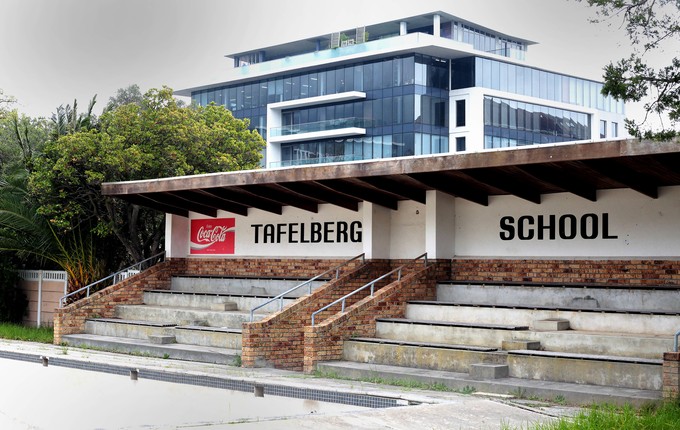
The Tafelberg school site in 2016. Archive photo: Masixole Feni
- This week, the Western Cape Department of Infrastructure presented a Heritage Impact Assessment for the development of the long-contested Tafelberg site in Sea Point.
- It was proposed that the site be divided into three parts and be rezoned to allow for the construction of a residential and mixed-use development with a social housing component.
- But the heritage committee and the residents’ association raised concerns that the old Tafelberg School building, earmarked for the Department of Social Development, was not properly considered in the assessment.
The future of the long-contested Tafelberg site in Sea Point was top of the agenda at a Heritage Western Cape meeting this week.
Last year, we reported that the Western Cape government has plans to use part of the Tafelberg site for affordable housing. At a public participation meeting in May 2025, the government presented three options for the site’s redevelopment.
This follows a decade of pressure from housing activists. In November 2015, the provincial government announced it would sell the site to the Phyllis Jowell Jewish Day School for R135-million. This was despite the Province having previously earmarked the site for social housing.
The sale sparked a campaign led by housing activist groups, Ndifuna Ukwazi and Reclaim the City, who took the government to court. A Constitutional Court judgment in this matter remains reserved more than a year after the matter was heard.

At the meeting this week, Heritage Western Cape said the property is a provincial heritage site. It has several key heritage elements, including the historic school building, Wynyard Mansions, and avenues of mature trees.
The Western Cape Department of Infrastructure also presented its Heritage Impact Assessment (HIA). The proposal includes dividing the property into three parts and rezoning it to allow the construction of a residential and mixed-use development with a social housing component.
Parcel 1 will include an eight-storey building of open market residential units with retail stores on the ground floor. Parcels 2 and 3 will include a four-storey social housing building around a multi-functional courtyard.
According to the HIA: “Measures need to be incorporated into the design, however, to ensure that the social housing component does not become siloed but is rather able to integrate into the redevelopment and the Sea Point community.”
Following several objections during the public participation process, the proposed building height was reduced from 11 storeys with 481 units to 8 storeys with 440 units. This reduction in height will also mean a lower number of open market and social housing units on the site.
The open market and social housing unit split is subject to grant availability and market conditions.
The heritage committee also agreed that the development proposal of the site must be “comprehensive”.
They raised concerns about the old Tafelberg School building, earmarked for the Department of Social Development. They said it was not properly considered in the HIA.
In a statement after the meeting, they said, “A final decision on the redevelopment will only follow once the required spatial framework and accompanying consultation process are completed.
“Heritage Western Cape remains committed to working with all stakeholders to ensure that the future of this important Provincial Heritage Site is guided by responsible, heritage‑led planning that honours its layered past while empowering an equitable and inclusive future.”
School building concerns
At the meeting, Dave Saunders, a member of the Impact Assessment Committee, said the old school building “needs a lot of work inside and it’s going to require a lot of investment to get that building occupied in one way or another”.
The Sea Point, Fresnaye and Bantry Bay Ratepayers and Residents Association had initially stated that they support inclusionary housing in principle, but after reviewing the HIA, they stated that the report “should not be accepted in its current form”.
“No explanation was provided on the decision to give the buildings and site over to the Department of Social Development, and no information was offered as to the intended future use of that building and site. Many of the comments on the proposed development relate directly to heritage concerns,” they said.
In response to questions, the Western Cape Department of Social Development said that it will only issue a call for proposals once the land use processes are concluded by the Department of Infrastructure.
Support independent journalism
Donate using Payfast

Don't miss out on the latest news
We respect your privacy, and promise we won't spam you.
Next: Joburg waste piles up amid labour disputes and landfill closures
Previous: Student hunger a hidden crisis at universities, Human Rights Commission hears
© 2026 GroundUp. This article is licensed under a Creative Commons Attribution-NoDerivatives 4.0 International License.
You may republish this article, so long as you credit the authors and GroundUp, and do not change the text. Please include a link back to the original article.
We put an invisible pixel in the article so that we can count traffic to republishers. All analytics tools are solely on our servers. We do not give our logs to any third party. Logs are deleted after two weeks. We do not use any IP address identifying information except to count regional traffic. We are solely interested in counting hits, not tracking users. If you republish, please do not delete the invisible pixel.