
Government promises to fix payment backlog choking film industry
The Department of Trade, Industry and Competition tells Parliament it will secure urgent funding
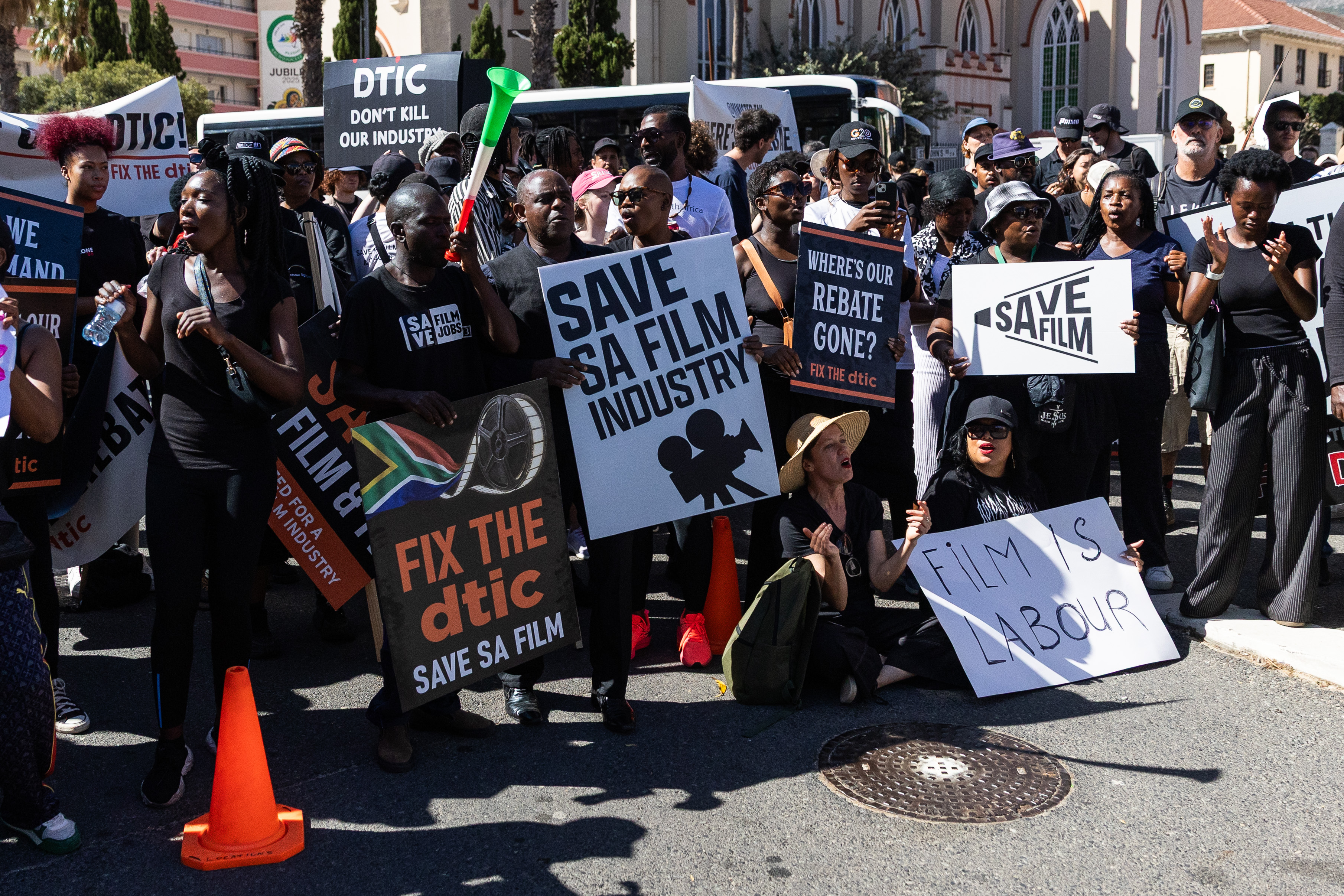
Hundreds of film industry professionals protested in Cape Town on 28 January. Photo: Ashraf Hendricks.
- The Department of Trade, Industry and Competition (DTIC) and representatives of the Save SA Films Jobs Coalition briefed Parliament on Tuesday on the crisis in the South African film industry.
- The DTIC has stopped approving production incentive payments due to a huge unpaid backlog.
- DTIC deputy minister Zuko Godlimpi said the department will try to secure urgent interim funding.
The Department of Trade, Industry and Competition (DTIC) told Parliament on Tuesday that it is trying to secure urgent interim funding to clear a backlog of film South African Film and Television Production Incentive payments.
Last month, hundreds of people working in the film industry protested in Cape Town and Pretoria over the department’s management of the incentive scheme.
The incentive, introduced in 2004, provides rebates to support the local film and TV industry. The Save SA Films Jobs Coalition says paralysis in the programme has brought the SA film industry to its knees.
On Tuesday, DTIC officials, industry representatives and members of the coalition briefed Parliament’s portfolio committee on trade, industry and competition on what was described as a “crisis” in the sector.
DTIC Minister Parks Tau said that due to the covid lockdown stalling the film industry, National Treasury had reallocated the budget for the film incentive to another programme. This incurred significant “contingent liabilities” for the department – a backlog of payments for films approved and already completed but not paid by the DTIC because of lack of funds.
“Every financial year, instead of approving new applications, we are paying … those that we owe so that we are able to stabilise the situation,” said Tau.
DTIC Director-General Simphiwe Hamilton said the contingent liability, which stood at about R2-billion in the financial year ending March 2021, had been reduced to R473-million.
In the 2023/24 financial year, the film incentive budget was cut by R136-million compared to the previous year. No new approvals were made in 2024/25 and 2025/26 financial years because of the backlog in payments.
DTIC deputy minister Zuko Godlimpi said, “We understand the anxiety… We take these concerns very seriously. At the same time we have a responsibility to ensure that public funds are administered with strong governance, accountability, and long-term sustainability.”
He said the incentive had created a “massive demand with limited resources, which are continuously declining”.
Wandile Molebatsi, deputy chairperson of the Independent Producers Organisation (IPO) and part of the Save SA Films Jobs Coalition, said, “We are a driver of youth employment, transformation, and robust economic growth.”
Molebatsi said the IPO commissioned a study from international consultancy Olsberg, to be released at the Joburg Film Festival next month. A key finding was that for every R1 invested in the film industry, R5 is generated.
IPO chairperson Delon Bakker said the DTIC had been unresponsive in the past few years. He presented letters from the film industry to the DTIC from the past few years which he said had not received a response.
Portfolio committee chairperson Mzwandile Masina said the lack of response from the DTIC was “just unacceptable”.
Bakker said that in 2023 new complicated guidelines, increasing the red-tape for incentive applications, were introduced without consulting the industry.
Godlimpi told the committee the DTIC would “secure urgent interim funding to address current claims and applications” and disburse the additional funds. He said the department would establish national industry working groups with stakeholders to address challenges facing the sector.
He said the DTIC would be considering alternative incentive structures and collaborate with the Industrial Development Corporation of South Africa and National Empowerment Fund.
Godlimpi said an automated system would be introduced to reduce application processing times and additional staff would be appointed to deal with the “influx of claims”.
He suggested that, in the long-term, the programme be transferred to the Department of Sports, Arts and Culture. But after several MPs expressed opposition to the idea, Tau said the suggestion would be scrapped.
The DTIC also promised to investigate allegations of mismanagement of the incentive.
Support independent journalism
Donate using Payfast

Don't miss out on the latest news
We respect your privacy, and promise we won't spam you.
Next: SANRAL roadworks stalled for 17 months
Previous: What is antisemitism?
© 2026 GroundUp. This article is licensed under a Creative Commons Attribution-NoDerivatives 4.0 International License.
You may republish this article, so long as you credit the authors and GroundUp, and do not change the text. Please include a link back to the original article.
We put an invisible pixel in the article so that we can count traffic to republishers. All analytics tools are solely on our servers. We do not give our logs to any third party. Logs are deleted after two weeks. We do not use any IP address identifying information except to count regional traffic. We are solely interested in counting hits, not tracking users. If you republish, please do not delete the invisible pixel.