
No plan to review SA’s coal exports to Israel, says Parks Tau
The minister says sanctions against Israel would violate World Trade Organisation principles
 Add GroundUp on Google
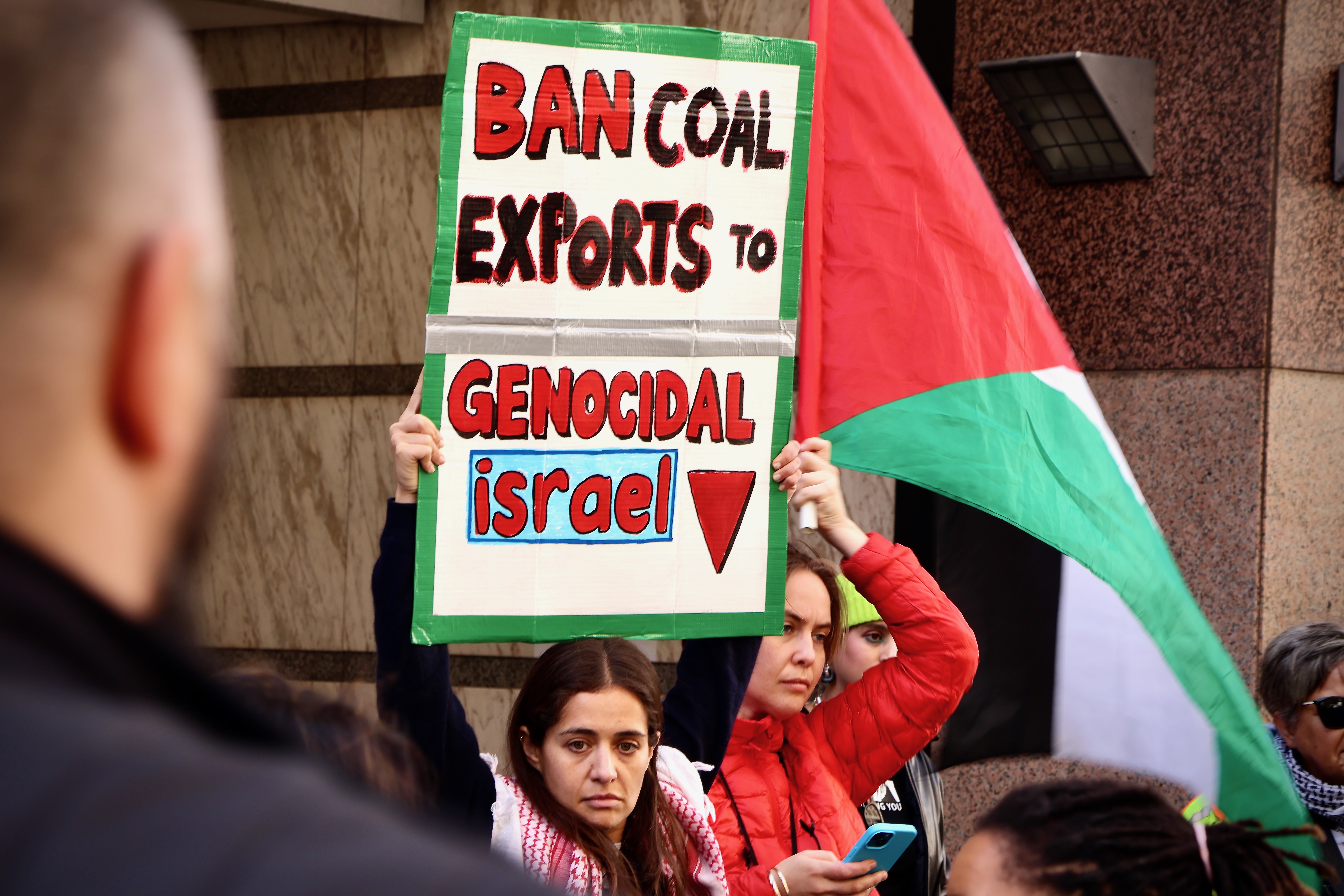
Protesters outside the Department of Trade, Industry and Competition’s offices in Cape Town in August 2025. Archive photo: Matthew Hirsch
- Trade minister Parks Tau has told Parliament that there are no plans to review the country’s coal exports to Israel.
- South Africa exported 1.8-million tons of coal to Israel in 2025.
- Tau claims that imposing sanctions against Israel without a United Nations resolution would violate World Trade Organisation (WTO) principles.
- But activists claim South African coal is “fuelling the genocide”, and say there are exceptions to WTO rules which other countries have used to stop exports to Israel.
Minister of Trade and Industry Parks Tau says there are no plans to review South Africa’s coal exports to Israel. Tau, in a written response to EFF MP Carl Niehaus earlier this month, confirmed that South Africa exported 1.8-million tons of coal to Israel in 2025, equating to 2.6% of South Africa’s global coal exports of 71.5-million tons.
Activists have held protests and launched petitions, urging the government to stop exports to Israel, claiming that South African coal is “fuelling the genocide” in Palestine.
In his parliamentary response, Tau said the government was “deeply concerned about the situation in the Middle East and remained committed to initiatives to achieve peaceful coexistence in the region”.
He said South Africa and Israel do not have formal relations but are both members of the World Trade Organisation (WTO).

“Sanctions applied by one member against another in the absence of multilateral sanctions by the [United Nations] would violate the WTO principle of non-discrimination and would open the country to legal challenge,” said Tau.
He said the South African government has “not conducted a study on whether the coal exports sustain or to what extent the exports sustain the Israeli electricity grid”.
While South Africa has voted in favour of sanctions against Israel at the UN, a legally binding resolution to impose sanctions can only be passed by the UN Security Council, where the United States has consistently vetoed efforts to impose sanctions.
The South African Boycott, Divestment and Sanctions (BDS) Coalition submitted a 260-page dossier to Tau’s department in March, written by human rights lawyer Sirhaan Ché Khan.
The dossier argues that WTO principles allow exceptions that would permit South Africa to suspend coal exports to Israel.
“Article XXI(b)(iii) of GATT provides that nothing in the agreement prevents a member from taking any action ‘in time of war or other emergency in international relations’, a provision increasingly invoked in the context of grave humanitarian crises,” Khan argues.
“The South African State does not itself mine or sell the coal, but it exercises decisive regulatory authority over whether such exports may lawfully occur.”
The BDS Coalition’s Roshan Dadoo said the minister’s response was disappointing.
“This argument that you have to wait for the Security Council to agree upon a multilateral system of sanctions … isn’t true. States are already taking action. Colombia, Spain, even the UK in a very, very limited way because of popular pressure within Britain,” she added.
Tau’s response “flies in the face of our International Court of Justice case,” said Dadoo.
The Palestine Solidarity Campaign (PSC) has also called on South Africa to ban coal exports to Israel. Usuf Chikte of the PSC said the government should follow Colombia’s example.
“It’s also putting profits above people, and it goes against our international obligations,” said Chikte.
Francesca Albanese, the United Nations Special Rapporteur on the occupied Palestinian territories, wrote in a July 2025 report that “by supplying Israel with coal, gas, oil and fuel, companies are contributing to civilian infrastructures that Israel uses to entrench permanent annexation and weaponise in the destruction of Palestinian life.”
Support independent journalism
Donate using Payfast

Don't miss out on the latest news
We respect your privacy, and promise we won't spam you.
Next: Commuters to pay up to R5 more on taxi fares from Monday
Previous: Fewer people are being convicted for commercial crimes
© 2026 GroundUp. This article is published under the GroundUp Republication Licence Version 1.0. Email [email protected] to request permission to republish.