
The generator broke, leaving this village without water — 17 years ago
Residents who can’t afford to buy water have to get it from a distant river
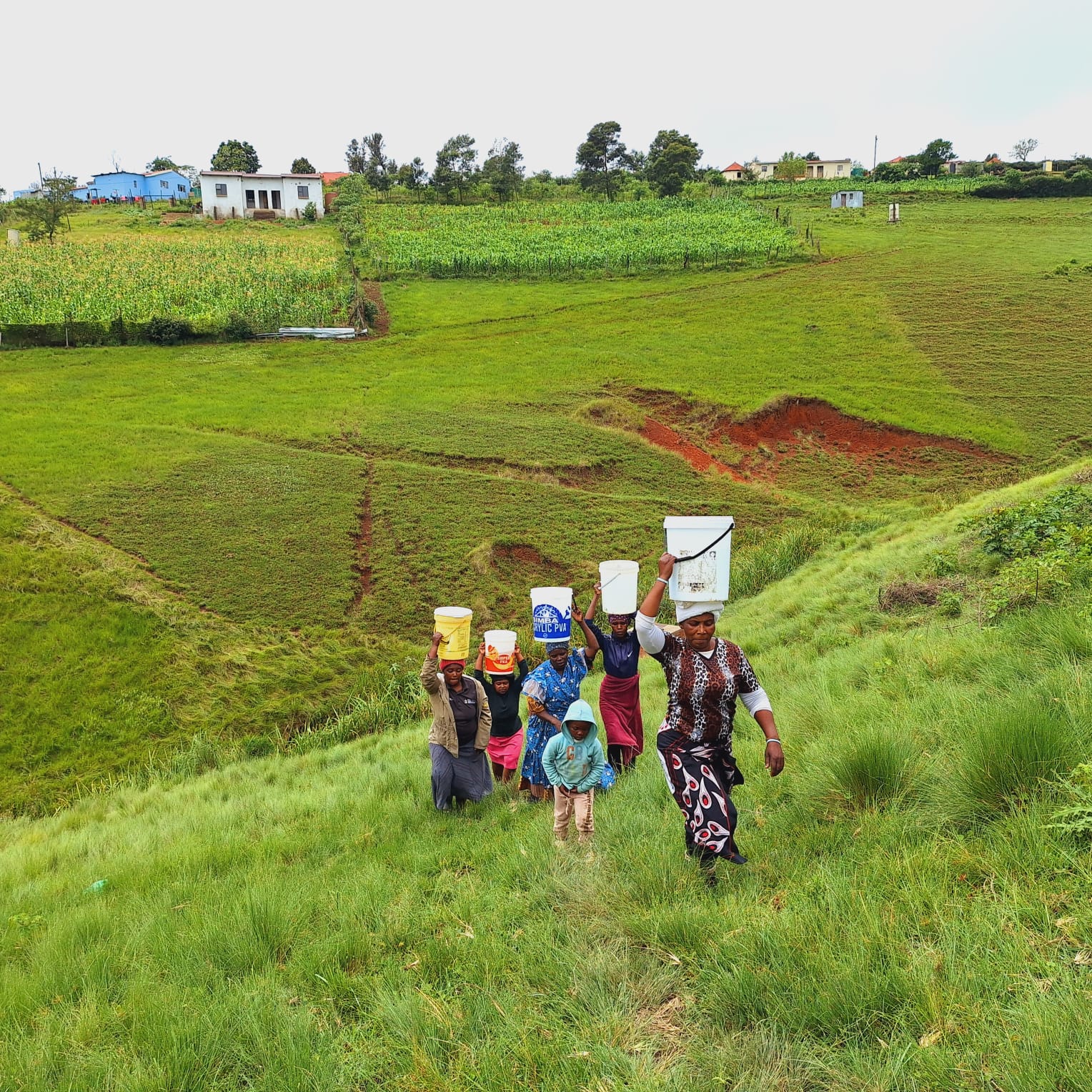
Villagers in Sicwenza walk more than a kilometer, crossing hills, to collect buckets of water because the area has not had running water for years. Photos: Yamkela Ntshongwana
- Six villages in Sicwenza outside Flagstaff in the Eastern Cape have gone without water for 17 years.
- Residents collect water from a nearby river shared with cattle and other animals. Those who can afford it buy water, spending about R1,500 for 2,500 litres.
- The community’s water supply is meant to come from the Ludiwane Water Treatment Works under the Mzintlava River Scheme, which began in 2024. But delays with construction have halted these efforts.
Hundreds of residents from six villages in Sicwenza outside Flagstaff in the Eastern Cape have gone without running water for 17 years.
Villagers say problems started in 2009 when a generator for a borehole that supplied the area was removed by municipal officials after it broke down. It was never returned. They complain that their pleas for the generator to be returned have been ignored for years.
When we visited the borehole site, it was filled with water, but the generator storeroom was empty and badly vandalised. Doors had been stolen and pipes were broken.
Villages affected include Sicwenza, Mangquzu, Khimbili, Ngqwabeni, Mission and KwaNdayeni. Residents there now rely on collecting water from a nearby river shared with cattle and other animals. Those who can afford to, spend about R1,500 for 2,500 litres of water.
Resident Yandisa Mtshoqolwana said, “We have gone back and forth to the municipality seeking an intervention, but nothing has been resolved.”
“They are all aware of what’s happening here. Our ward councillor is never available when we need him. We are sharing dirty water with animals,” he said.
Farmer Mphuthani Miya said the lack of water has made daily life extremely difficult, forcing residents to stop planting their own maize and vegetables. “We used to farm on our amasimi (fields) to feed our families, but now we spend our small social grants buying vegetables,” he said. “I’m old and crippled. I cannot carry containers from the river, so I depend on my grandchildren to fetch me water.”
The community’s water supply is meant to come from the Ludiwane Water Treatment Works under the Mzintlava River Scheme, which began in 2024, according to ward councillor Bongani Nokhele. But delays with construction have halted these efforts.
He added that water will be provided to residents on request, particularly for funerals.
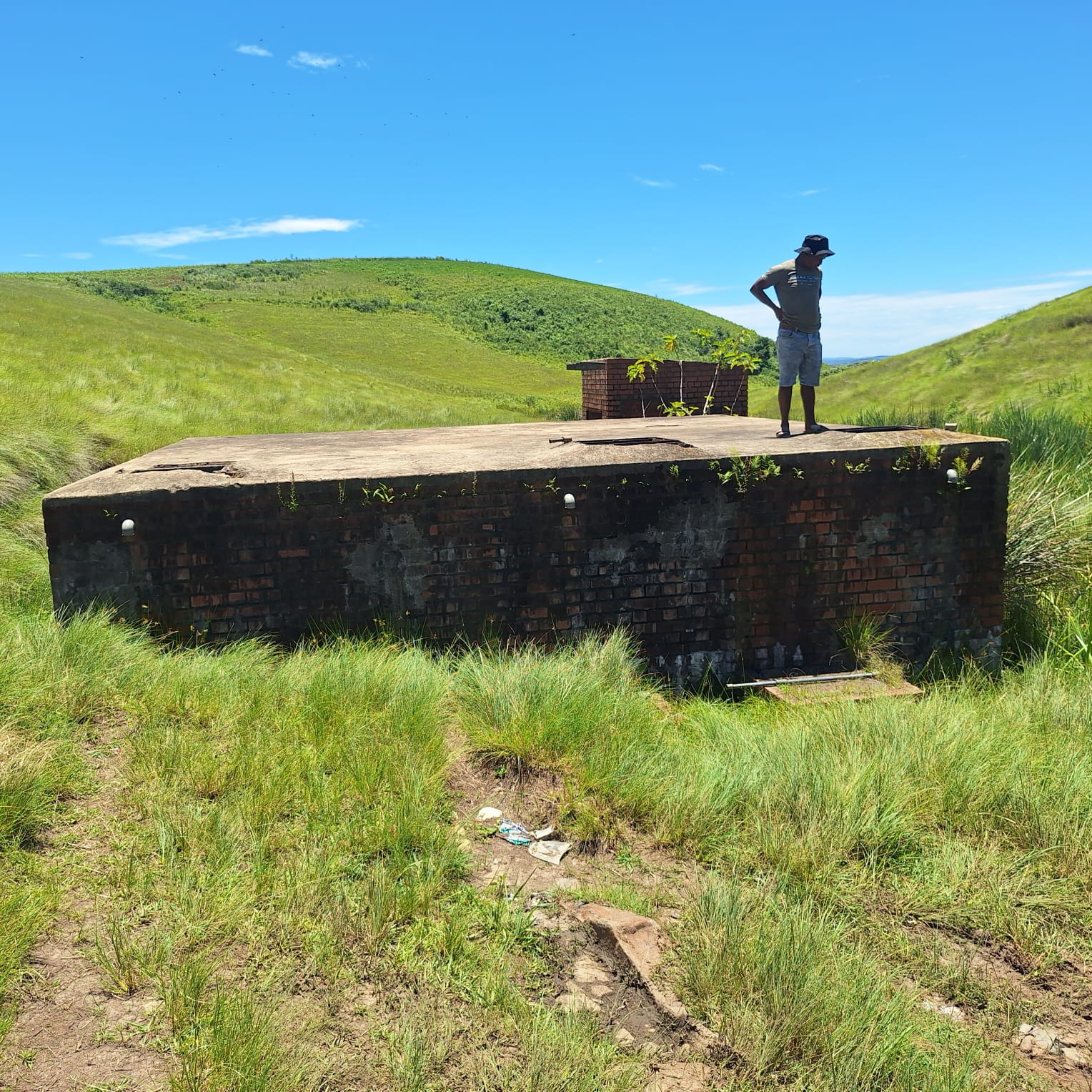
Sicwenza borehole has a good supply of water but no generator to pump to the community taps.
OR Tambo District Municipality spokesperson Ncebakazi Kolwane acknowledged that there were “long-standing water supply challenges” in the area. The broader challenge stems from historical bulk water infrastructure backlogs, she said.
According to Kolwane, the villages were previously supplied through a spring water scheme from a reservoir that flowed into communal taps. She said this system was repeatedly hit by vandalism for several years, which ultimately rendered it inoperable.
Kolwane said the generator was later installed and used to pump water but it was stolen while the municipality was in the process of replacing parts damaged by vandalism. However, residents dispute the municipality’s account, insisting that the generator was removed by municipal officials driving a municipal truck.
Kolwane said the bulk water project is currently supplying about 40% of villages in the Ingquza Hill Local Municipality and has the capacity to supply more than 60% once complete.
She said Sicwenza has already been connected to the Ludiwane Water Treatment Works system, but there is still outstanding work needed to pump water into existing reservoirs and taps. She said construction was at times disrupted by community protests and vandalism, requiring sections of the project to be restarted.
“The municipality notes the frustrations of the Sicwenza community and reiterates its commitment to addressing water service challenges through temporary relief measures and long-term infrastructure development,” she said.
Support independent journalism
Donate using Payfast

Don't miss out on the latest news
We respect your privacy, and promise we won't spam you.
Next: Families take refuge in churches after Limpopo floods
Previous: Massacre on the Cape Flats: police search for gunmen
Letters
Dear Editor
The report on the six villages in Sicwenza who have been without running water for seventeen years is a devastating record of a state that has fundamentally resigned from its most basic obligations. To leave hundreds of families to share river water with livestock for nearly two decades – simply because a generator was removed and never replaced – is not a "service delivery challenge". It is a calculated act of structural violence.
The contradictory accounts between the OR Tambo District Municipality and the residents are telling. While the municipality pivots to narratives of vandalism and "bulk infrastructure backlogs", the residents recall a much simpler betrayal: a municipal truck driving away with their only source of life in 2009 and never returning. This 17-year drought is not an accident of geography or a result of criminal interference; it is a profound act of governmental complicity through systematic neglect.
Water is a foundational right guaranteed by our Constitution, yet for the elderly and the impoverished in Flagstaff, it has become a luxury they must buy with their meagre social grants or a hazard they must fetch from a riverbed. When a local government suggests that water will be provided "on request, particularly for funerals," they are effectively admitting that they only prioritise the dignity of their citizens once they are dead.
The "commitment" echoed by municipal spokespeople rings hollow against the backdrop of a generation raised on river water. Until our political leadership treats the lack of a borehole generator in a rural village with the same urgency as a national security crisis, the residents of Sicwenza remain a footnote in a narrative of administrative indifference. Seventeen years is not a delay; it is an abandonment.
© 2026 GroundUp. This article is licensed under a Creative Commons Attribution-NoDerivatives 4.0 International License.
You may republish this article, so long as you credit the authors and GroundUp, and do not change the text. Please include a link back to the original article.
We put an invisible pixel in the article so that we can count traffic to republishers. All analytics tools are solely on our servers. We do not give our logs to any third party. Logs are deleted after two weeks. We do not use any IP address identifying information except to count regional traffic. We are solely interested in counting hits, not tracking users. If you republish, please do not delete the invisible pixel.