
District Six families ordered to vacate Searle Street cottages
Five families who have fought their eviction for years have lost their court battle
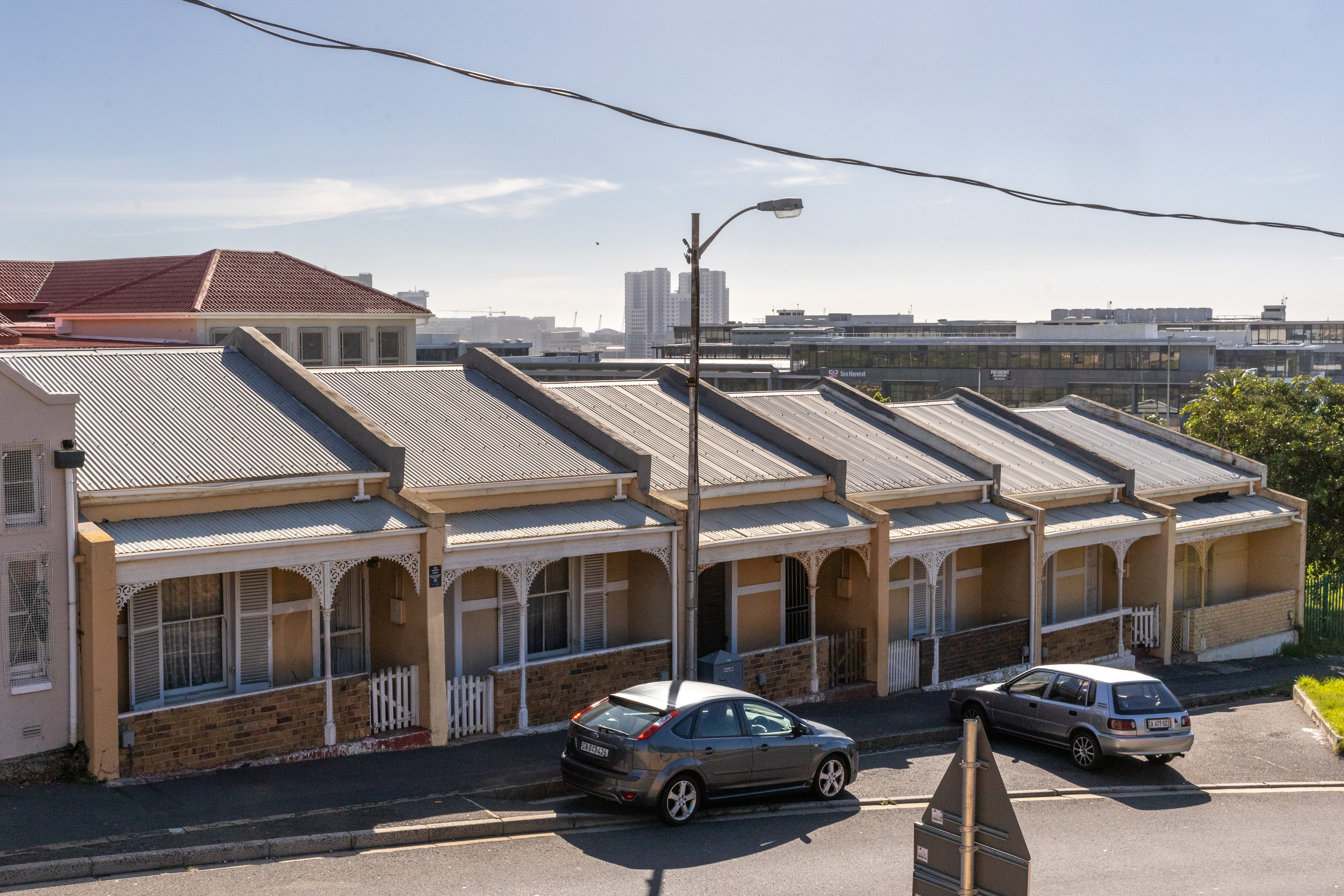
Five District Six families, who withstood apartheid’s forced removals, have been ordered to vacate these Victorian cottages. Archive photo: Ashraf Hendricks
- Five District Six families must vacate their Victorian cottages in Searle Street by 6 March, after acting magistrate Juan de Pontes granted an eviction order.
- Developer Ettiene Du Toit bought the properties from the Holy Cross Sisters for R2.45-million in 2014.
- De Pontes said the cottages provided “rare continuity” for families who stayed on the land when thousands were forcibly removed during apartheid, but said the law and not sentiment must be considered.
It is likely the end of the legal road for five District Six families who have spent years in the courts to stop their eviction from Victorian cottages in Searle Street which survived apartheid-era demolitions.
In a judgment handed down in December 2025, acting Cape Town magistrate Juan de Pontes granted an order in terms of the Prevention of Illegal Eviction from and Unlawful Occupation of Land Act (PIE), in favour of the owner of the properties, Ettiene du Toit, a private developer.
De Pontes gave the families until 6 March to vacate their homes.
He ordered the City of Cape Town to provide temporary emergency housing and the Department of Social Welfare to assist them to find accommodation in a care or living facility.
GroundUp has not been able to ascertain if the residents will apply for leave to appeal his ruling.
De Pontes made the ruling in an ex tempore (oral) judgment in November and then provided written reasons in December.
The cottages initially belonged to the Holy Cross Sisters, who fought during apartheid against their demolition. The religious order sold the cottages in 2014 to Du Toit, a Mpumulanga-based developer, for R2.45-million. He subsequently served the residents with notices to vacate.
The residents approached the Western Cape High Court, seeking to set aside the sale agreement, claiming they had been given “lifelong tenure” by church officials. The court rejected this argument, finding their evidence to be unreliable, hearsay and inaccurate.
The PIE application proceeded in the magistrates’ court. The residents initially denied that they were unlawful occupants, but later abandoned this argument – “a concession properly made”, Du Pontes said.
The court then had to decide what would be just and equitable.
In opposing affidavits, the residents repeated what De Pontes described as “the prolix account of the history of the property’s occupation from 1928 onwards”, and argued that they would be rendered homeless if evicted.
De Pontes considered the affidavits, reports by social workers on the residents’ personal circumstances, and a report by the City which stated that it had no accommodation available near District Six. However, the City said it could refer some residents to social housing, old-age residential facilities, or provide emergency housing kits, depending on their income.
De Pontes acknowledged that the residents had strong ties to District Six and that the cottages provided a “rare continuity” for families who had been able to remain on the land while thousands of others were forcibly removed during apartheid.
However, the law, and not sentiment, had to be considered and the residents’ averments of homelessness were “baldly made”.
He said another relevant factor was that the residents had not paid rent, but had engaged in prolonged litigation, frustrating the owner’s rights.
“They have had ample warning to at least attempt to make arrangements for alternative accommodation of their own accord. They have known of the sale of the property for several years. They did nothing.”
Having weighed all the relevant factors, he found there could be no doubt that the owner was entitled to an eviction order, as the residents were in unlawful occupation.
However, he said, it was just, equitable and fair to set a vacation period that would enable the unlawful occupiers to vacate with dignity and find alternative accommodation, if possible.
He granted the eviction order, and gave the residents a little over three months to vacate.
On the issue of costs, he said, “The extraordinary duration of this matter has in no small way been caused by an unreasonable stance adopted by the [residents] who sought to use every opportunity, big or small, to postpone the matter to be heard to finality”.
While the owner had asked for punitive costs, De Pontes took into account that the residents were lay people, guided by their attorneys, who had been acting pro bono.
He ordered costs on a party to party scale against the residents.
Support independent journalism
Donate using Payfast

Don't miss out on the latest news
We respect your privacy, and promise we won't spam you.
Next: Still no public toilets at Durban bus rank
Previous: Dunoon fire victims rush to rebuild homes as City proposes reblocking
Letters
Dear Editor
It is sad indeed to be evicted in District Six in 2026, where your roots are.
How are we going to rebuild? It's happening because of greed of money.
What do we tell our children and grandchildren? We as Capetonians cannot benefit from our own city, it's becoming unbearable to read about in the news. We have a housing crisis, I am facing a similar situation in Ruyterwacht, I am awaiting an outcome in the High Court, after my husband passed away. I wish a woman could run this country, we will look after each other, we will flourish, there will be housing, jobs and we will farm. Amen, so help me, God.
Dear Editor
I feel that these people should be allowed to keep their cottages. Developers are a fairly heartless group of people who are filled with greed. These cottages are homes, filled with memories. The government should step in here and allow the good folk to keep their homes.
Dear Editor
"Apartheid and its laws happened in the past. You need to move on and forget about the past".
How often have we heard that? How often have we been told to create a future free from the past? But how can we "move on" when our very dignity continues to be stripped away like the dignity of the elderly people of Searle street? And for what?
The developer will put up some swanky accommodation only affordable to people with zero connection to District Six or even Cape Town, for that matter. Greed motivates people like this owner to act in this manner. The law is the law, they will shout. But does that give the developer the right to strip elderly folks of their dignity?
Dear Editor
It is unfortunate that the houses belong to someone else. Unfortunately, everyone needs to either buy or rent and cannot live free. If you have a house, you must pay rates, taxes, etc.
Who has been covering the rates and taxes on these properties all these years? It is not a matter of money or greed, but the owner has lost a lot of money over the past 10 years. All the people living there should pull together and buy a piece of land. Put up 4 or 5 houses. You have known for 10 years that the places belong to someone else.
Dear Editor
The court reportedly acknowledged the “rare continuity” these homes represent for families linked to historic forced removals, yet still ordered eviction and directed the City to provide temporary emergency accommodation.
This is not only a housing dispute; it is a spatial justice crisis. District Six is a symbol of dispossession and the long struggle for restitution, inclusion, and the right to the inner city. Any relocation far from the CBD would repeat the same pattern – displacement justified as “lawful”, while families lose access to jobs, schools, transport, social networks, and dignity.
In terms of s 26(3) of the Constitution and PIE, eviction must be “just and equitable” after considering all relevant circumstances, including vulnerability and the risk of homelessness. Legal compliance is the floor, not the ceiling. The City’s constitutional and planning duties require proactive steps to prevent displacement where it entrenches apartheid spatial geography.
The Blue Moonlight principle is central: even where a private owner seeks eviction, the municipality cannot stand aside; it must plan and act to avoid homelessness and provide emergency accommodation that is safe, dignified, and appropriately located. In a context like District Six, “appropriately located” must mean in/near District Six, unless truly impossible – because location is the substance of redress.
“No nearby accommodation” is not a neutral fact; it reflects a failure of inner-city housing planning, land release, budgeting, and prioritisation.
I call on the City, urgently and publicly, to table a clear plan before 6 March 2026 that: (1) secures well-located temporary emergency accommodation in/near District Six; (2) provides a written timeline for placement into permanent, well-located housing;(3) uses available public land/buildings and expedited approvals to prevent displacement; and (4) meaningfully consults the affected families.
District Six has endured removal once. Cape Town must not authorise a second displacement through delay, scarcity, and “admin” excuses.
Dear Editor
Why did the nuns sell the property to a developer? Surely, they knew he would want the residents who live in those properties. Evicted for land development, what a shame.
Dear Editor
If ever there was reason for our National Government to threaten Expropriation without compensation this is it.
That a developer from Mpumalanga has the gall to think that he can pick up five units for an amount of money that would not score him a one-bedroomed flat in the CBD these days is ludicrous. Those typically go for around R3,250,000 right now.
How do I know? Because I enjoy the theatre and the Symphony Orchestra, hallmarks of Cape Town's cultural heritage, but I can't get an Uber home afterwards because my home abuts Manenberg.
So, no. The law is indeed an ass, but applicable laws smartly applied following the necessary public pressure on Politicians often results in more just outcomes.
Let's mobilise, march, hand over petitions to the necessary government officials (with a copy to the US embassy so that the new ambassador can get on the matter right away) and put a stop to this madness. The judge is admitting the legitimacy of the current residents' claim to live there whilst bowing before the constraints placed on him by the legal framework as it stands.
But people make laws and people implement them. Let the people govern and put our legislators on notice that if they want to see an opening of Parliament beyond this year's one, they will make the necessary legal adjustments to put right the evil that the current laws mandated in this instance.
Dear Editor
I am sad to hear that the current occupation's families, having cultural and familial rights to those properties, have to vacate them. The new owner is a developer, so will demolish those historical houses, to build what? Where was our Heritage Foundation, to protect those invaluable historical buildings? How could such a sales contract have been gone through without proper assessments and to build another impersonal concrete hotel or apartment block? My heart is with all of your families.
© 2026 GroundUp. This article is licensed under a Creative Commons Attribution-NoDerivatives 4.0 International License.
You may republish this article, so long as you credit the authors and GroundUp, and do not change the text. Please include a link back to the original article.
We put an invisible pixel in the article so that we can count traffic to republishers. All analytics tools are solely on our servers. We do not give our logs to any third party. Logs are deleted after two weeks. We do not use any IP address identifying information except to count regional traffic. We are solely interested in counting hits, not tracking users. If you republish, please do not delete the invisible pixel.