
Budget 2026: Ten takeaways from Godongwana’s speech
Minister of Finance paints an optimistic picture

Minister of Finance Enoch Godongwana delivered his annual budget speech on Wednesday. Archive photo: Ashraf Hendricks
The National Treasury’s efforts to prioritise the repayment of South Africa’s national debt, by decreasing spending and increasing revenue, have paid off, Finance Minister Enoch Godongwana told Parliament on Wednesday.
- The budget deficit - the difference between government revenue and spending - has narrowed, and debt-service costs are also falling. But in 2026, the government will still have to spend R432.4-billion on debt repayments and interest.
- Although the government will have to borrow money to fund the budget shortfall, the amount borrowed in 2026 will decrease to R380-billion, from R563-billion in 2025.
- The economy is expected to grow by 1.6% in 2026 (taking inflation into account), up from an estimated 1.4% in 2025. Inflation is expected to be around 3.4% this year.
- Thanks to higher-than-expected revenue in 2025, a plan to increase income taxes to collect an extra R20-billion has been scrapped. And for the first time since 2024, income tax brackets and rebates will be increased in line with inflation, which means people will not have to pay more tax if their salaries and wages increase by inflation.
- But excise duties on tobacco and alcohol go up in line with inflation. This means tax on a 20-pack of cigarettes rises from R22.81 to R23.58, and tax on a 340 millilitre can of beer or cider increases by 8c.
- Fuel levies also go up in line with inflation. For instance, the general fuel levy will go up by 9c a litre for petrol and 8c a litre for diesel.
- People will be encouraged to save more through an increase in the annual tax-free savings account contribution limit to R46,000 from R36,000. The limit to retirement fund deductions will also be raised from R350,000 to R430,000, allowing people to invest more in their retirement, on a tax-free basis.
- Small businesses will only be required to register for VAT when their turnover exceeds R2.3-million. Previously, the threshold was R1-million.
- About 60% of the government’s main budget of R1.95-trillion will be spent on what the government calls the “social wage”, which includes education, healthcare, and social grants.
- R26-billion will be allocated to the HIV/AIDS programme over the next three years, to prevent mother-to-child transmission and provide antiretroviral medicines.
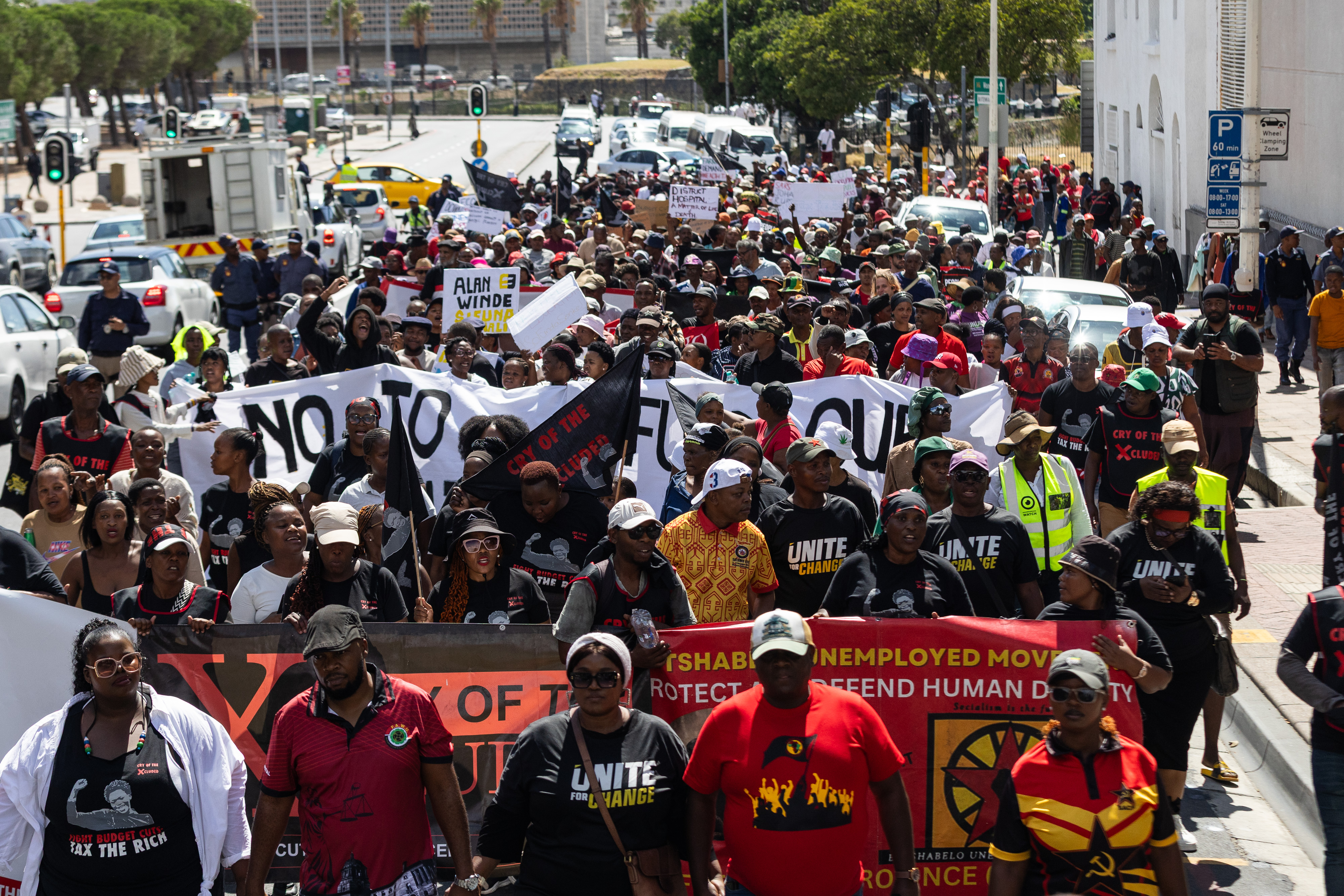
Hundreds of people protested outside Parliament ahead of the budget speech. Photo: Ashraf Hendricks
Video: Ashraf Hendricks and Marecia Damons
Support independent journalism
Donate using Payfast

Don't miss out on the latest news
We respect your privacy, and promise we won't spam you.
Letters
Dear Editor
I am Jean Julius and I have been working all my life for +- 30 years. I am 53. I have a son that resides with me who has a disability and is working.
I think I get a good salary and some months I can get by with what I earn. I rent a property as I cannot afford to/do not qualify for a bond. I do not qualify for low-cost housing.
My question is whether we need to do housing like it was done in the 1970/1980s. I lived in one of the council houses from 1979 to 2018.
I don't mind paying for a house. I do not want a free house. I will pay for my water and electricity. But my age and my income do not allow me to buy a home in Cape Town.
© 2026 GroundUp. This article is licensed under a Creative Commons Attribution-NoDerivatives 4.0 International License.
You may republish this article, so long as you credit the authors and GroundUp, and do not change the text. Please include a link back to the original article.
We put an invisible pixel in the article so that we can count traffic to republishers. All analytics tools are solely on our servers. We do not give our logs to any third party. Logs are deleted after two weeks. We do not use any IP address identifying information except to count regional traffic. We are solely interested in counting hits, not tracking users. If you republish, please do not delete the invisible pixel.