
Beware of populist leaders, warns judge
Justice Azhar Cachalia makes a clarion call for the rule of law underpinned by universal human rights and an independent judiciary
 Add GroundUp on Google
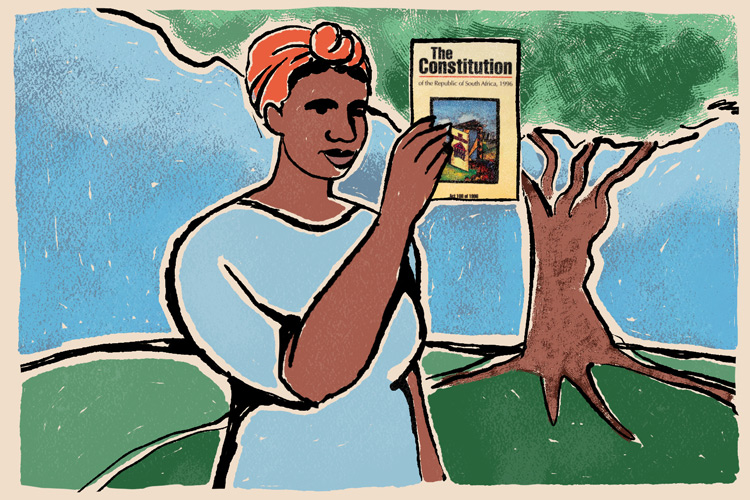
Retired justice of the Supreme Court of Appeal Azhar Cachalia defended the South African Constitution in the annual Ben Beinart lecture. Illustration: Lisa Nelson
This is an edited and shortened extract from Azhar Cachalia’s Ben Beinart lecture, delivered on 15 September at UCT. Justice Cachalia described the life of Ben Beinart, and then his own family’s life under apartheid. The extract below starts with his warning about populism.
Populist leaders, including some in the ANC and minority parties, pose significant threats to South Africa’s constitutional order.
Ben Beinart, a Jewish legal scholar whose family had fled European persecution, had his worldview shaped by the global rise of fascism. When he became the WP Schreiner Professor of Roman Law at UCT in 1950, he observed the recently elected Nationalist government begin implementing apartheid. It would not have escaped him that many of its leaders had openly advocated fascist and Nazi ideologies, which embraced authoritarianism and racially exclusionary policies: policies that would become the hallmark of white-nationalist rule throughout Beinart’s life.
This was the context in which Beinart’s legal philosophy and political action was shaped. Throughout the 1950s, as apartheid legislation tightened its grip, Beinart’s was an influential voice of legal resistance to the systematic erosion of the rule of law.
The recent attempts by powerful political actors to capture and repurpose state institutions for extractive purposes is well documented. Organised criminal networks working with politicians have infiltrated state institutions, including the criminal justice system. The constitutional vision of a non-racial country with racial equality as a founding principle is being challenged by an ugly brand of ethno-nationalist politics. Their project is regrettably shared by lawyers who share and promote their brand of politics. Their strategy includes undermining the authority of the courts and stoking xenophobic sentiment. Some openly declare their aversion to the Constitution, seeking a return to a parliamentary system with an executive that exercises untrammelled authority over the country. Their strategy is also to weaken and destabilise democratic institutions. The increasing failure of the state to provide even the most basic services in large parts of the country is testimony to this sorry tale.

Beinart’s own exile was born of a catastrophe with lessons for us today. The Weimar Republic did not fall to invasion or coup; it was hollowed out from within. A fractured, multi-party parliament proved unable to govern through the hyperinflation of the early 1920s and the mass unemployment that followed the Depression. Article 48 of its own constitution, meant to allow the President emergency powers in a genuine crisis, was instead used with increasing regularity to govern by decree and sideline an elected legislature. And in January 1933, conservative elites who believed they could control and use Hitler for their own purposes installed him as Chancellor, then dismantled what remained of constitutional government through ostensibly legal means: a decree suspending civil liberties after the Reichstag fire, and an Enabling Act extracted from a cowed parliament barely two months later.
I do not draw this parallel lightly, nor do I suggest that we stand where Germany stood in 1933. But the pattern by which a constitutional order is captured rather than confronted — in which those with power persuade themselves that they can harness dangerous forces for their own ends, and in which economic hardship and institutional failure create fertile ground for those who trade accountability for order — is one our Constitution’s framers understood well. It is also, I fear, a pattern that organised criminal networks and their political enablers are exploiting here, today, as they attempt to capture our courts, our prosecuting authority and our public service from within, rather than confronting them from without.
This happens at a time when the international rules-based order has all but collapsed as illiberal democracies gain ascendancy. These are typically governing systems that combine regular, competitive elections with the systematic erosion of constitutional liberties, the rule of law, and institutional checks and balances. Rather than overthrowing democracy by force, leaders in an illiberal democracy subvert it from within by using their democratic mandates to change the rules of the state to serve their own interests, as happened in the case of Weimar. Power is consolidated heavily within the executive branch, leaving parliament, local governments and the judiciary weakened. Some recent examples include Hungary, Serbia, Slovakia, Turkey, Israel, India and increasingly, the United States.
Their brand of politics is not dissimilar to the populism we are experiencing here, except that illiberalism is usually associated with the right. Here populists clothe themselves in ideologies of both the left and the right. But don’t be fooled by the colour of their T-shirts or their rhetoric. Their ultimate goals are the same.
I use the concept of illiberalism not to describe the polar opposite of classical liberalism as a political philosophy, which emphasises free markets, individual rights, the rule of law and limited government. Or to take issue with those who advocate a radically different philosophy. But rather to describe the back-lash against constitutionalism whose main features are the separation of powers, the rule of law underpinned by universal human rights and an independent judiciary.
I must end by returning to Beinart. We lived in this country at different times, and the particular injustices we confronted were not the same: his was the tightening of apartheid’s grip in its first uncertain decade; mine was its long, brutal entrenchment and eventual unravelling. Yet the more I have reflected on his life alongside my own, the more the differences seem to recede.
Both of us came to believe, from opposite ends of the same unjust system, that law could be turned against arbitrary power, even while knowing its limits; that an independent judiciary and a rigid, rights-based constitution were not abstractions but the only real defence ordinary people had against a state determined to strip them of dignity. Both of us paid a price for that belief — his was exile, mine was detention and banning. And both of us, I think, would recognise in the other a stubborn, perhaps old-fashioned, faith: that defending constitutional government is never a task completed, only ever a task resumed.
As we remember Ben Beinart, let us draw inspiration from his unwavering dedication to justice, his belief in the power of law to protect the vulnerable, and his vision of a society where human rights are rigorously defended for all. That task is as pressing today as it was then.
Support independent journalism
Donate using Payfast

Don't miss out on the latest news
We respect your privacy, and promise we won't spam you.
© 2026 GroundUp. This article is published under the GroundUp Republication Licence Version 1.0. Email [email protected] to request permission to republish.