
Textbook saga may delay plans to improve child literacy
New catalogue for grades 1-3 is expected to be based on latest research
 Add GroundUp on Google
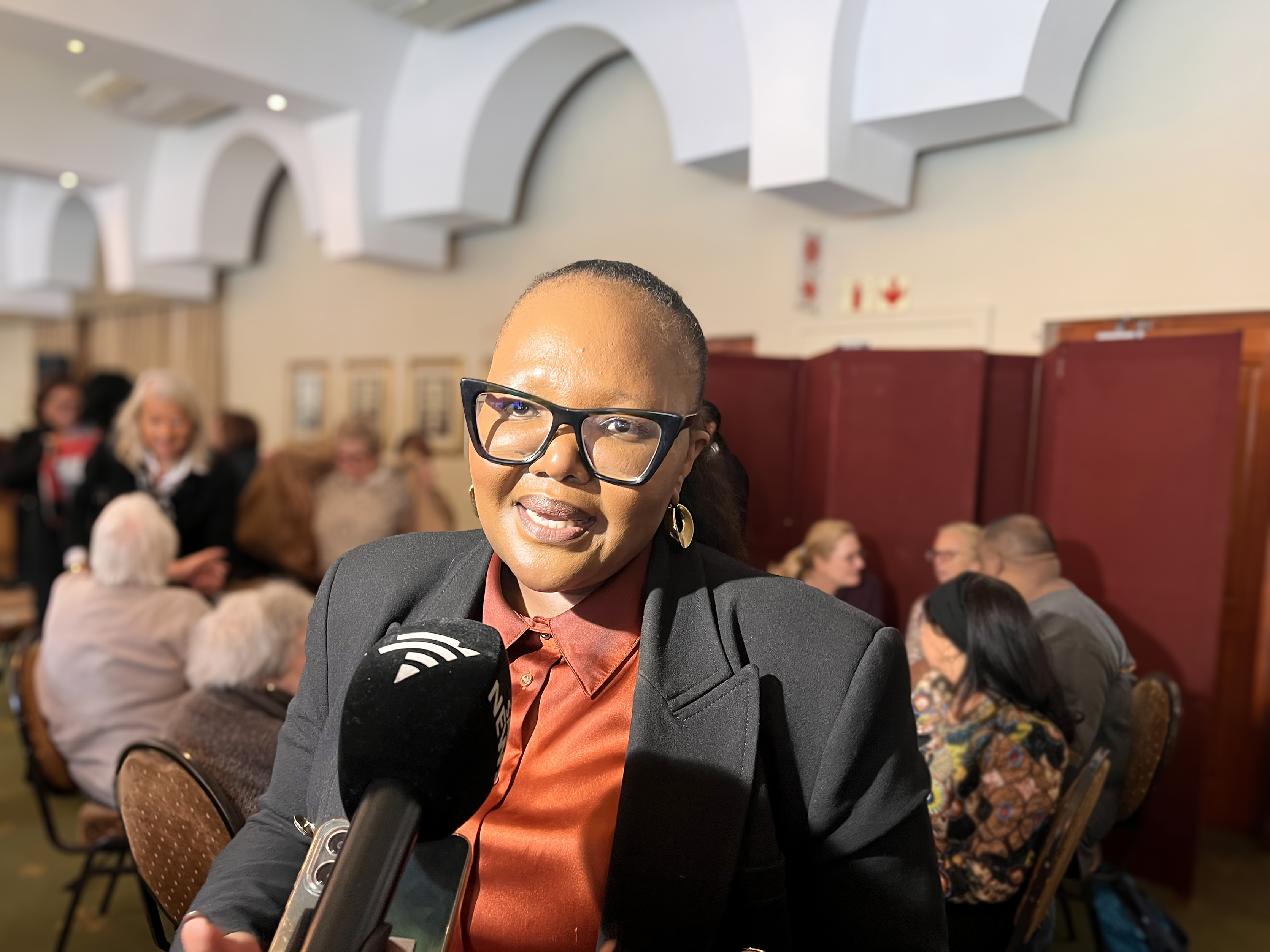
Basic education minister Siviwe Gwarube at the Cape Town Press Club on 14 September 2026. Photo: Velani Ludidi
South African public schools may have to rely on a 15-year-old Foundation Phase textbook catalogue next year, as the rollout of new materials remains frozen.
The new catalogue for grades 1 to 3 includes maths, home language, first additional language and life skills. The textbooks and other learning materials are expected to be based on the latest research to improve literacy, in line with the National Literacy Strategy and Plan 2024–2030. More than 80% of grade 4 learners were found to be unable to read for meaning in any language in the 2021 Progress in International Reading Literacy Study.
But basic education minister Siviwe Gwarube has suspended the new catalogue over concerns about the procurement process. The government is set to spend about R1.6-billion on procuring new Foundation Phase textbooks and support materials from the catalogue, which has been developed by various publishers.
Dr Amy Sarah Padayachee, education lecturer at Cape Peninsula University of Technology, has warned that the suspension could set back South Africa’s push to eradicate illiteracy.
“A learner entering grade 1 in 2027 will complete grade 3 in 2029. In other words, the learners affected by decisions about materials for 2027 are the very cohort that should be demonstrating improved foundational outcomes as South Africa approaches 2030,” Padayachee said.

“Every delay matters when the country has so little time to accelerate improvements in literacy and numeracy,” she said.
The Early Grade Reading Studies by the Department of Basic Education (DBE) found that structured lesson plans, when combined with graded readers, phonics materials, and teacher coaching, led to improved literacy outcomes.
The research also tested reading interventions in African languages, providing evidence for strengthening home-language literacy instruction.
Padayachee said updated materials offered an opportunity to incorporate these research insights, strengthen home-language teaching, and improve the sequencing and practice of foundational skills.
The new catalogue has also integrated coding and robotics concepts such as pattern recognition and basic problem-solving, alongside mathematics in the early grades.
Schools would usually start ordering new books in September for the new year, and anticipated using the new catalogue from 2027; now uncertainty is mounting over whether the new books will be ready in time.
In fact, schools and provincial education departments have been told to use the dated catalogue to top up learning materials. Gwarube told the Cape Town Press Club this week that the new catalogue had not been cancelled.
Gwarube defended her decision to extend the suspension while she awaits legal advice. The catalogue was initially suspended in May, then extended in September, due to governance weaknesses, non-compliance, and potential procurement and financial risks.
Speaking to EdDesk, Gwarube acknowledged this meant falling back on an old catalogue that was about 15 years old.
South African Principals Association (SAPA) president Mashudu Ramulumo warned that learners should not bear the brunt.
“When the elephants are fighting, the grass suffers,” he said. “Let us not involve our learners in this. We are involving them by not giving them what is due to them — books.”
Padayachee said that whether the suspension ultimately disrupts learning will depend heavily on what happens between now and the opening of schools in January. Schools first need to assess which books and materials they have, which are damaged or missing, and what needs replacing. Because schools were expecting a new catalogue, they were not assessing their existing stock.
Provincial departments need to procure and distribute materials early enough for schools to begin the academic year properly resourced.
The impact is unlikely to be uniform. “A well-resourced school may have sufficient readers, textbooks and supplementary materials and experience little disruption. A school already experiencing shortages may be much more dependent on effective top-up procurement,” Padayachee said.
The concern is particularly acute because schools do not have equal access to supplementary resources that would compensate for weaknesses in a dated catalogue. Some provinces, like the Western Cape, and some schools already have extensive reading programmes and additional teaching materials, while others depend primarily on resources procured by provincial departments.
For Padayachee, lawful procurement and classroom delivery must go hand in hand. “The goal should be to resolve the issue as quickly and transparently as possible while ensuring that no learner enters a Foundation Phase classroom in 2027 without the materials required to learn.”
Why the catalogue was suspended
The controversy blew up after media reports cited publishers’ complaints about the bidding process and that one publisher had been unfairly awarded a big chunk of the catalogue.
An independent, still confidential investigation into the development of the new catalogue found that while some reported allegations were not substantiated, and there was no evidence of fraud or evaluation irregularities against the publisher at the centre of the row, there were serious weaknesses in the broader procurement process, according to Gwarube.
According to a News24 report, the majority of publishers were not informed in advance of the department’s weighted pricing formula or ranking methodology, allegedly causing a “massive” imbalance in the bidding process.
The DBE’s model awards the cheapest publisher 37% of sales for a specific textbook. The second cheapest publisher will get 33% of sales, and the third cheapest will get 30% of the total sales for that book.
Publishers have said that had they been informed of these pricing rules or caps during the bidding process, they would have submitted lower bids.
Gwarube said that some suppliers failed to adhere to mandatory supplier-document requirements.
As for who may be implicated, those details are contained in the report, which has not yet been made public but has been shared confidentially with provincial education MECs.
The report also raised potential financial misconduct implications, although Gwarube stressed that this did not constitute a finding of guilt.
An independent senior advocate has now been appointed to advise the minister on lawful next steps.
The controversy triggered a public disagreement between Gwarube and basic education director-general Mathanzima Mweli. Gwarube maintained that the new catalogue should remain suspended while Mweli indicated that the process had received a “green light”. The contradictory positions raised questions about lines of authority and decision-making.
Gwarube this week downplayed suggestions of a breakdown, saying disagreement between political and administrative leadership should not automatically be interpreted as a dysfunctional relationship.

Support independent journalism
Donate using Payfast

Don't miss out on the latest news
We respect your privacy, and promise we won't spam you.
Letters
Dear Editor
The textbook "saga", as it is being referred to, is the ongoing saga of poor planning, decision-making, and governance which has been dragging our country back for far too long.
However, I fail to see how textbooks alone can be blamed for our literacy problems. With such low rates of real literacy - actually understanding what you read rather than sounding out words - it is clear that the issues run far deeper.'
No problem is ever solved by beginning with the last step. The solution has to begin with the first step.
Is it not time we reimagined our entire system of education if we are ever to produce a population properly literate in language, basic arithmetic, and reasoning?
© 2026 GroundUp. This article is published under the GroundUp Republication Licence Version 1.0. Email [email protected] to request permission to republish.