
Raising revenue from alien invasives
A pilot project in the Overberg aims to produce useful agricultural products using cleared invasive plants
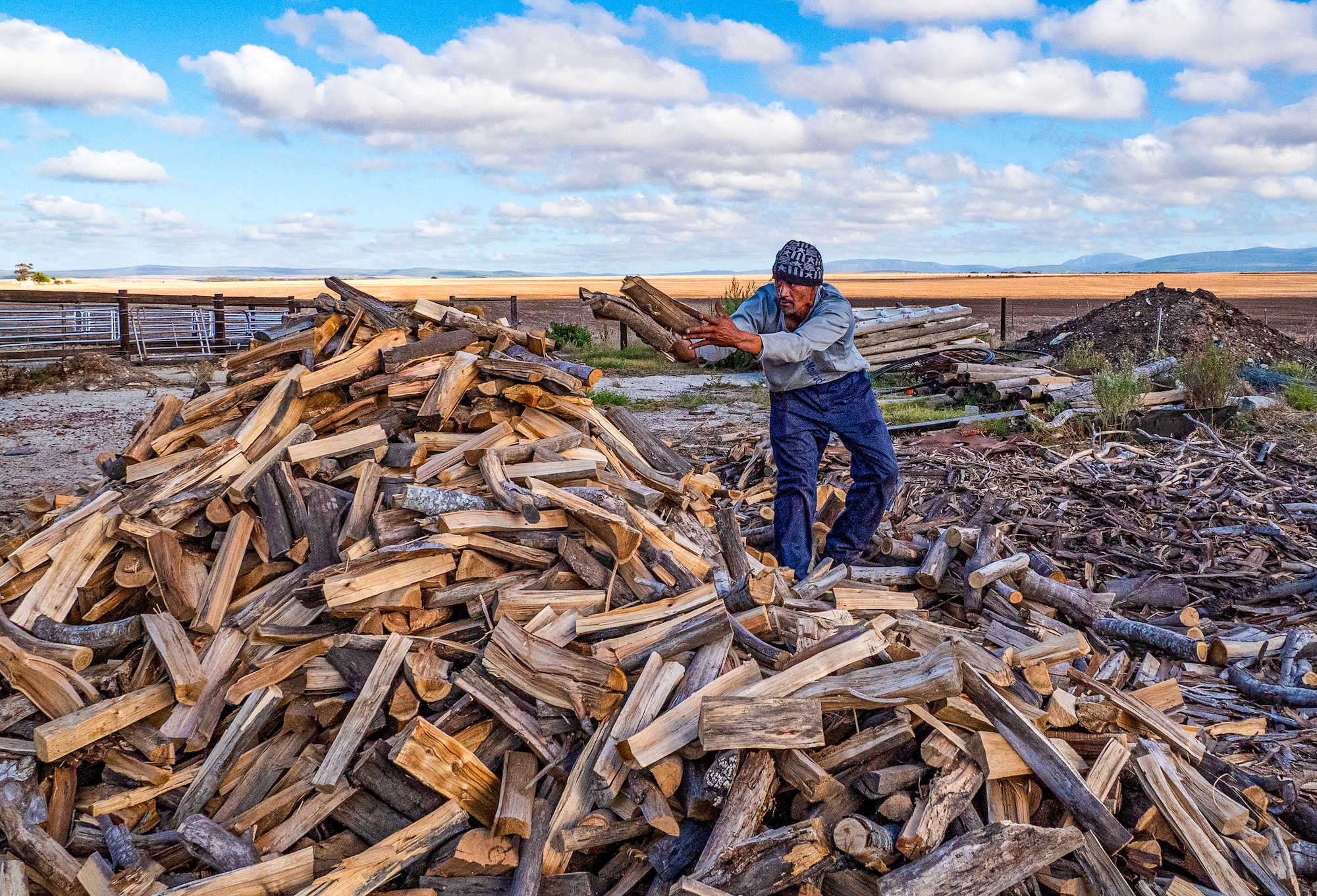
Morné Engel sorts wood from alien invasive Port Jackson willow trees to fuel a pyrolysis machine converting the wood into useful biochar. Photo supplied by NWSMA.
Clearing water-guzzling and soil-damaging alien invasive plants costs South Africa several hundred million rands every year. Now, a promising pilot project to recoup some of this cost by producing useful products from the cleared alien vegetation is underway.
Conservationists are optimistic that a project in the richly biodiverse Agulhas Plain in the Overberg could lead to self-sustaining alien clearing in the long term. It could also create some permanent new job opportunities and provide a blueprint for similar projects in other conservation-worthy regions.
The project is one of several restoration and conservation interventions underway since 2008 in the 47,000-hectare Nuwejaars Wetlands Special Management Area (NWSMA).
Ross Kettles, operations manager of the non-profit Nuwejaars River Nature Reserve, the management structure for NWSMA, says large tracts of the region were effectively “green deserts” – under dense alien plant infestation. But thanks to a major clearing effort, a huge part is now clear of aliens.
However, alien seeds remain viable for many decades, up to 90 years. “So you can clear an area, and do a follow-up, and then another follow-up, and just when you think you’ve got it all under control, you get ideal circumstances [for germination] such as a fire, and then the aliens are all back again, and you’ve got a new carpet to deal with,” says Kettles.
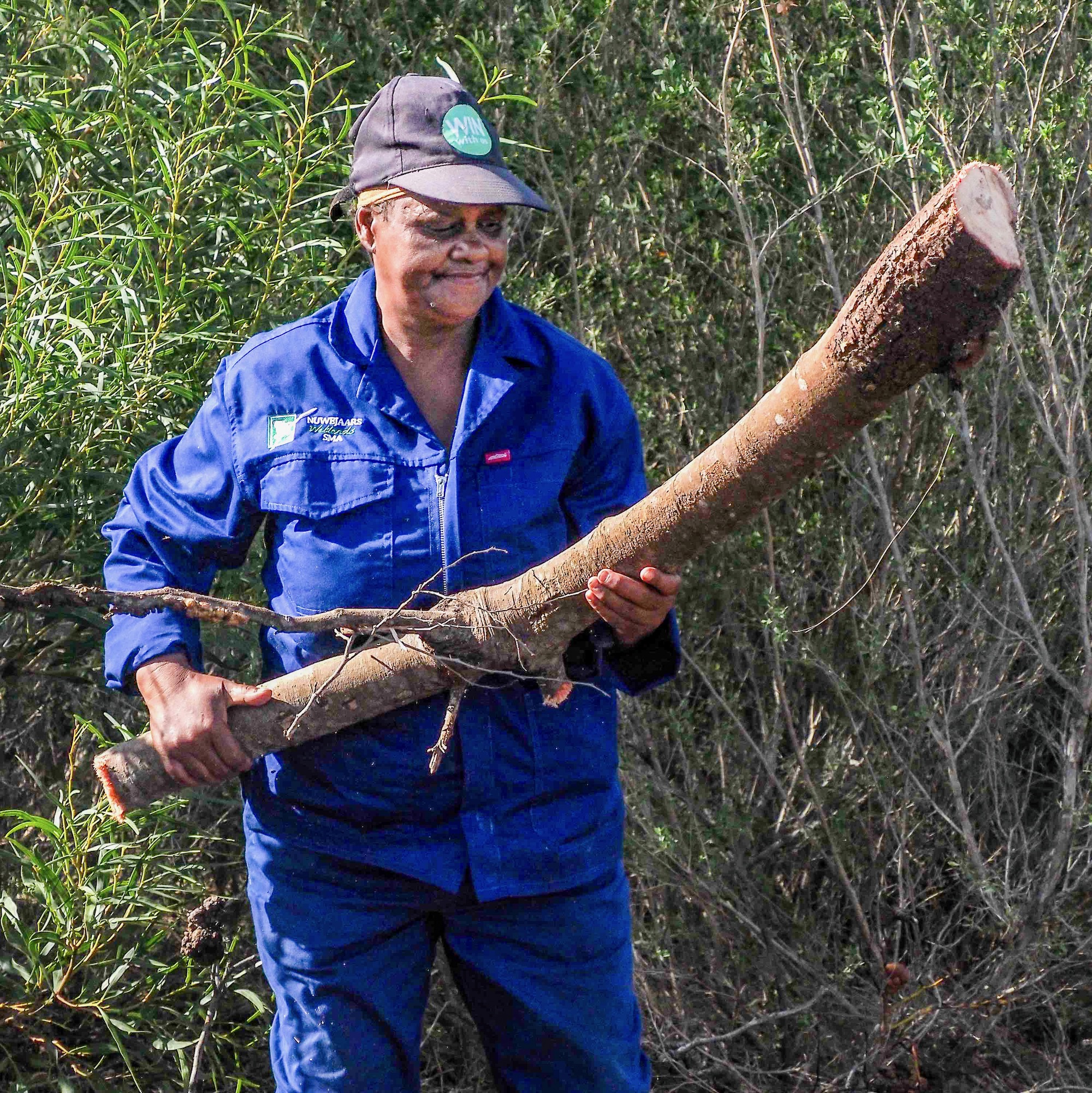
Invasive alien plant clearing team member Paulina Swanepoel at work in the Nuwejaars River wetlands on the Agulhas Plain. Photo supplied by NWSMA.
Alien clearing and restoration efforts will therefore continue long into the future. There has been generous external funding for these operations, but future costs will probably fall on the landowners. Finding additional revenue-generating activities is paramount, says Kettles.
“Securing support and then watching the clock tick towards the conclusion date of any project is immensely stressful, knowing that jobs are on the line and that the work is never done. Accordingly, sustainability has become a core focus of ours.”
“We did a lot of research into the nutrient value of Port Jackson, and we found that the leaves and the pods are actually very nutritious – the protein constituent is about 18%, so it’s not far behind lucerne [at around 22%], for example,” says Kettles.
“Unfortunately, it contains a lot of tannin, and the problem is that as you mill it, it becomes very fibrous and clogs the rollers of the machine.”
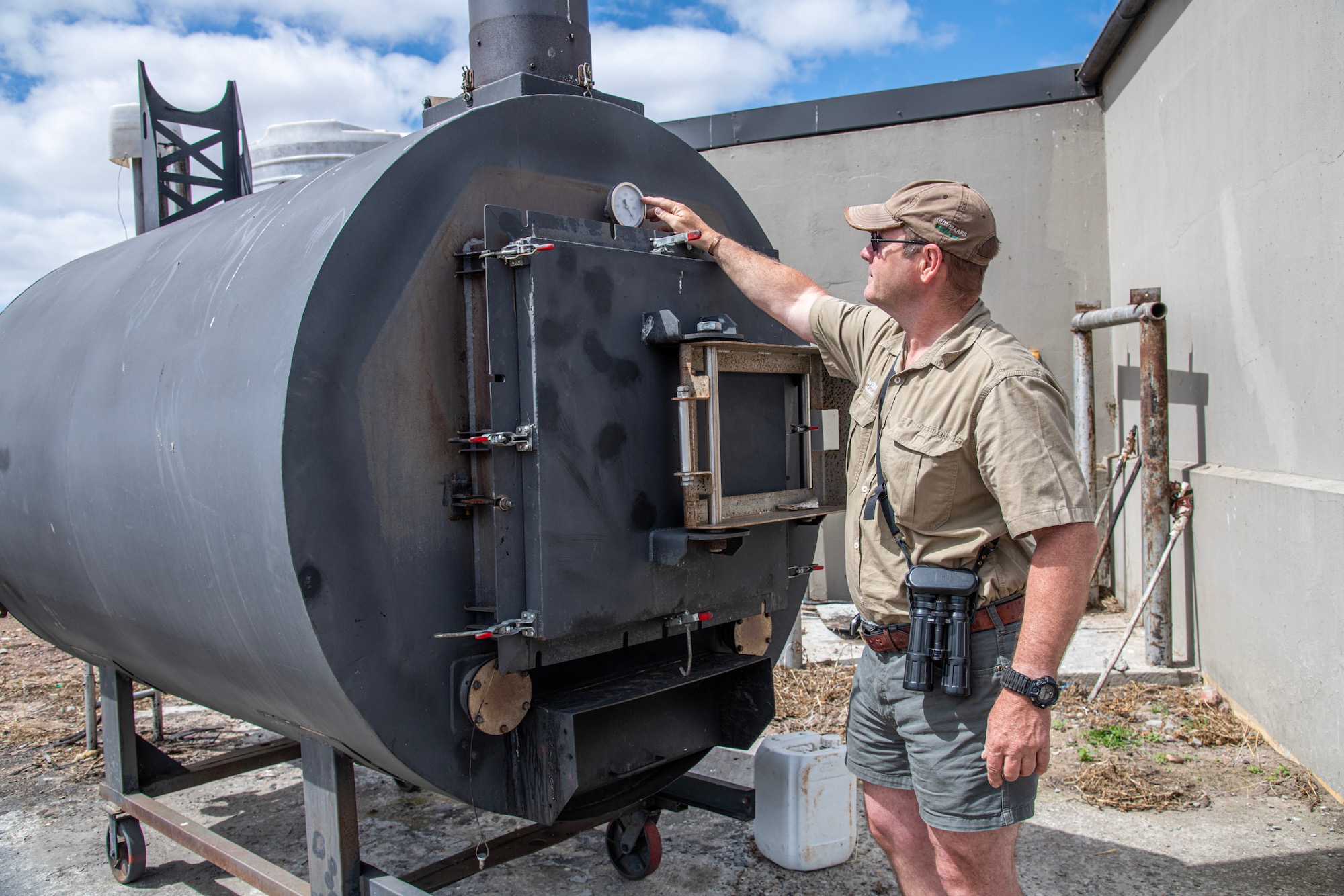
Nuwejaars River Nature Reserve operations manager Ross Kettles with the pyrolysis machine that converts invasive alien plant material into agriculturally useful biochar. Photo: John Yeld.
Kettles and colleagues turned their attention to using Port Jackson willow residue in the production of biochar and animal feed pellets.
Biochar is the solid material obtained from the thermochemical conversion of biomass (wood and plant residue) in a high-temperature, oxygen-limited environment – a process known as pyrolysis. In this case, the biomass would be the huge amount of wood residue produced during the clearing of aliens.
Biochar is somewhat similar to charcoal used for braais, but production is technically more complex, and it’s a much more sophisticated product. It is primarily used to improve soil fertility and agricultural production through its ability to retain moisture and increase beneficial microbial life in soils.
It also promotes the absorption of carbon into the soil, acting as a stable carbon sink and contributing to mitigating global warming.
As animal feed pellets, they are nutritious and can stimulate the production of beneficial gut biota.
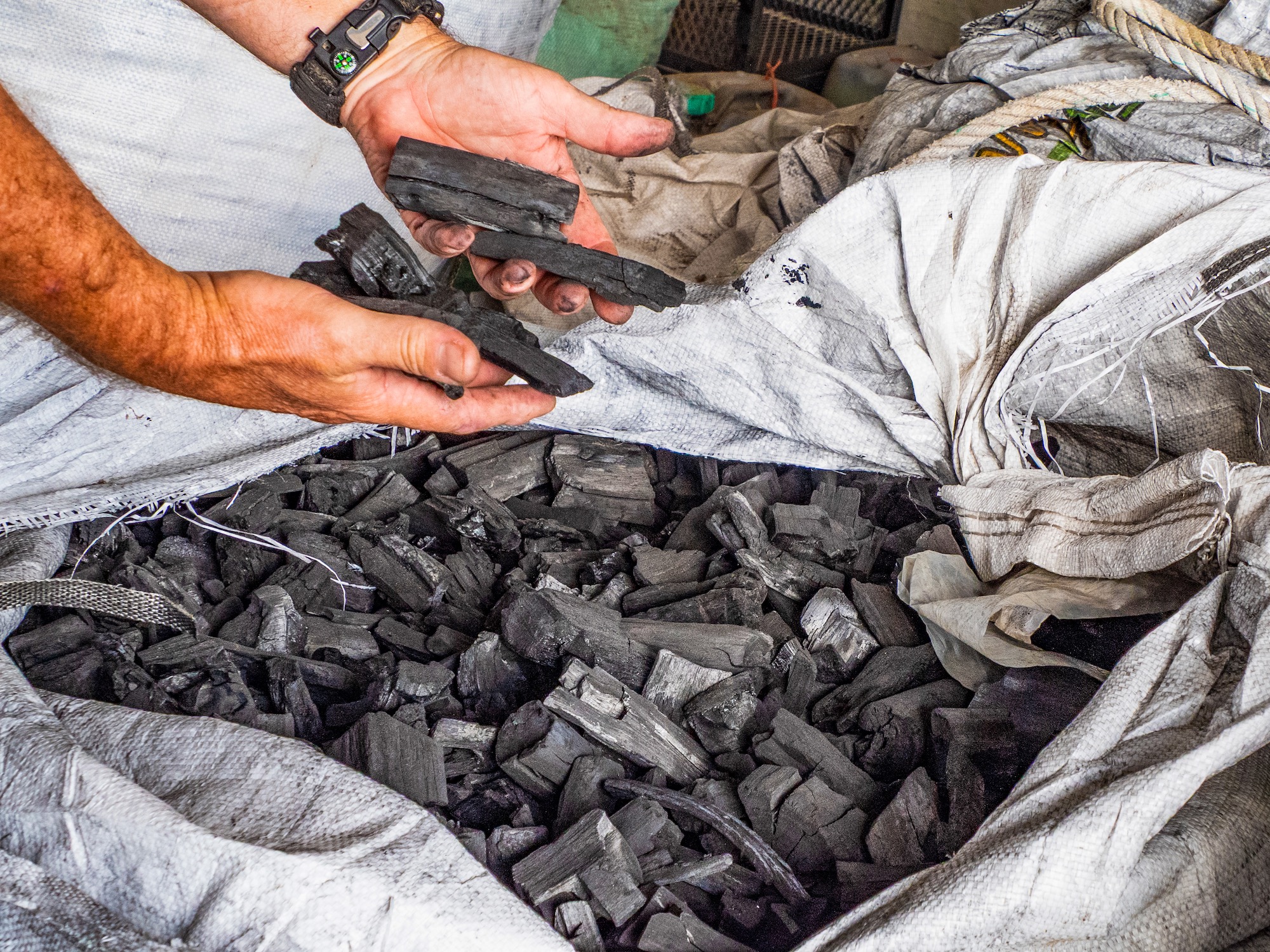
Biochar is used to improve soil fertility and crop production. It is produced by burning invasive alien vegetation in a high-temperature, oxygen-limited environment. Photo supplied by NWSMA.
With donor funding from the German IKI Small Grants Programme, the Nuwejaars conservation team bought a small pyrolysis machine (a biochar reactor) and a new animal feed pelleting plant.
“At the moment we’re selling most of the biochar to just one buyer, just to get the project going so that we can get some cash to pay our electricity account,” says Kettles.
“Our long-term goal is to sell our biochar to local farmers for them to work it into their soil. So we’ll get an income from that, and the farmers will be in a position to apply for carbon credits. Potentially, they’ll be able to get more than half of their costs back.”
“We’ll need to produce a lot of biochar, because farmers use between three and six tons per hectare.”
It is the first biochar plant in South Africa to be registered with Switzerland-based Carbon Standards International.
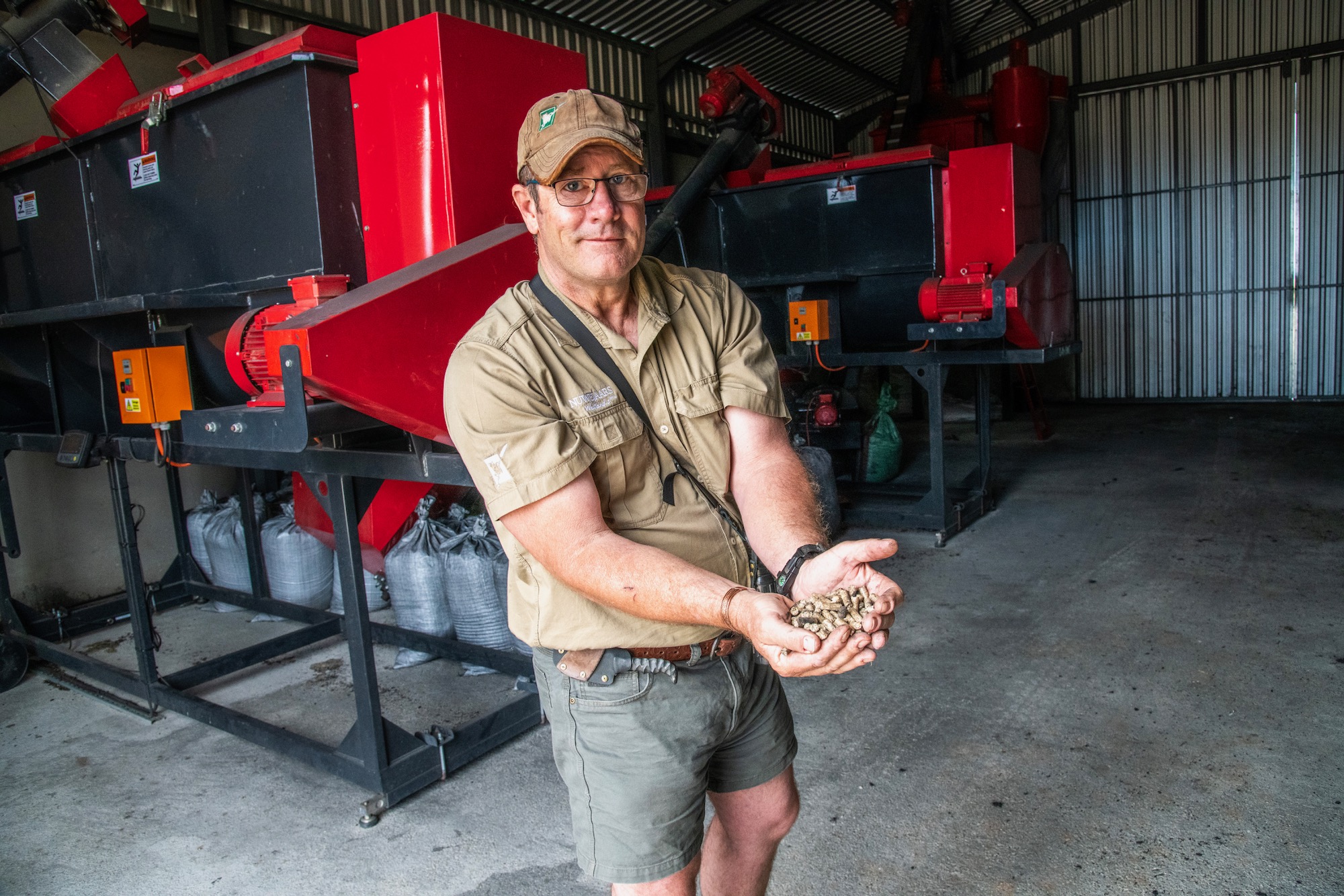
Nuwejaars River Nature Reserve operations manager Ross Kettles shows animal feed pellets derived partly from invasive alien vegetation cleared from wetlands on the Agulhas Plain. Photo: John Yeld
The animal feed pellets are produced with a new pelleting plant manufactured in Bloemfontein.
“We’re approaching farmers and landowners in the area and asking them what kind of animal feed they want. Then we make up specific orders for them,” says Kettles.
“We get the farmers to supply us with the bulk of the raw ingredients for the pellets – mostly lucerne at around 70% – and then mix that with barley and hay before adding molasses and a few other things to raise the energy count.
“And we add our biochar to this mix, although only about one percent. It draws all the harmful bacteria and toxins out of the food, and then the carbon goes back into the soil,” says Kettles.
The income goes straight back to the restoration teams.
“It’s a model for how conservation can sustain itself in the long term. Although we need to scale up to make the project entirely self-sufficient, we believe we’re on the right track. And we want to show that restoration is not only essential for nature but that it can also be smart, circular and financially viable.”
“We’re proud to say that our conservation model is unique, and it remains our dream to come up with a replicable model to encourage the restoration of ecosystems elsewhere.”
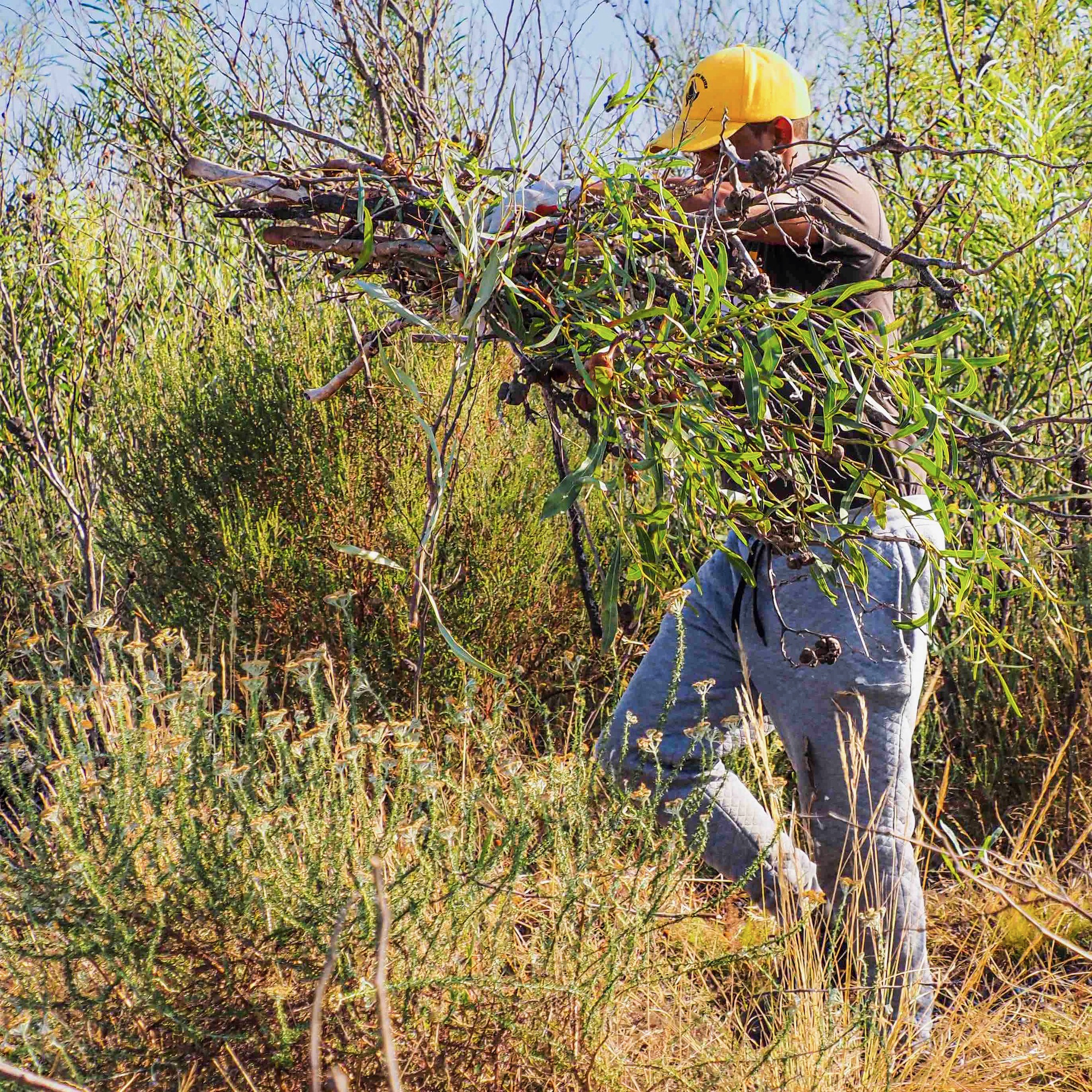
Philip Ross helps clear a dense stand of alien invasive Port Jackson willow trees in the Nuwejaars River wetlands on the Agulhas Plain. Photo supplied by NWSMA.
The IKI Small Grants Programme is part of Germany’s International Climate Initiative, funded by the German Federal Ministry for the Environment, Climate Action, Nature Conservation and Nuclear Safety.
Invasive alien plant clearing in the Nuwejaars Wetlands Special Management Area is supported by donors who include WWF South Africa, the Hans Hoheisen Charitable Trust, the Mapula Trust and the Rolf-Stephan Nussbaum Foundation.
Support independent journalism
Donate using Payfast

Don't miss out on the latest news
We respect your privacy, and promise we won't spam you.
Next: Social housing set to be built at Salt River Market this year
Previous: Patients wait four hours for an ambulance in rural KwaZulu-Natal
Letters
Dear Editor
Thank you for the interesting and informative article. We have a similar project going in Limpopo, except that we use the wood from the alien invasive plants to sell as firewood to local game lodges. However, firewood also produces smoke, which is bad for the environment. Therefore, we have looked at the production of biochar but the carbon emissions produced by the process of making biochar is much more than that of firewood. And then one must take the costs of biochar making into account as well.
How do you manage this scenario sustainably?
© 2025 GroundUp. This article is licensed under a Creative Commons Attribution-NoDerivatives 4.0 International License.
You may republish this article, so long as you credit the authors and GroundUp, and do not change the text. Please include a link back to the original article.
We put an invisible pixel in the article so that we can count traffic to republishers. All analytics tools are solely on our servers. We do not give our logs to any third party. Logs are deleted after two weeks. We do not use any IP address identifying information except to count regional traffic. We are solely interested in counting hits, not tracking users. If you republish, please do not delete the invisible pixel.