
Lesotho village with solar farm has no power
Villagers say they gave up grazing land for solar panels in 2022, but they have not seen any reward
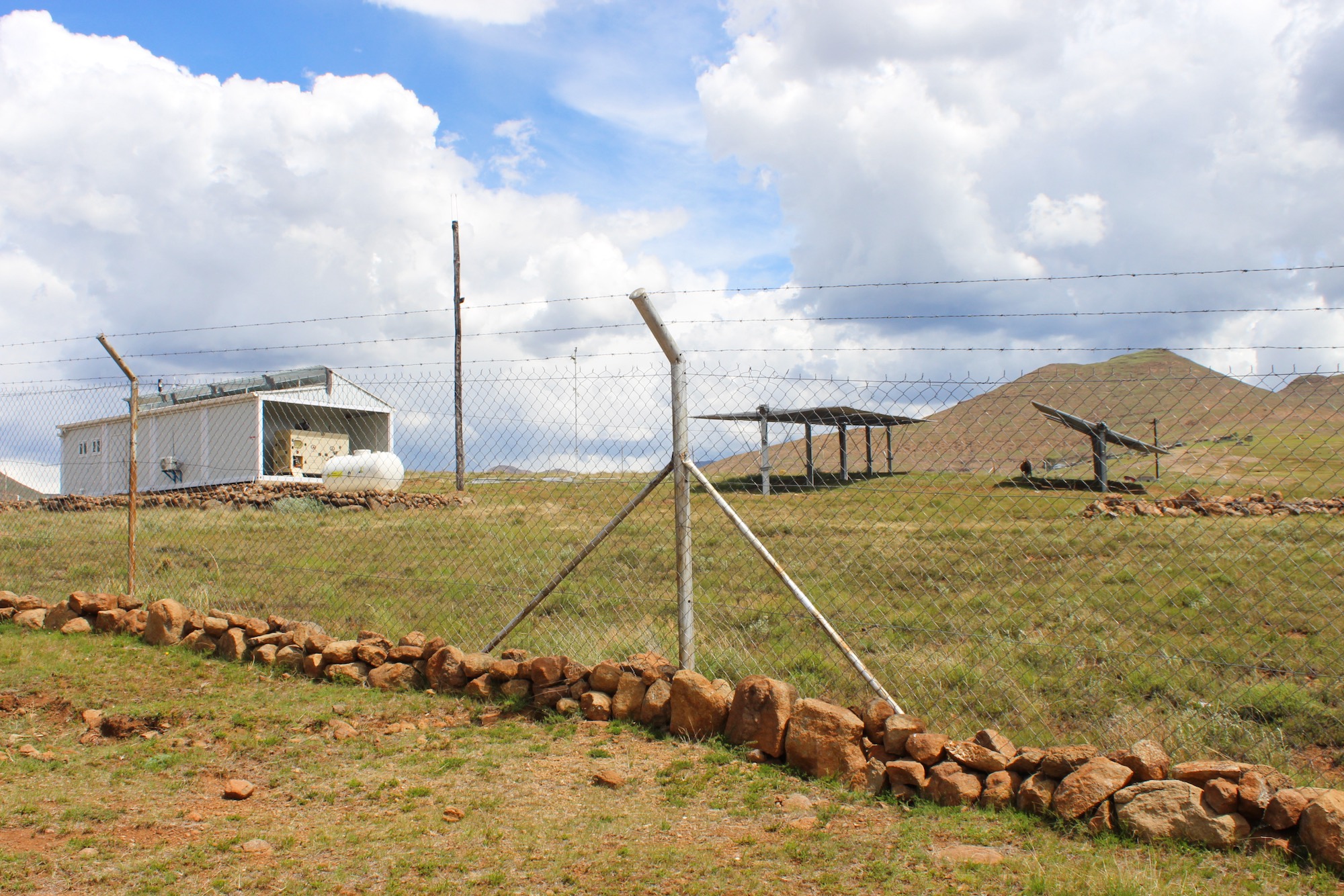
OnePower’s offices at Maphiring village. Photo: Sechaba Mokhethi.
- Maphiring village in Mokhotlong district gave up grazing land in 2022 to allow OnePower Lesotho to install a solar farm and offices.
- But the villagers remain without electricity while the company generates power for neighbouring villages.
- OnePower says the situation is “purely due to a scheduling issue” and is committed to providing the village with power “in due course”.
Seeing a solar farm located next to a village, one would expect the village to have electricity. But not so in Maphiring village in Matsoaing, Mokhotlong district, Lesotho.
Villagers say that, in 2022, they gave up grazing land to allow OnePower Lesotho, founded by American entrepreneur Mathew Orosz, to install a solar farm and set up its project offices.
The community expected electrification in return, but years later are still without power. Meanwhile, the company, which provides solar power to communities not on the national grid, is generating electricity for neighbouring villages.
Maphiring village Chief Ntoetsi Letsie said they were not compensated for the loss of their grazing land. He also complained that village committees from other areas were sent for training around the project, but Maphiring’s committee was excluded.
Resident Maphezulo Motšekalle said that in 2024, they protested by blocking the road to OnePower’s offices with rocks.
“The staff at the site called their Maseru office, and we were told they would come to Maphiring after completing work at Ha Mamolibeli,” she said.
“We kept the road blocked while their vehicles were waiting. We were singing to show our protest. Eventually, they came to speak to us and promised they would return soon to resolve the issue.”
Moeketsi Ramothangoana, chairperson of the village committee that liaises with OnePower and the neighbouring Ha Setefane community, said, “I witnessed the protest myself.”
He said the protesters were addressed by Teboho Makhoalinyane, OnePower operations and maintenance electrician.
Chief Letsie also confirmed the protest.
Tumelo Makhetha, OnePower’s director of operations, initially said he did not know about the protest. “We kindly ask that you fact-check this statement,” he said.
On follow-up questions, Makhetha said the community had paid a visit to the office. “The meeting was requested by the Maphiring community to deliver their grievance to us.”
He said the company could only supply electricity to communities listed in its concession agreement with the Department of Energy, and “Maphiring was not included in our concession contract for Matsoaing [by the department]”.
However, Makhetha said, the Maphiring community had subsequently completed the prescribed steps to be included.
“The matter was resolved in collaboration with our stakeholders – the Department of Energy, Menoaneng Community Council and Mokhotlong District Council. The reason Maphiring has not yet been connected is purely due to a scheduling issue,” Makhetha said.
He said the village would “also be electrified in due course along with the rest of the villages”, but they first needed to complete electrifying Liphakoeng and Ha Mokone. “Following which, the next batch of villages will be electrified”.
Makhetha could not guarantee that Maphiring would soon be electrified, saying that this “will be informed by prevailing operational challenges and opportunities”.
He said the company had faced delays over the past four years due to Covid, offshore material delivery problems, and financial restructuring.
“Despite these challenges, we remain committed to electrifying all villages within our scope in Matsoaing and other concession areas,” he said.
Approximately 1,180 customers have already been connected across Matsoaing and ten other villages.
Makhetha said, “All land allocated to OnePower for generation sites has followed a rigorous and transparent application process”, which involved local chiefs, community councils and the communities.
He said the land was allocated “without any compensation required”, because “our application was for land that does not require any compensation”. Makhetha said the company understood that mitigation for affected land users was addressed by the council, village chief and community.
However, human rights lawyer Lepeli Moeketsi said the assertion that the land “does not require any compensation” is alarming.
“Invoking normal procedures without demonstrating meaningful consultation, impact assessment, or rights‑based decision-making is not acceptable. Land is not an administrative abstraction; it is the foundation of livelihood security, cultural identity, and community resilience,” Moeketsi said.
Support independent journalism
Donate using Payfast

Don't miss out on the latest news
We respect your privacy, and promise we won't spam you.
Next: Human Rights Commission visits school where learners use playground as a loo
Previous: Unemployed teachers camp outside KZN education department
© 2026 GroundUp. This article is licensed under a Creative Commons Attribution-NoDerivatives 4.0 International License.
You may republish this article, so long as you credit the authors and GroundUp, and do not change the text. Please include a link back to the original article.
We put an invisible pixel in the article so that we can count traffic to republishers. All analytics tools are solely on our servers. We do not give our logs to any third party. Logs are deleted after two weeks. We do not use any IP address identifying information except to count regional traffic. We are solely interested in counting hits, not tracking users. If you republish, please do not delete the invisible pixel.