
Langeberg water restrictions caused by lack of planning
Summer water restrictions in Robertson and surrounding towns are not due to a lack of water
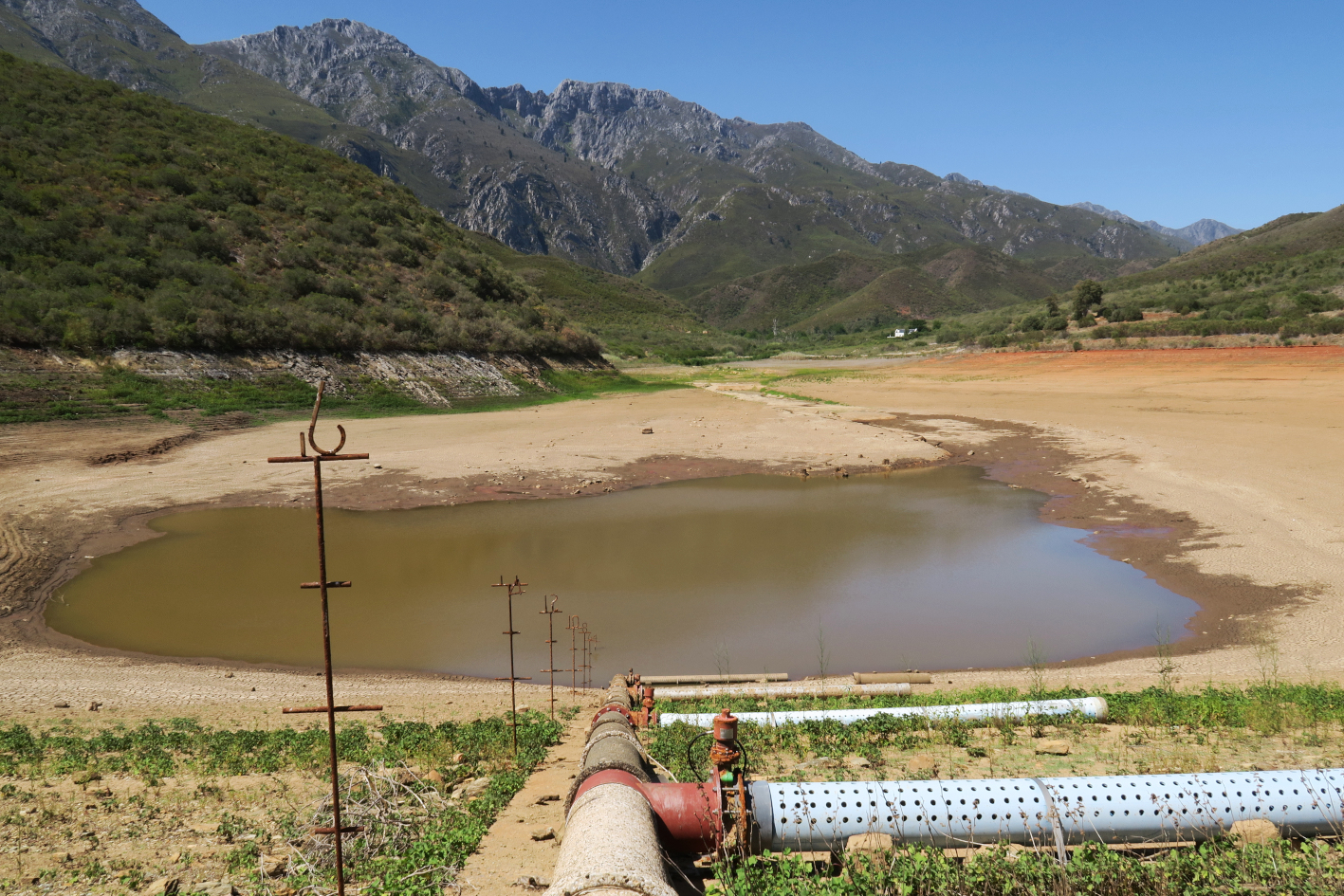
Dassieshoek Dam is one of two small dams on the mountain slopes which are supposed to hold water in reserve for Robertson during the summer months. It was little more than a puddle in January this year, partly because it had been used to supply the town for seven weeks from July to September during extended maintenance of the canal that feeds bulk water to Robertson from the Breede River. This annual maintenance normally takes three weeks. Photos: Steve Kretzmann
- Before unseasonal rain last week, the Langeberg municipality had tightened water restrictions to level 2, which were eased last week after thundershowers drenched the Breede Valley.
- Level 1 restrictions remain, and they were also implemented at the end of last summer.
- But reports from 2014 warned the municipality was facing water supply shortages if it did not put measures in place to increase its water allocations and storage capacity.
Langeberg joins several Western Cape municipalities which say they are suffering water shortages. But as with Knysna and Swellendam, the purported water shortage may be largely self-created.
Before unseasonal rainfall last week, the Langeberg municipality had tightened water restrictions to level 2. For water use exceeding 15 kilolitres (kl) per month, residents faced a 100% increase in water tariffs, with a 20% increase applied to businesses.
The level 2 water restrictions took effect on 1 February, just as the wine growing area, which includes Robertson, Bonnievale, Ashton, McGregor, and Montagu, entered its harvest and wine-making period. This is when the multi-billion rand industry is most in need of potable water.
Restrictions were eased on 9 February after thundershowers drenched the Breede Valley. Level 1 restrictions, introduced in November, remain. They were also implemented at the end of last summer. Under level 1, business water tariff hikes are 10% above standard prices.
When implementing the level 2 restrictions, the municipality said the decision was due to “exceptionally low rainfall, increasing water use, high temperatures and the ongoing impacts of climate change”, which have led to “critically low” dam levels.
But, although rainfall recorded in the area during 2025 was less than half the annual average, there is enough bulk water in the Breede River to supply the Langeberg municipality’s three towns in the valley – Robertson, Bonnievale and Ashton – with their needs.
By late January, the Brandvlei dam, from which water is released into the Breede River, was around half-full, which is considered normal for this time of year.
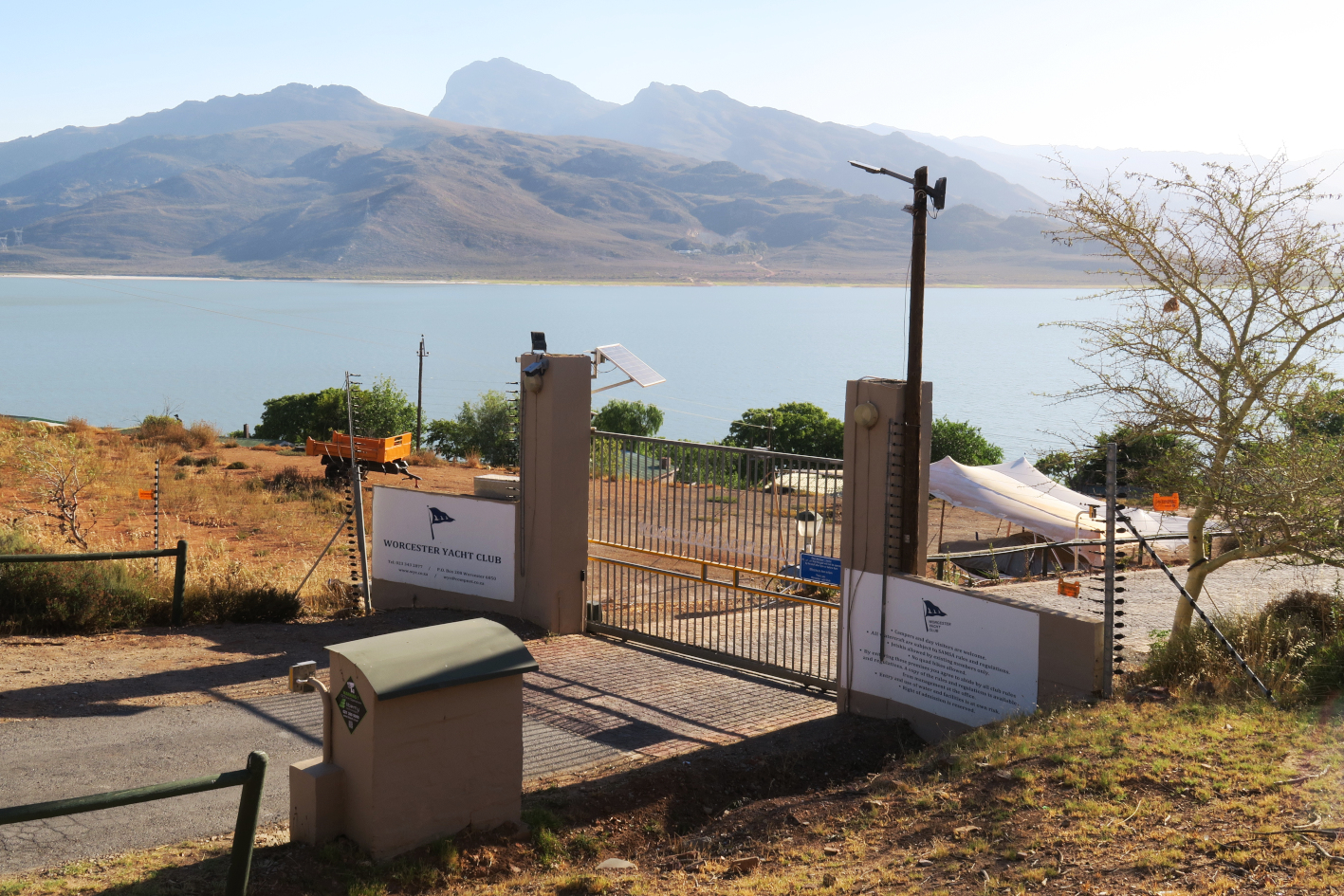
Four of Langeberg municipality’s five towns are supplied with water from the Breede River, which is fed by the Brandvlei Dam. By late January, the dam was around half-full, which is considered normal for this time of year.
Current flow rates indicate there is enough bulk water in the Breede for these towns, according to data provided by the Department of Water and Sanitation (DWS). On 23 January, the flow rate above the Robertson canal was more than 570,000Kl per day – enough to supply the daily needs of Robertson, Bonnievale, Ashton, and farm irrigation.
Head of the Central Breede Water Users’ Association, Louis Bruwer, says the municipality’s current water shortages are a result of a lack of infrastructure development and maintenance over the past 15 years, rather than a water source shortage.
Reports from 2014 warned the municipality was facing water supply shortages if it did not put measures in place to increase its water allocations and storage capacity.
The municipality’s head of engineering, Deon Louwrens, stated in council on 23 January, when the level 2 restrictions were tabled, that Robertson’s capacity to purify available bulk water was “insufficient”. Louwrens’s explanation makes it clear this was not due to low rainfall or lack of bulk water.
Robertson
According to municipal manager Danie Lubbe, Robertson was using about 11,000Kl of water per day, which necessitated the need for increased restrictions.
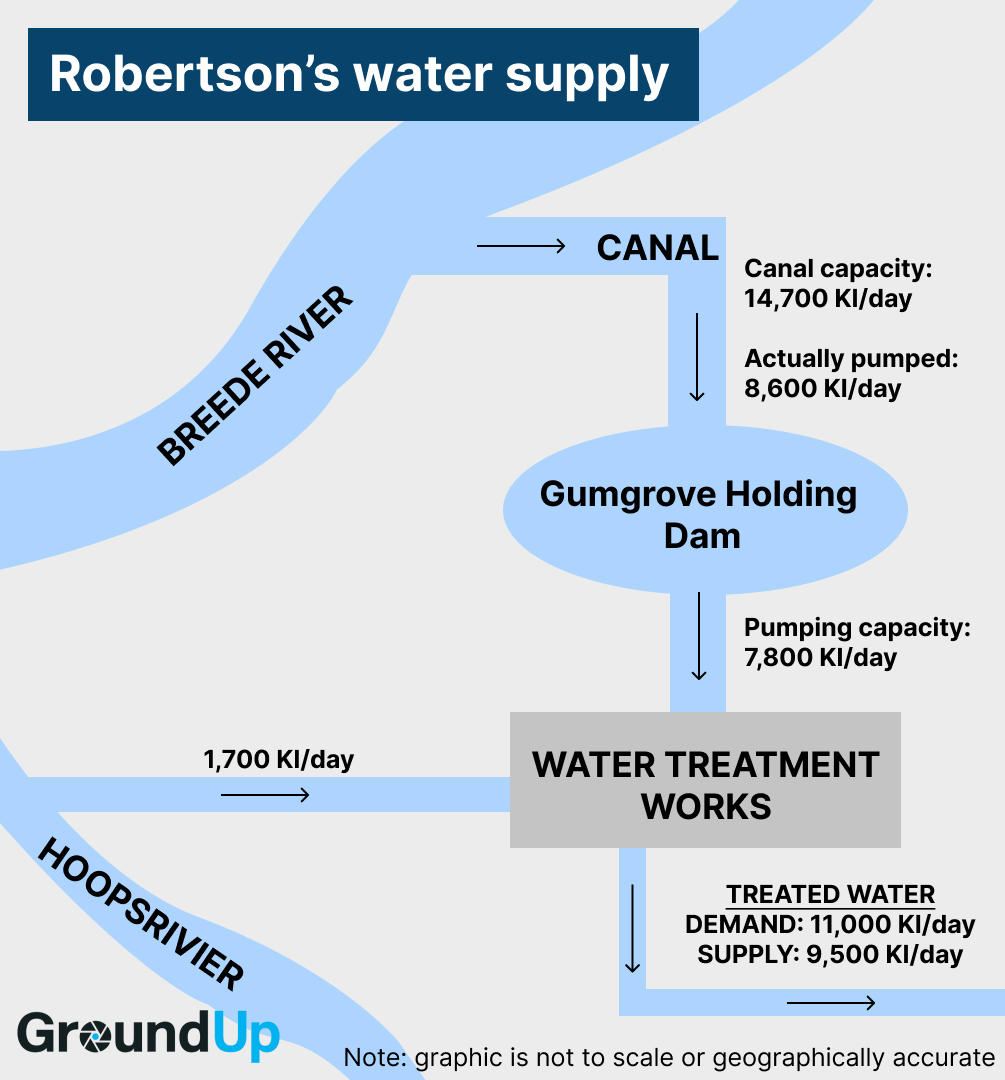
Robertson’s main water source is the Breede River, from which water is pumped via a canal to the Gumgrove holding dam. The canal could deliver almost 14,700Kl a day, according to Louwrens.
But the municipality was only able to pump 8,600Kl/day through the canal to the dam. And from the dam, it only had the capacity to pump 7,800Kl/day to the WTW.
Robertson also gets water from the Hoopsrivier, which flows down the Langeberg mountains year-round and from which water is gravity-fed directly to the WTW. Louwrens said 1,700Kl/day was flowing in the Hoopsriver pipeline to the WTW.
This added up to 9,500Kl per day going to the WTW, leaving the municipality about 1,700Kl per day short of demand.
Robertson also gets water from two relatively small dams in the mountains – the Dassieshoek and Koos Kok dams. These dams fill up in winter, but the mountain streams that feed them dry up in summer. They are supposed to hold water in reserve for the dry summer months. Both were almost empty when GroundUp viewed them on 23 January, partly because they were used as a water supply for an extended maintenance period of seven weeks from July to September.
Bonnievale
Bonnievale receives its water from another canal fed from the Breede River. The canal is also used to supply irrigation water to farms.
Bonnievale has an allocation of 1,245-million Kl per year (average 3,458Kl per day). About 60% of this is used by industry, there being two cheese factories in the town dependent on this supply.
But last year, Bonnievale took 2,196-million Kl from the canal, nearing double its annual quota. It has been exceeding its allocation since at least 2013, when this was highlighted by a DWS report published in 2014.
The reports – Development of Reconciliation Strategies for the Langeberg towns – recommended that the municipality investigate obtaining a larger water allocation from the canal scheme.
But Lubbe said no increase in abstraction allocations from Brandvlei or the Breede River has been obtained since 2014. He said the municipality was currently “in process” of applying for greater allocations from the Brandvlei Dam.
According to the 2014 DWS report, Bonnievale’s WTW has a design capacity of 3,040 Kl per day and, at that stage, was running at 151% over capacity.
According to Lubbe, the WTW has not been upgraded in the interim. According to his figures, peak monthly demand in summer is around 6,420Kl. The WTW is therefore now running at more than double its designed capacity. Lubbe said an upgrade to the WTW is planned within the next three years.
Ashton
Ashton has an annual water allocation from the Brandvlei/Breede scheme amounting to an average of 6,750Kl per day. It used an average of 5,590Kl per day last year, according to the municipal manager, but in peak summer months this rose to around 8,500Kl per day.
With sufficient bulk water, this points to a storage challenge, in which excess water during winter could be held for summer demand. The DWS report of 2014 states that “the summer shortfall (or a portion thereof) cannot be balanced within the internal reticulation storage. This needs immediate attention by supplying additional storage capacity.”
The water reticulation system (pipes, valves, reservoirs etc.) was partly rehabilitated and upgraded in 2015 and 2021, according to Lubbe, but no additional storage capacity has been built in the intervening 12 years, and no plan is in place over the next three years.
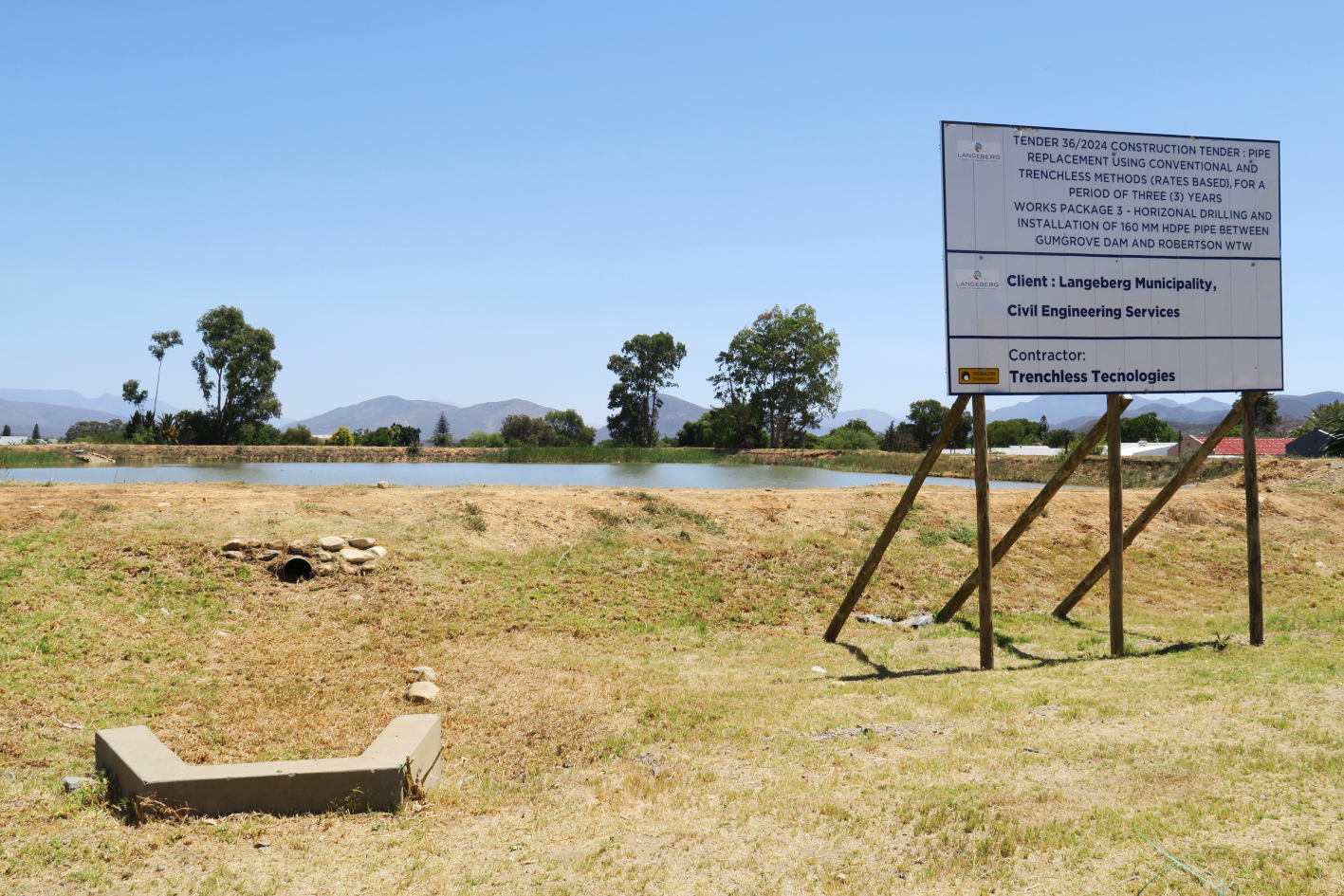
This small dam below the water treatment works in Robertson holds water pumped from the Breede River canal, but the infrastructure from the dam to the treatment plant is insufficient to supply enough raw water to be treated to meet the town’s water demand during summer.
Montagu and McGregor
Although the Langeberg mountain range lies between Montagu and the Breede River valley, almost half Montagu’s annual water allocation of 1,732-million Kl per year is pumped from the Breede. The rest is from seasonal streams running off the leeward side of the mountains.
In 2025, the town was within its average daily allocation of 4,745Kl per day, even during peak summer months.
However, the DWS 2014 report warned the municipality to apply for additional abstraction from the Breede. This has not been done.
The report also recommended that the use of groundwater (boreholes) should be investigated.
McGregor is supplied by good quality water from the Houtbaais River, which is dammed above the town, and is the most water secure of them all. The DWS report states its water supply “will meet the future water requirements” past 2040.
The question of leiwater
Robertson has a system of gravity-fed canals feeding raw (non-potable) water through the town, known as a leiwater system.
Residents pay for an allocation they can tap off by opening a sluice gate to irrigate their garden. Some residents build a large pond or reservoir to store the water for irrigation.
Under the level 1 water restrictions, leiwater was restricted to once a fortnight, but was terminated under level 2. But at the 23 January council meeting, Lubbe announced there was enough water for one more “slot” of leiwater, which would be released the following week. He said this was so that “people don’t use purified water to water their gardens”.
This led the FF+ PR councillor Johnny Steenkamp to state: “The fact that leiwater allocations have been reinstituted for a week indicates there is enough water available. It is clearly not effectively pumped to residents.”
“Even in areas such as Ashton and Montagu, which are not experiencing any [raw] water shortages, the same water restrictions are being applied.”
Lubbe published an online response, saying the temporary reinstatement of leiwater was “a short-term measure to relieve agricultural pressure and reduce the use of potable water for watering gardens, not proof of surplus water.”
Bruwer notes that the leiwater system is “low energy”, as it uses gravity, and the water has not had to go through a purification process.
“Experience has shown that as soon as the system is curtailed, there is a huge increase in the consumption of purified water. Users are obviously not prepared to sacrifice their gardens because of a shortage of water, especially if the shortage is perceived by the public to be the result of poor management.”
Support independent journalism
Donate using Payfast

Don't miss out on the latest news
We respect your privacy, and promise we won't spam you.
Letters
Dear Editor
Thanks for the excellent backfeed. It is a fact that the infrastructure in Robertson is poor. The terrible leakage near 4 Cousins is a sore eye,as well as all the potholes in the roads. We used to have water after 8 pm on Mondays and Thursdays during the level 1 restrictions, because when half of the street is watering their gardens between 6pm and 8 pm, the water pressure is zero minus one.
© 2026 GroundUp. This article is licensed under a Creative Commons Attribution-NoDerivatives 4.0 International License.
You may republish this article, so long as you credit the authors and GroundUp, and do not change the text. Please include a link back to the original article.
We put an invisible pixel in the article so that we can count traffic to republishers. All analytics tools are solely on our servers. We do not give our logs to any third party. Logs are deleted after two weeks. We do not use any IP address identifying information except to count regional traffic. We are solely interested in counting hits, not tracking users. If you republish, please do not delete the invisible pixel.