
Hundreds protest in Gauteng over government funding mess
NGOs call for an end to delayed payments, an overhaul of the payment process and transparency
 Add GroundUp on Google
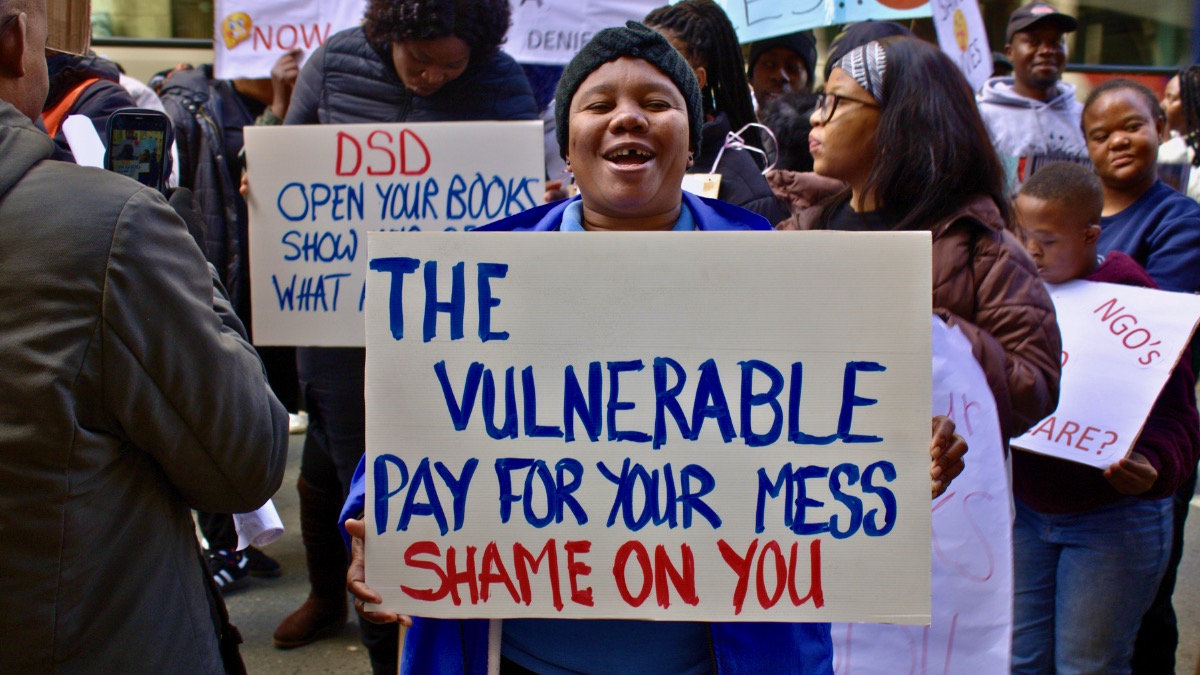
Non-profit organisations protested outside the Gauteng Department of Social Development in Marshalltown, Johannesburg, on Friday. Photo: Seth Thorne.
- Hundreds of Gauteng non-profit organisation workers protested outside the provincial Department of Social Development in Johannesburg on Friday, demanding payment of outstanding subsidies by the end of May.
- They also called for an overhaul of the contracting process, which they say has left vulnerable communities at risk.
- The department says R320-million has been disbursed to 872 organisations and that payments depend on organisations signing agreements. But the NPOs say it is the department that fails to sign.
Hundreds of people from Gauteng non-profit organisations gathered outside the head office of the provincial Department of Social Development (GDSD) in Marshalltown, Johannesburg, on Friday to call for an end to what they describe as years of “funding injustice”.
In a memorandum of demands to department head Phumla Sekhonyane, they called for: the payment of all outstanding subsidies by the end of May; improved pay; a commitment to reform the contracting process; a public status update on the 2026/27 funding process; and a list of all organisations still awaiting decisions.
Under the banner of the Gauteng Care Crisis Committee (GCCC), the protesters say a recurring cycle of late payments and administrative failures has left the province’s most vulnerable communities at risk. This follows years of mounting frustration with the GDSD.

Epworth Children’s Home, People Opposing Women Abuse (POWA), Khulisa Social Solutions, the Gauteng Provincial Association for Persons with Disabilities, Kids Haven, and the Nisaa Institute for Women’s Development were among the organisations that joined the protest.
According to the GCCC, the department has repeatedly breached the 2010 National Association of Welfare Organisations and Non-Governmental Organisations (NAWONGO) court judgment, which legally binds the state to fund organisations serving vulnerable people according to a strict timeline.
“We are tired of being the Gauteng Care Crisis Committee. We don’t want to be in crisis anymore. This should be about care,” said Lisa Vetten, GCCC Chairperson.
“[Non-profit organisations] are supposed to be in partnership with GDSD to render services to the vulnerable, but clearly they don’t see that,” said Kwanele Mbense from the now-closed Daveyton Association for the Physically Disabled.
He said that every year, there are delays and organisations are left in the dark.
“We are tired of being in limbo, we demand answers, our Service Level Agreements to be signed, and commitments answered.”
Fatima Shaik, executive director of POWA, said NPOs are “holding the province together while the system that depends on us slowly starves us to death”.
She lamented consistent funding delays, a lack of communication, staff not receiving salary increases since before Covid, and a mere R66 paid for electricity, among their concerns.
Sam Mokgopha from Kids Haven said they are “tired” of protesting.
“Big department salaries are always paid on time, yet NGOs beg for peanuts,” he said.
We have previously reported on R215-million irregular expenditure at the department and the chaotic start to the 2026 funding cycle.
In December 2025, GroundUp secured a court order compelling the GDSD to disclose details of its grants paid to organisations between 2014 and 2024.
Department response
Flanked by a staff complement and fleet of police officers, Sekhonyane told protesters that when she came into the position last year, she “committed to being accountable”.
“Some of the issues that you are raising here are issues that are unjustifiable,” she said.
She said there would be an overhaul of the payment processes.
To address the flurry of concerns raised by organisations, she agreed to meet with the GCCC next week.
But in a statement this week, the department denied that its “grantor system” was the cause of non-payments, stating that the system has existed for years and was only being enhanced, not replaced.
While acknowledging “initial access difficulties”, the department claimed these were isolated and did not prevent the processing of applications.
But the hundreds of attendees at the protest said this was not the case.
Regarding the status of payments, the department reported that R320-million has already been disbursed to 872 organisations across the province. The department said that payments are dependent on organisations signing and returning their agreements. But organisations say it is the department that fails to sign agreements.
MEC Nomantu Nkomo-Ralehoko said that “measures are in place to ensure that beneficiaries continue to receive services without disruption, while the administrative processes are being finalised”.
We received a response from department spokesperson Motsamai Mothaolwa after publication. He said that the department aims to sign all agreements and pay all organisations by the end of the month.
Support independent journalism
Donate using Payfast

Don't miss out on the latest news
We respect your privacy, and promise we won't spam you.
Next: Limpopo Judge President abused power, committee finds
Previous: Katlehong residents use digger to tear up main road during protest
© 2026 GroundUp. This article is published under the GroundUp Republication Licence Version 1.0. Email [email protected] to request permission to republish.