
Human Rights festival highlights plight of domestic workers
Domestic workers are often underpaid, overworked, given poor accommodation and no benefits
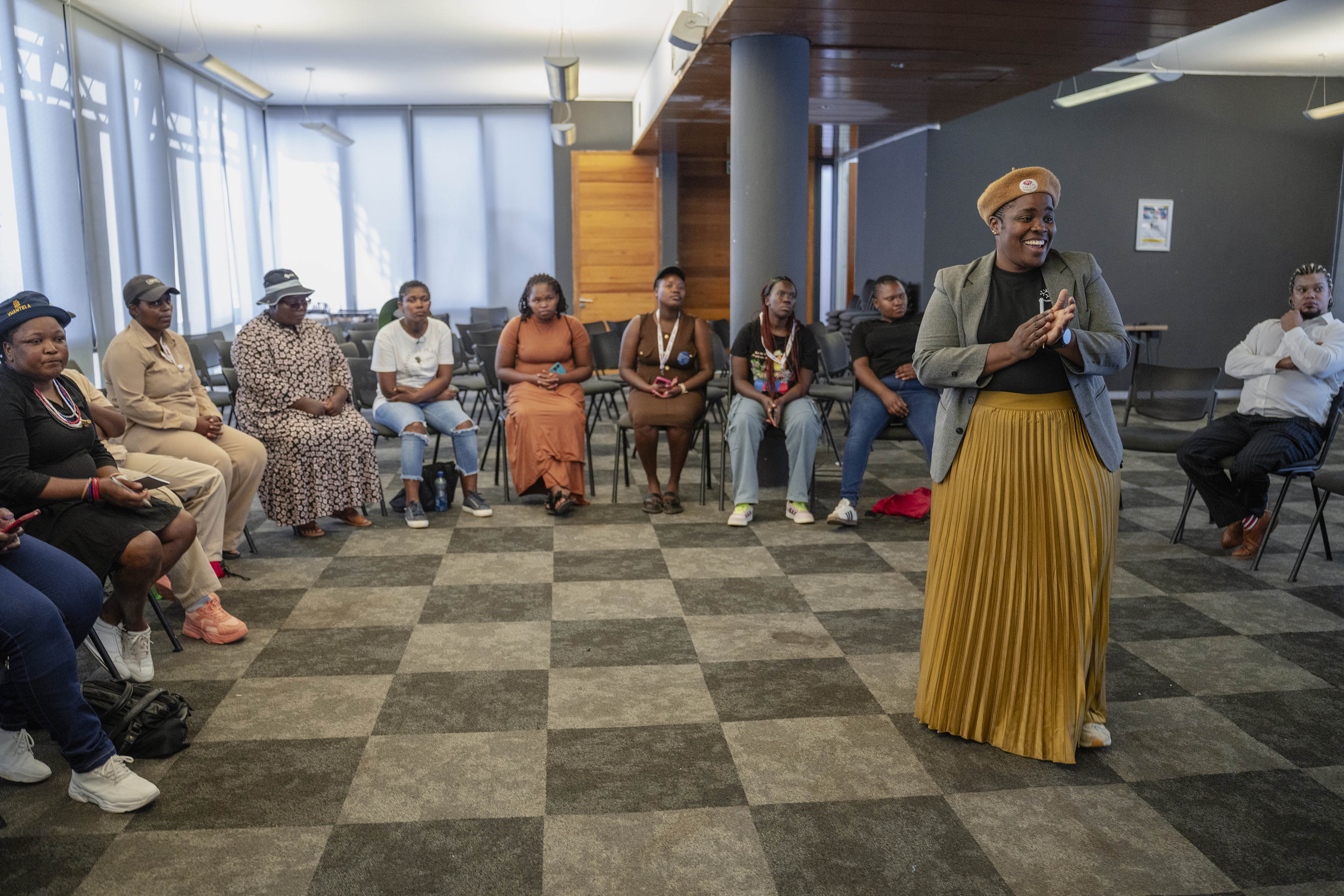
Maggie Mthombeni (right), chairperson of Izwi Domestic Worker Alliance, during the discussion on domestic workers’ rights at a Human Rights Festival at Constitutional Hill, Johannesburg. Photo: Ihsaan Haffejee
“We find that domestic workers are not being paid minimum wage. That they are working overtime without pay and being forced to live in unacceptable standards of accommodation,” says Maggie Mthombeni, chairperson of Izwi Domestic Workers Alliance.
“Unfortunately, there is little to no enforcement of the laws from the Department of Labour,” she says.
In response, the Dignity in Every Home campaign has been launched with a website to provide practical, legal and easy-to-follow guidelines for employers. Topics covered include: Are You a Fair Employer?, Code of Good Conduct for Accommodating Live-In Domestic Workers, and Employing a Domestic Worker – A Legal and Practical Guide.

According to StatsSA there are currently around 850,000 people working as domestic workers in South Africa, down from around one million pre-covid.
“Domestic workers often tell us they cannot take responsibility for enforcing laws or confronting their employers, as they fear losing their jobs,” says Amy Tekie, co-founder of Izwi.
“That is why we are focusing on outreach to employers – raising awareness of their obligations to the people they entrust with the deeply personal and valuable work of caring for their children, the elderly, and their homes,” says Tekie.
Speaking at a recent Human Rights Festival at Constitutional Hill, domestic worker Grace Masuku told the gathering, “My mother worked for the same employer for 35 years and got paid just over R1,000 per month. She hardly had any time to rest, and as children, we didn’t see her much as she was always taking care of other people’s kids. After 35 years, she was just dismissed, no pension, no support, nothing.”
Masuku’s mother worked as a “live-in domestic” and her employer justified her low wages by claiming that she was provided with accommodation and food.
“When you’re living in somebody’s home, then there are a whole new set of issues because often employers think, ‘Oh, she’s living in my home, therefore, I have the right to make rules for her’,” says Tekie.
The Dignity in Every Home campaign is supported by Izwi, the Socio-Economic Rights Institute of South Africa (SERI), the United Domestic Workers of South Africa (UDWOSA) and the South African Domestic Service and Allied Workers Union (SADSAWU).
Support independent journalism
Donate using Payfast

Don't miss out on the latest news
We respect your privacy, and promise we won't spam you.
Next: Documentary reveals SA’s skewed food system
Previous: Pietermaritzburg Master’s office gets mixed reviews
© 2026 GroundUp. This article is licensed under a Creative Commons Attribution-NoDerivatives 4.0 International License.
You may republish this article, so long as you credit the authors and GroundUp, and do not change the text. Please include a link back to the original article.
We put an invisible pixel in the article so that we can count traffic to republishers. All analytics tools are solely on our servers. We do not give our logs to any third party. Logs are deleted after two weeks. We do not use any IP address identifying information except to count regional traffic. We are solely interested in counting hits, not tracking users. If you republish, please do not delete the invisible pixel.