
How foot and mouth disease ran amok
Farmers saw it coming but they couldn’t prevent it
 Add GroundUp on Google

Cows in a meadow on Mearns farm in the KwaZulu-Natal Midlands. All photos (except the trench with sick cows): Ihsaan Haffejee
- We are in the midst of the worst foot and mouth disease epidemic in South Africa’s history.
- The disease has hit cattle farms across the country, making animals sick and causing huge financial losses and emotional distress.
- The epidemic exposes how the South African state has neglected its duties, and how farming communities have come together to fill the gaps.
Workers dig a long, narrow trench. It is summer on Mearns dairy farm, just outside Mooi River in the KwaZulu-Natal Midlands. It is hot and sticky. The men gently usher the cows, single-file, into the hole. Then they shoot and bury them. They believe this is the most humane way to cull these sick animals. Some of the men, experienced farmworkers familiar with animals dying, cry.*
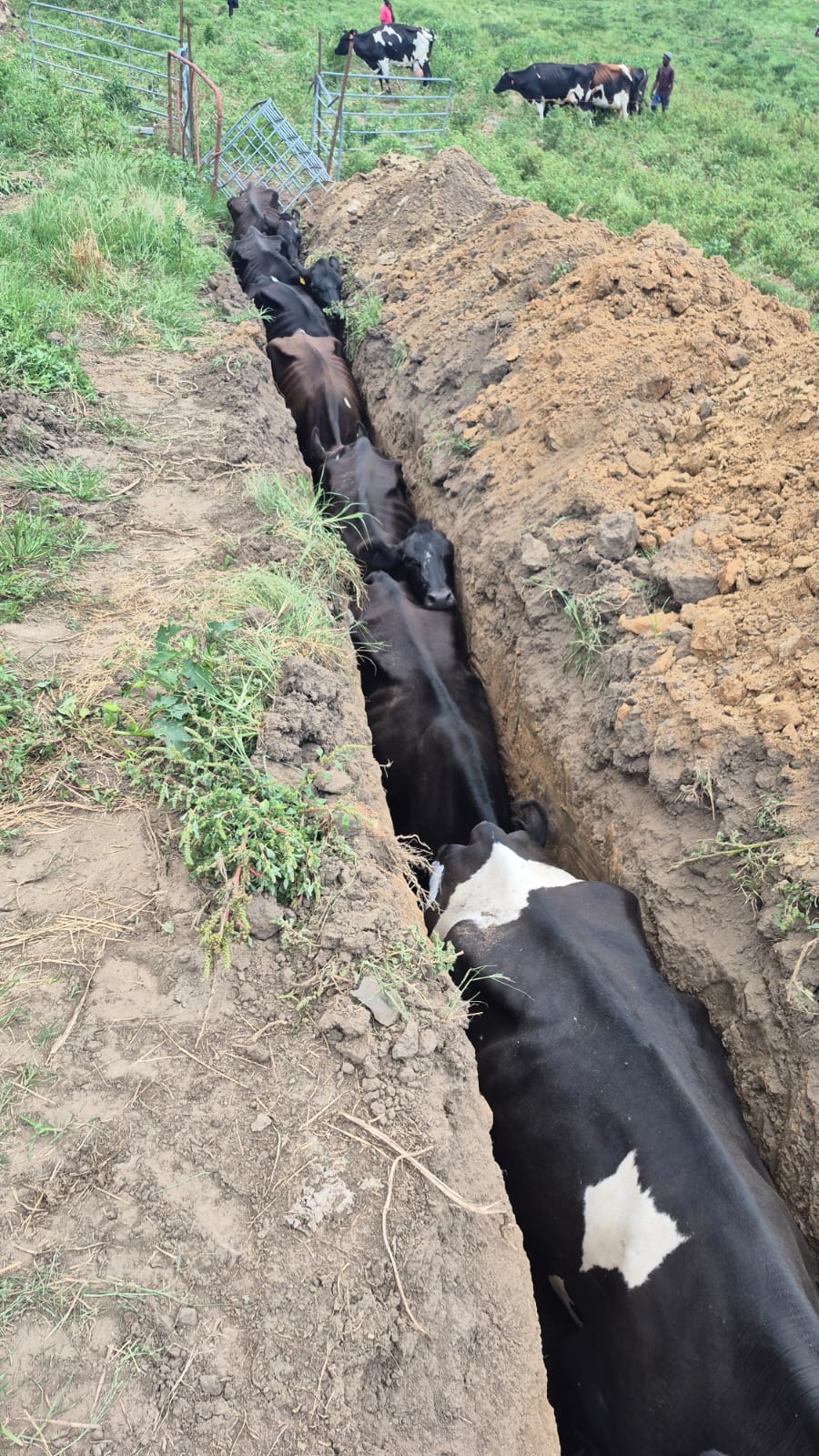
Sick cows are gently ushered into a trench on Mearns farm in February. They are then shot. This, James Kean explained to us, was the most humane way of euthanising them. Many farms across the country had to cull their cattle using similar methods. Photo courtesy of Mearns.
Half a year later, we are on Mearns. The scene is idyllic: a clear August day, rolling green hills, the Drakensberg in the distance, and large numbers of well-fed, healthy cows grazing lazily in groups scattered across the landscape. Other than the occasional skinny-looking cow with scars on its udders, there are few signs left on this or the other farms we visited of the torment this area endured.
James Kean, the farm owner, stands in a meadow, flanked by Sibonele Xaba and Bongani Mkhize, who have worked here for many years.
“We farm grass,” says Kean. “Cows are the machines that turn the grass into milk.”
Kean has a knack for metaphors. He describes how his farm planned meticulously for foot and mouth disease (FMD) like the Springboks prepare for the All Blacks. But sometimes, despite all that planning, the plans don’t work and the All Blacks win. And so it was when FMD hit Mearns on 23 January.
At first it was just one cow with symptoms. For the next two months Kean and his employees, despite their plans, fought what seemed a losing battle. Fifteen-hundred of their sixteen-hundred cattle got infected.
Assigning a start date to the current epidemic is hard. We lost control of FMD in 2019. Official data shows that it abated in 2020, but that may have been because of poor monitoring. From at least mid-2021 the epidemic has been slowly engulfing the country, and it has exploded these past two years.


James Kean, the owner of Mearns farm, flanked by long-time employees Sibonele Xaba and Bongani Mkhize. “We farm grass,” Kean, a dairy farmer, explained to us.
Typically when a cow gets sick from FMD, she gets blisters on her lips and tongue, and her temperature rises. She drools and battles to eat. Blisters spread to her hooves and teats. Her udders can become inflamed – which is called mastitis. Dairy cows need to be milked daily, else pressure builds up causing them severe pain and infection. But milking a cow with mastitis is hard. She is in agony and each infected teat has to be carefully handled. She will probably not want to walk, but if she can’t walk she can’t graze. Instead of eating 15 to 20kg of food a day, she eats about two or three. Her milk production plummets.
All six of Richard de Bufanos’s farms in Gauteng and Free State were hit. He says FMD is the worst disease that can befall a dairy farm. But it’s not only because of the mortality. The percentage of a herd hit by FMD that dies fluctuates from farm to farm. Five percent is the number typically given, but this depends on many variables such as the strain of the virus, medicines used, the health and age of animals before the outbreak, sheer luck, and, most importantly, whether the herd was vaccinated prior to the outbreak. Many of the surviving cows fail to thrive though. They become skinny or the mastitis destroys part of their udders, and they can’t produce enough milk. They get culled.
Du Bufanos and all the farmers we spoke to emphasised that one of the worst aspects of an outbreak is the effect on worker morale.

Brothers Miles and Nick March run dairy farms in the Kamberg Valley. They were hit by FMD. But they did manage to vaccinate their herds shortly before the outbreak and they were not as badly affected as many others. They have thousands of cows, but only about 125 got ill.
Farm workers go through hell. Miles and Nick March’s farm is in the Kamberg valley, about 30km from Mearns. Dairy farming is a non-stop process, every day of the year. Cows are unaware of weekends and holidays. So the farm workers here are on a roster, 8.5 hours a day, seven days a week for three weeks, followed by a week off. But during the outbreak on their farm the workers were going 11.5 hours a day trying to keep things under control. The main problem is that milking takes so much longer when the herd is infected. The cows have to be given medicines, and because they can’t walk, getting them to eat is an extra burden.

Nick March and his Jack Russell, Rex, use a motorbike to navigate their farmlands in the Kamberg Valley. While the scene is idyllic now, an FMD outbreak caused the farms in this area great distress a few months ago.

A cow in the Kamberg Valley. The udders have scars left by FMD. This cow is not thriving and may have to be culled.
De Bufanos explains that you can’t work on a dairy farm if you’re not fond of animals. It’s in the interest of dairy farmers for their animals to live long lives. The farmers grow attached to the cows. This is not merely sentiment; healthy, well-cared for cows produce more milk. Dealing daily, for long hours, with a large number of sick animals is exhausting and traumatic.
While four or five years is a decent age for a dairy cow, some of the cows on the farms we visited were teenagers in good nick and still producing milk. On every farm we visited, the cows appeared to be well looked after and treated respectfully by workers. Watching an entire herd become ill, unable to eat properly, is traumatising, de Bufanos said.
The financial losses to a farm hit by the disease are enormous. Kean told us the outbreak on his farm cost at least R7-million, about R3-million of that on medicines. There are also additional wages to be paid. And while expenses rise, milk production plummets, and so does income.
Moreover, farms with outbreaks had to endure strict and complicated quarantine regulations on the movement of their cattle for about a year. Cattle could only be culled at specialised abattoirs, for example. The regulations, not entirely informed by science, were so severe that they were a disincentive to farmers reporting that they had outbreaks, so new, more sensible ones came into effect in July.


The dairy farms we visited are all pasture-based. Free-range cows graze in large grass meadows. They eat about 15 to 20kg in dry-weight of food daily, and make roughly the equivalent amount of milk in litres.
It’s important to understand that the FMD virus is not a threat to humans. It does not make us or our pets sick. It only affects cloven-hoofed animals - mainly cows, sheep and pigs. You can eat meat from infected animals and drink their milk (which will be pasteurised by the time you drink it). If a sick cow is being treated with certain medicines, the milk will be discarded. The reason that there are quarantines of FMD-infected farms and export bans on countries with FMD outbreaks is that the disease spreads rapidly and easily. Countries that are FMD-free do not want the slightest risk of the disease spreading through their farms.

Signs warning against unauthorised transporting of livestock, because of the FMD epidemic, are at the entrances to some of the valleys in the Midlands. But this is hard to enforce.
South Africa is experiencing its worst ever FMD epidemic. Scientists, vets and farmers we spoke to suspect the virus is more virulent and contagious than previously. Every province and thousands of farms have been hit. We have faced export bans on our cattle industry. Dairy farms lost over R1-billion between January 2024 and January 2026, a staggering amount for an industry that has a gross production value of about R22-billion a year. And the epidemic escalated after January.
“Many dairy farms might opt to close down, which will lead to major job losses in rural areas,” says a report by the Bureau for Food and Agricultural Policy, an independent South African research organisation. Losses in the much bigger beef industry are estimated to be even larger, though proportionately the dairy industry is worse-affected.
It could all have been prevented. South Africa once had an effective animal biosafety monitoring system, with its centre at the Agricultural Research Council at the Onderstepoort Veterinary Research Campus. How FMD ran out of control is a story of massive state failure, decades in the making. Monitoring of the disease, control of cattle movements and vaccination systems broke. (We’ll describe this in coming weeks.)
But this is also a tale of cautious optimism. Every one of the farmers we spoke to is hopeful and believes that in only the last few weeks the Department of Agriculture, under a new minister, has started moving in the right direction.
It is those farmers themselves who constitute the most uplifting aspect of this story. Across the country dairy and beef farmers took matters into their own hands. They worked with their communities to reduce the spread of the disease. They went to court to fight for vaccination and won. By now, most of the country’s dairy cows have probably been vaccinated, many by the farmers themselves.
But this is just the beginning; the country’s cattle stock need to be vaccinated twice a year. Vaccination is the most critical way to get FMD under control - this time and for the future. This is the view of every farmer and scientist we’ve spoken to.

Andrew Morphew on Colbourne farm in the Karkloof valley. He sends certified organic milk to Fairfield Dairy which supplies Woolworths. Morphew has been at the forefront of calls for all cattle in the country to be vaccinated against FMD twice-yearly in the same 30 to 60-day period. This will reduce the amount of circulating virus and hopefully bring the epidemic under control.
Andrew Morphew runs Colbourne dairy farm in the Karkloof valley. If you’ve bought organic milk from Woolworths, you’ve likely drunk milk from his cows’ udders. He has been cajoling and organising farmers to vaccinate. Morphew wants virtually all cattle in South Africa to be vaccinated twice-yearly over the same 30 to 60-day period. That means procuring about 25-million vials of vaccine a year.
Morphew and other farmers are working with the local community to organise vaccination for informal herds. Buying those vaccines is unequivocally something the state should do, but is not doing fast enough. This means Morphew and the other formal farmers in the area might end up buying them.
Much political argument – in nearly every country – is about the division of duties between the state and private sector. The breakdown in animal biosafety in South Africa in general, and the FMD epidemic in particular, illuminate this debate.
The economics of dairy farming
South Africa has an estimated 12 to 14-million cattle. About half of these are on formal farms. And of these, about 1.2-million are dairy cows. While informal herding is huge in South Africa, this is almost exclusively for the meat value of the cows; dairy farming in this country is almost always a formal commercial enterprise, involving complex systems, strict biosafety, sufficient land to grow high-nutrient grass and heavy machinery. When you buy a 1 litre bottle of milk for about R17 at a supermarket, that product has gone through an extraordinarily complicated process to get to you.
A dairy cow costs about R15,000 to R20,000. A healthy lactating cow produces about 15 to 20 litres of milk per day and eats about the equivalent weight in dry food. The farmer is typically paid about R7 to R8 per litre of milk by one of the large dairies - such as Clover, Danone, Lactalis, Lancewood or Parmalat. Farms have huge non-labour expenses: milking machines, tractors and fertilizers. Mearns has a ginormous battery, built on the farm, for making enough ice to keep the milk cold, essential during loadshedding.
A cow needs to live nearly three years before it becomes profitable. Most farms have at least 600 cows. The ones we visited all had at least 800 cattle, and the larger ones had about 2,000. A farm employs about 20 people for every 1,000 cows.
Video by Ihsaan Haffejee
* The story of the culling of the cattle on Mearns was told to us by James Kean.
Support independent journalism
Donate using Payfast

Don't miss out on the latest news
We respect your privacy, and promise we won't spam you.
Next: Immigrants stuck in Cape jails since June
Previous: Climate Week kicks off with a train trip from Cape Town to Khayelitsha
© 2026 GroundUp. This article is published under the GroundUp Republication Licence Version 1.0. Email [email protected] to request permission to republish.