
Here’s how many people receive a SASSA grant
25% of the population received a grant in 2006. Today, it is about 41%.
 Add GroundUp on Google
Over the past few weeks, we have run a short series looking back at 20 years of SASSA. We’ve looked at the Covid SRD grant, the old age grant, and government spending on social grants. This week, we look at how the number of social grant recipients has increased.
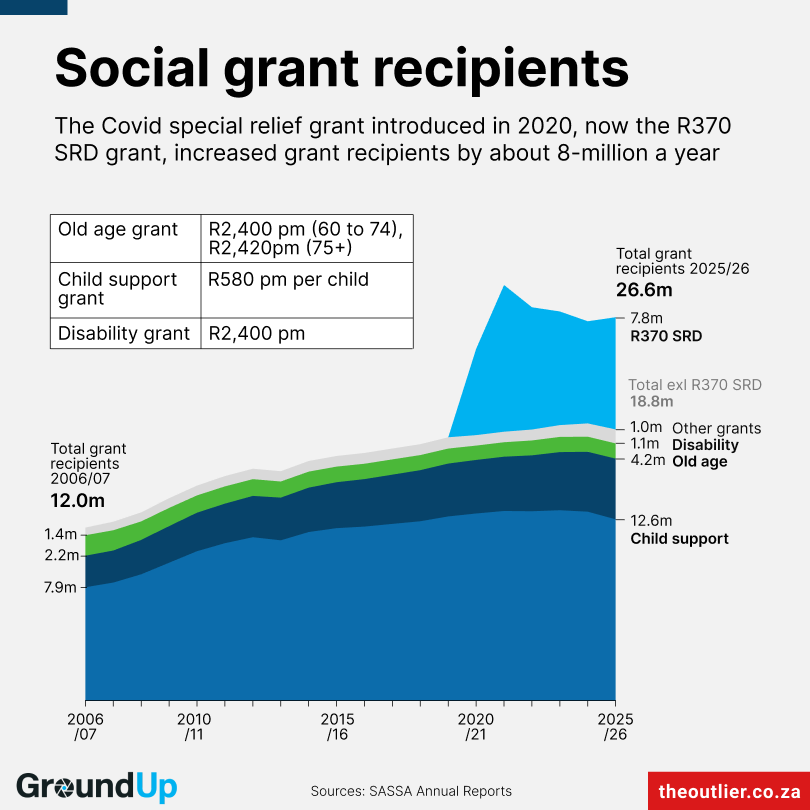
When the South African Social Security Agency (SASSA) began operating in 2006, about 12-million social grants were being paid. Last year, the figure had risen to 26.6-million, including the Covid-19 Social Relief of Distress (SRD) grant.
As a proportion of the estimated population, it has risen from about 25% to 41%.
The biggest change came during the Covid pandemic, when the government introduced the SRD grant to support people without income. The grant, now worth R370 a month, added about eight-million people to the social grant system. It was intended as temporary relief but has been extended repeatedly, most recently until March 2028.
The number of grant recipients peaked at nearly 29-million in 2021/22. Excluding the SRD grant, the number receiving regular grants has grown from about 12-million in 2006/07 to 18.8-million in 2025/26.
The child support grant accounts for most regular grant beneficiaries. The number of children receiving it rose from 7.9-million in 2006/07 to about 12.6-million in 2025/26. The number of people receiving the old age grant has also almost doubled, from 2.2-million to 4.2-million.
One of the fastest periods of growth for the number of people receiving social grants was between 2009 and 2012, when eligibility for the child support grant was extended to older children.
As the number of grants has increased, so has the amount the government spends on them, although it has stayed stable at just over 11% of total government spending.
Government expects fewer beneficiaries
After years of growth, the number of grant beneficiaries (excluding the SRD grant) fell from about 19.3-million to 18.8 million during 2025/26, a drop of 2.2%. According to SASSA’s 2025/26 annual report, most of the decline was in the child support and foster care grants.
In its October Medium Term Budget Policy Statement, Treasury projected that the number of regular grant beneficiaries would fall further: from 17.8-million in 2026/27 to 17.1-million by 2029/30. It expects stronger verification measures to save R13.1-billion over three years.
SASSA has stepped up reviews of beneficiaries’ eligibility, including checks against bank and government records. Treasury says the aim is to identify grants that were approved incorrectly or fraudulently, rather than remove support from people who still qualify.
The government has also extended the SRD grant until March 2028 while it continues to develop a proposed Basic Income Support policy for unemployed working-age adults. The policy has been delayed, with Cabinet asking for stronger links between income support and employment opportunities. The Department of Social Development aims to return the revised policy to Cabinet by March 2027.
Support independent journalism
Donate using Payfast

Don't miss out on the latest news
We respect your privacy, and promise we won't spam you.
© 2026 GroundUp. This article is published under the GroundUp Republication Licence Version 1.0. Email [email protected] to request permission to republish.