
South Africa is getting a handle on debt
Government expects to earn more, borrow less, and spend less on debt repayments
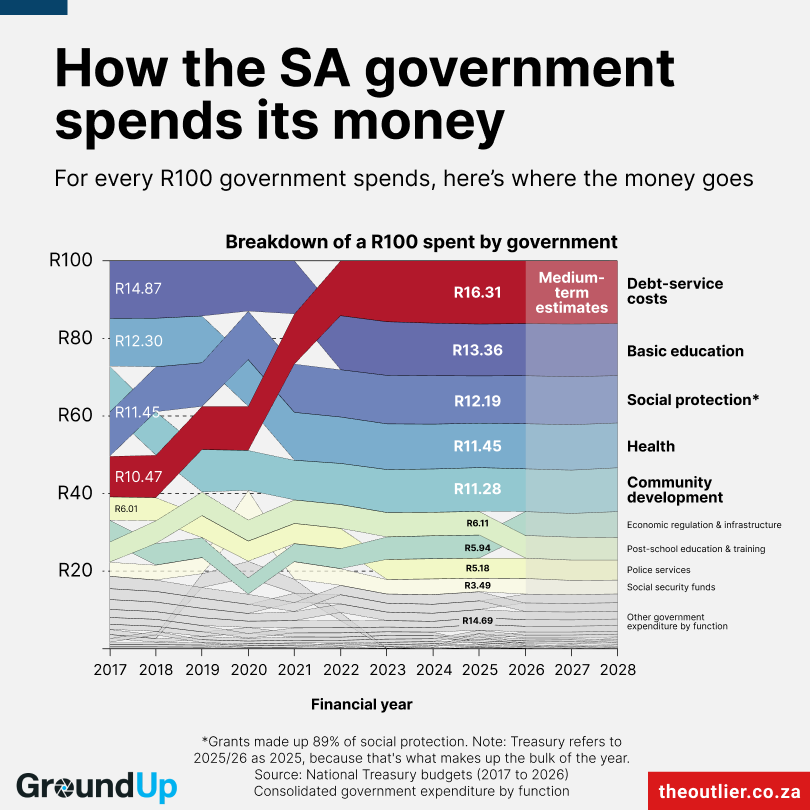
Since 2017, the proportion of South Africa’s budget spent on paying back debt and interest on debt has skyrocketed, overtaking spending on education, social grants, health, and community development. Spending in these “social wage” categories had to be cut to cover debt-servicing costs.
But finance minister Enoch Godongwana, while tabling the 2026 budget before Parliament on Wednesday, announced that South Africa has “turned a corner” and that government debt is stabilising.
Why debt costs increased
- Low economic growth, at an average of 0.6% (taking inflation into account) between 2017 and 2023, meant there was less revenue from tax.
- The effects of covid were particularly hard on the economy. With less revenue coming in, the government had to spend more on emergency relief and social grants. This led to a big budget deficit, which the government had to fund by borrowing.
- Rising interest rates around the globe and a weaker rand meant the cost of paying back loans was higher.
- State-owned companies like Eskom required massive bailouts, which drained government revenue.
- Years of state capture and institutional collapse under the Jacob Zuma presidency caused the economy to stagnate.
Why debt costs are stabilising
- In the last few years, the government has tightened its belt to find funds to repay debt and to pay interest on debt.
- At the same time, tax revenue is increasing as investment in electricity generation and improving export infrastructure at ports pays off and the economy grows. The economy is expected to grow by 1.6% in 2026 (taking inflation into account) and by 2% in 2028.
- This means the primary surplus – the difference between what the government earns and what it spends, excluding debt repayments – is increasing.
- It is now cheaper for the government to borrow money and to service debt, thanks to lower global interest rates, a stronger rand, lower inflation, and more optimism about South Africa among foreign investors.
- South Africa’s debt is still equivalent to more than 78% of its annual economic output (Gross Domestic Product or GDP). But Treasury believes this ratio will decrease from 2026 onwards.
Why this matters
- Government will have to borrow less money to fund the budget deficit.
- Because there is more money coming in, previous plans to increase income tax have been scrapped, and instead, income taxes will be lower for most people. This has drawn criticism from activists for disproportionately benefiting wealthier people.
- The smaller budget deficit leaves space for more spending on infrastructure, particularly electricity, transport, and water and sanitation, which should boost economic growth.
- The proportion of the budget that goes to the “social wage” (such as health, social grants, and education) will also remain relatively stable.
- However, the actual amount spent is not expected to keep pace with inflation. Taking inflation into account, total government spending will decrease by 2% in 2026 and by 1.7% over the next three years, the Institute for Economic Justice has pointed out. Spending on education, for example, will receive lower-than-inflation increases.
Support independent journalism
Donate using Payfast

Don't miss out on the latest news
We respect your privacy, and promise we won't spam you.
© 2026 GroundUp. This article is licensed under a Creative Commons Attribution-NoDerivatives 4.0 International License.
You may republish this article, so long as you credit the authors and GroundUp, and do not change the text. Please include a link back to the original article.
We put an invisible pixel in the article so that we can count traffic to republishers. All analytics tools are solely on our servers. We do not give our logs to any third party. Logs are deleted after two weeks. We do not use any IP address identifying information except to count regional traffic. We are solely interested in counting hits, not tracking users. If you republish, please do not delete the invisible pixel.