
Appeal Court overturns Joburg eviction ruling
In 2024, occupiers of land in Rabie Ridge secured a court interdict to stop their removal
 Add GroundUp on Google
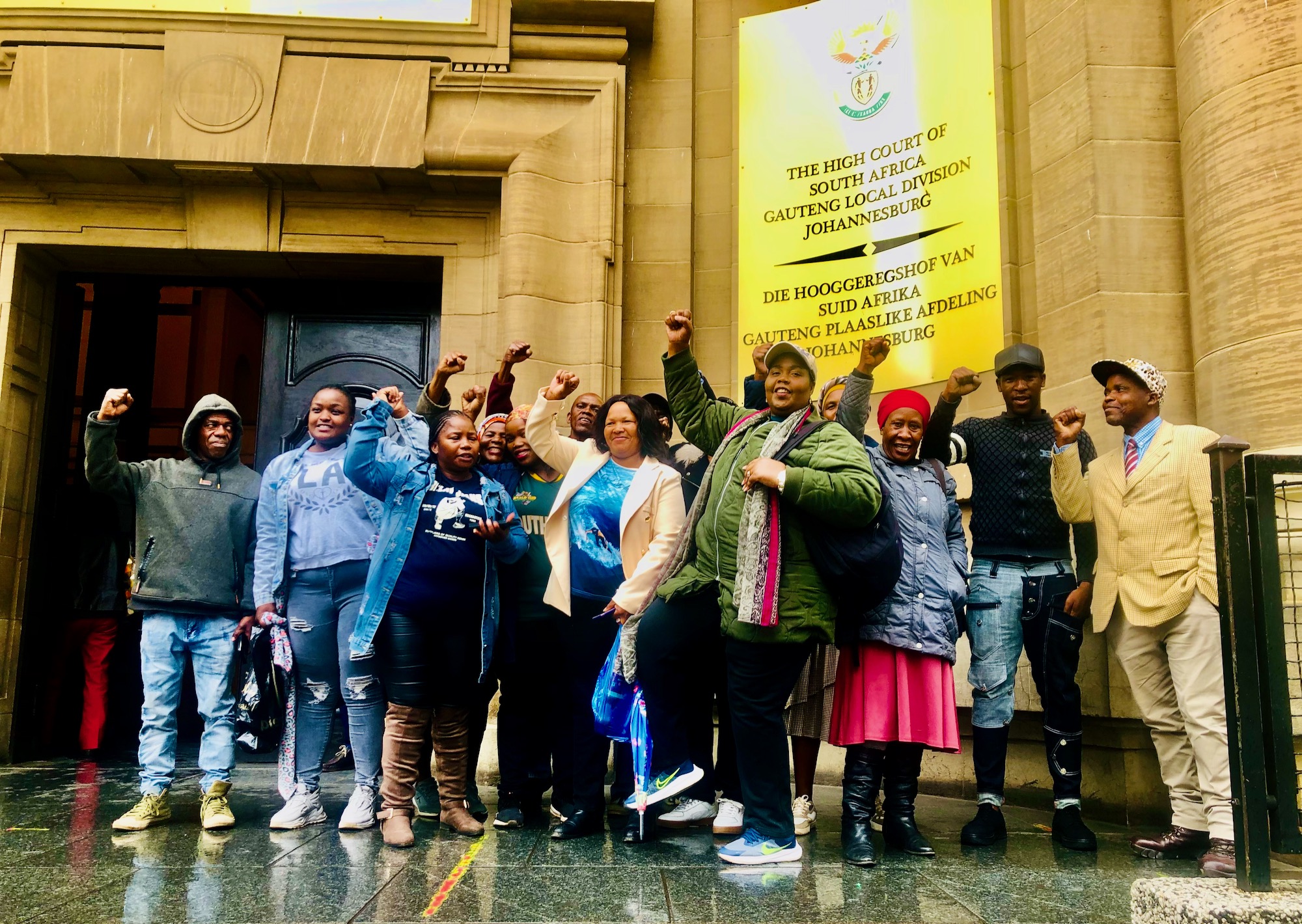
Representatives of over 300 families occupying land in Rabie Ridge outside court in November 2024 to fight their eviction by the City of Johannesburg. Archive photo: Kimberly Mutandiro
- The fate of families occupying municipal land in Rabie Ridge is uncertain after the Supreme Court of Appeal (SCA) upheld an appeal by the City of Johannesburg against an earlier order.
- In 2024, the occupiers secured an order in the high court to stop their removal without a court order.
- Overturning the order, the SCA criticised the high court for “curing the defects” in the occupiers’ case.
The City of Johannesburg has secured a court order overturning a previous order preventing it from evicting a group of people from municipal land at Rabie Ridge.
In 2024, the occupiers secured a court interdict to stop their removal without judicial sanction.
This week, the Supreme Court of Appeal (SCA) set aside the order by Johannesburg High Court Judge Stuart Wilson, detailing missteps he took when he found in favour of the occupiers.
The main bone of contention in the City’s appeal was that the occupiers had not properly identified themselves. Instead they submitted one-page affidavits in support of a founding affidavit by the so-called “leader” Calvin Bantham.

Those affidavits, supposedly confirming the correctness of Bantham’s affidavit, were in fact signed days before his statement had been commissioned.
Furthermore, the affidavits were not properly served on the municipality and were only uploaded on the court’s online system.
In the SCA ruling - penned by Judge Raylene Keightley - the appeal judges said Judge Wilson was wrong to use these documents to compile a list of named occupiers who were then listed on “Annexure A” and protected by his interdict which declared their eviction unlawful, preventing their removal from the property without a court order.
The court said Judge Wilson should not have “cured the defects” in the occupiers’ case by taking matters into his own hands. He should have dismissed the application, the SCA said.
The occupiers first launched what was an urgent application in late 2023, claiming they had been subjected to repeated unlawful evictions by the City and its agents. According to Bantham, the community had occupied the land after failed promises for RDP housing. The matter was set down for July 2024 when Judge Wilson ordered the parties to compile and confirm a “bone fide” list of occupiers.
Judge Keightley in the penned ruling said the City had filed a supplementary affidavit, claiming it had only found one completed structure on the land where four people lived. The City also found “several individuals attempting to construct additional structures” that morning.
Banthan claimed this was because the City had that very morning demolished those structures. In a second explanation he claimed the City had instructed occupiers to demolish their own structures.
The parties agreed to meet for a second time on 24 July 2024.
The City told the court that its officials arrived two hours earlier and again observed people building new structures and moving mattresses onto the property.
Bantham handed officials a list of 159 names which the City rejected. Subsequently a reduced list of 114 names was provided.
In a further affidavit, the City said Bantham had been at the inspection but could not point out his own dwelling.
Bantham then said that to avoid harassment, the occupiers demolished their homes daily, stored the material elsewhere, and rebuilt them at night. He did not say why he could not point out his own dwelling.
Judge Wilson, in his ruling, said the City had argued that the confirmatory affidavits of those allegedly impacted by the evictions should not be accepted, “but could not say why”.
Judge Keightley said “Annexure A” - which contained 249 names - was central to the City’s appeal.
It argued that Wilson’s order gave rights of occupation to an “unverified group”.
“The basic problem before the high court was there was no indication in (Bantham’s) founding affidavit who (the community), individually, were.
“The high court resolved this issue by using the confirmatory affidavits on the court file to compile Annexure A.”
However, Keightley said even in the documents presented during the appeal, there were only “a few confirmatory affidavits” on record.
The SCA sought clarity on this and discovered that “large batches” had been uploaded onto the court online system on 11 December 2023, two days after the City filed its answering affidavit in the high court application.
All but one of those documents were commissioned on 30 November 2023, four days before Bantham’s affidavit was commissioned. All stated that they confirmed the correctness of his affidavit.
“The primary difficulty with this is that it was generated by the high court, and not the occupiers. A further problem is the very reason why the high court felt it necessary to compile Annexure A was because the (occupiers’) case was deficient in this regard,” Judge Keightley said.
“It was for the (occupiers), to remedy this.”
Instead, Judge Keightley said, the high court had “conducted its own active forensic exercise”, without involving the parties or providing them with an opportunity to make submissions.
She said there were discrepancies and contradictions in Bantham’s evidence and courts had previously criticised the “slovenly practice” of using “bland” statements by occupiers that they lived on the property, with no further proof.
“In this case, there was a marked absence of any personal information or details provided to demonstrate their possession and occupation of the property and to link them to structures that were removed,” she said.
The court upheld the City’s appeal and set aside the high court order.
Support independent journalism
Donate using Payfast

Don't miss out on the latest news
We respect your privacy, and promise we won't spam you.
© 2026 GroundUp. This article is published under the GroundUp Republication Licence Version 1.0. Email [email protected] to request permission to republish.