
Thriving township karate dojos have struggle roots
“Karate is not only about kicking and punching but also building the character of the individual”

Students from Thandokhulu High School perform a kata during a Friday training session at the Goju Kai Hombu Dojo in Mowbray. The students come every week after school as part of the Goju Kai karate development programme. Photos: David Harrison
Peter Brandon started teaching karate to a small group of men in a Nyanga hall in the late 1960s, often by candlelight. Today the students at Goju Kai Africa dojos come from across Cape Town’s townships and take part in international competitions.
“I saw a group of men training on the side of the road in Nyanga,” says Brandon. “They weren’t practising karate, but rather some type of Kung Fu that they had picked up from watching Chinese films.
“Although they were quite suspicious of me at first, I asked them if they could find a venue to train in, and then I would come back and teach them proper karate,” says Brandon.
The men organised a small hall located at the present day Zolani Centre.
“There were no lights in the hall and often we were training by candlelight. You could barely see what you were doing. I started bringing along a 100W light bulb.”
Two years after his son was born in 1971, he opened another dojo in Kalk Bay, and then, in 1981, he opened Hombu Dojo in Mowbray, which is still his main venue.

Peter Brandon (centre left), Frank Brandon (second left) and other senior instructors during a grading session in Mowbray.
His son, Frank Brandon, says back in the apartheid 1960s his father was harassed by the police for teaching karate in Nyanga.
“In 1968 my father used to go in under a blanket, it was hectic.”
In 1976 during the national uprising Brandon was arrested, taken to Athlone police station, interrogated, and accused of being a Communist and part of the uprising.
“They released me, but I had to stay under a type of house arrest and had to report to the police station. They tapped my phone.”
The Hombu Dojo was originally the Mowbray Hindu temple. “We would lock ourselves in the dojo so that the police couldn’t come in to check if there was anyone from the townships training there. A young, top student at the time, Patrick Plum, once had to hide in the roof for many hours, while police searched the building after an undercover police officer, who had joined the dojo and trained with us, right up to orange belt, informed on us,” Brandon says.
“I was arrested there once too and taken for questioning after a bomb went off in front to the Mowbray police station in the 1980s. I was released after a few hours.”

The Goju Kai Hombu Dojo in Mowbray was built in an old Hindu temple in Mount Street in 1981. Students from Thandokhulu Secondary School can be seen during a training session.
At the time, white karate teams flew to competitions around the country and were sponsored to stay in hotels. Brandon’s students had to travel in small buses. Yet, says Brandon, they would always make it to the finals.
“We trained so hard and my students had so much talent, but we were still not recognised by anyone. It was very difficult to have a normal training programme in an abnormal society.”
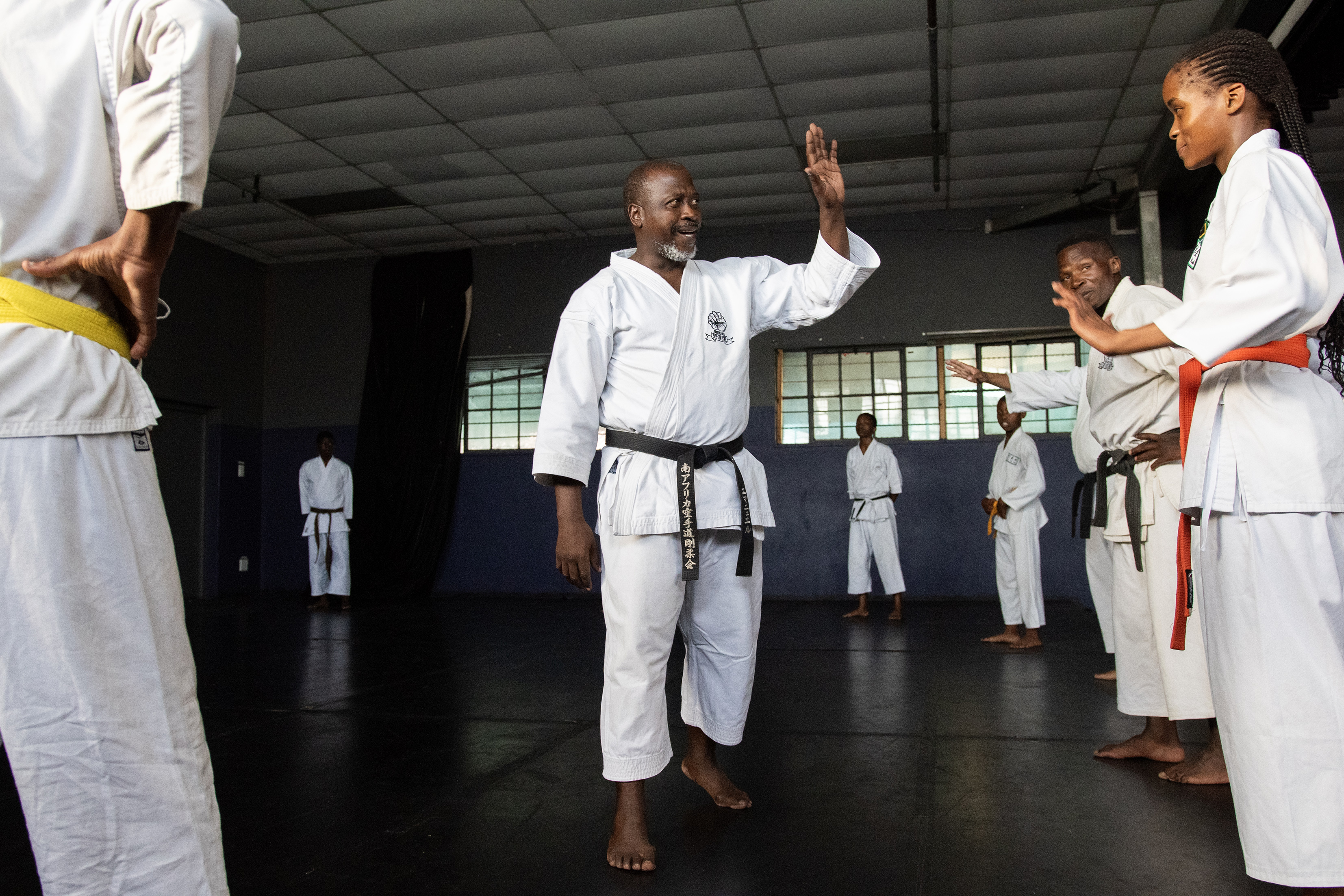
Emmanuel Dyantyi works with students during a training class at the Zolani Centre in Nyanga.
Emmanuel Dyantyi, who trained at the Zolani Centre with Brandon’s son Frank, now runs the Goju Kai township dojos.
He says he was given an opportunity to learn karate as an eight-year-old in the 1970s and “it’s my turn to give back now”.
“Living in the townships is a battle of resources, so if we instil self-reliance in these kids and foster an attitude to persevere, that’s the best thing we can do as an instructor,” says Dyantyi.
“Karate is not only about kicking and punching, but also about building the character of the individuals and making sure that they become better persons.”
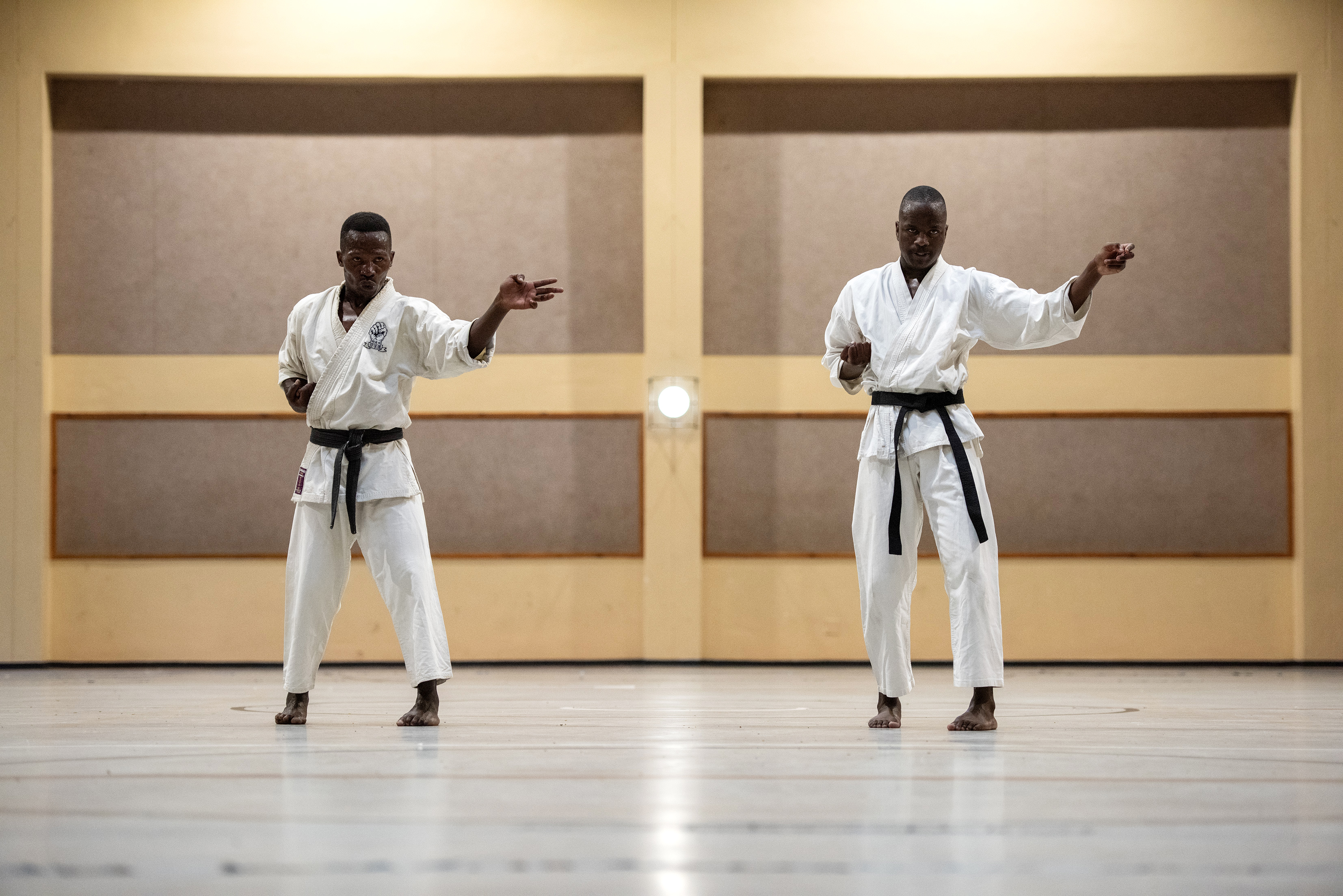
Makhaya Mpotholo (left) and Khazimla Malusi perform kata Tensho (revolving hands) at the Langa Centre.
Makhaya Mpothulo, 38, a San Dan black belt senpai (meaning mentor) was first introduced to Goju Kai by Patrick Plum in 2007 and later Dyanti became his teacher. He now teaches a few students at the Langa Community Centre.
“I would like Goju Kai karate to keep expanding all over the townships so that the people can see that it’s not about fighting, it’s about understanding who you are in a deeper way. A lot of kids in the townships come from difficult backgrounds. We want to take them from the streets and train them in karate to be better leaders tomorrow. Karate teaches you a lot of things. It changes your mindset. It gives you confidence.”
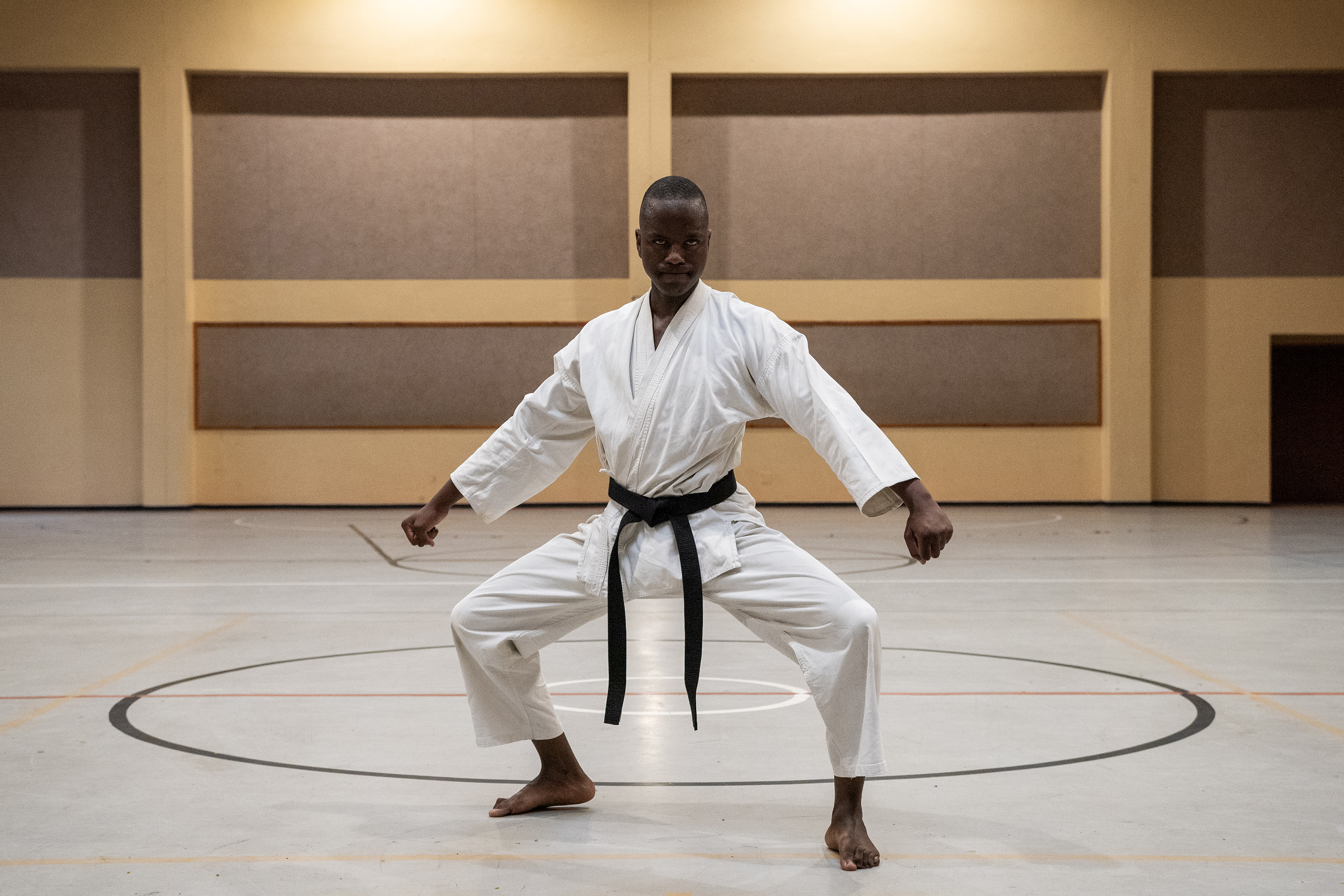
Khazimla Malusi performs a kata during a training session at the Langa Centre.
Khazimla Malusi, 19, began karate in 2017 with Mpothulo. He trains every day at the Langa Centre after he finishes school in Athlone. He was recently awarded his black belt Shodan in November. The disciplined martial arts training helps him cope under pressure.
“When I entered karate I had anger issues, but now after training for all these years I am a very calm person.”
He hopes to study electrical engineering when he matriculates next year.

Lethu Tom (left) and Khazimla Malusi perform a kata during a training class held at the Zolani Centre in Nyanga. Kata is a Japanese word meaning “form”.
Lethu Tom, 19, warms up the class before Dyanti’s arrival. She is taking a gap year from her studies and does volunteer work in nearby Philippi.
“Karate gives me confidence,” she says. “They teach us discipline and how to maintain ourselves in the outside world.”

Students perform a kata during a training session held at the Zolani Centre. Practicing various katas regularly develops skill, strength, balance, coordination and overall fitness.
Frank Brandon says the passion, dedication and discipline of the township students made “a massive impression on me, living out everything that the Goju Kai tradition stands for: honour, loyalty and respect”.
Through his non-profit organisation African Warriors of Light, he has taken township karate students to international competitions in India, Australia, Japan and Canada, and on cultural exchanges across Europe and Japan.
“Many of our students have been sponsored into top Cape Town schools and have gone on to complete degrees at UCT, proving what is possible when talent meets opportunity.”
He said their next trips will be to Prague and Bari in 2027.
“Through travel, they see what’s out there and they gain hope. Through karate, they discover discipline, purpose and confidence and a belief that they can achieve more than they imagined.”

A boy leaves the Zolani Centre after a Goju Kai karate session.
Support independent journalism
Donate using Payfast

Don't miss out on the latest news
We respect your privacy, and promise we won't spam you.
Next: Former Lottery chair challenges Ramaphosa’s investigation
Previous: Literacy crisis: why Makhanda matters
© 2025 GroundUp. This article is licensed under a Creative Commons Attribution-NoDerivatives 4.0 International License.
You may republish this article, so long as you credit the authors and GroundUp, and do not change the text. Please include a link back to the original article.
We put an invisible pixel in the article so that we can count traffic to republishers. All analytics tools are solely on our servers. We do not give our logs to any third party. Logs are deleted after two weeks. We do not use any IP address identifying information except to count regional traffic. We are solely interested in counting hits, not tracking users. If you republish, please do not delete the invisible pixel.