
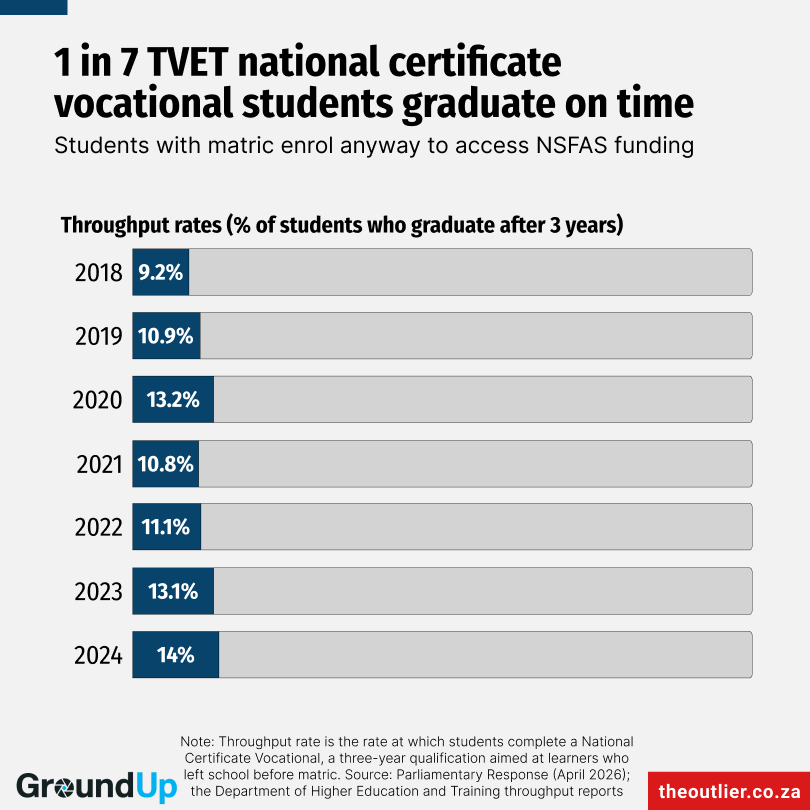
1 in 7 “vocational matric” students graduate on time. Why?
Government says most students enrol in the national certificate so that they can receive NSFAS funding, and never complete the course
 Add GroundUp on Google
The National Certificate Vocational (NCV) qualification offered by TVET colleges is a three-year course targeted at learners who left school at grade 9, 10 or 11 with a school leaving certificate. The NCV is a vocational alternative to a matric certificate.
The available data suggests that NCV students aren’t performing very well:
- 60% of students drop out before graduation;
- only one in seven students graduate on time;
- pass rates are 60% or lower.
Government believes the low percentage of people who graduate within the prescribed three years (or “throughput”) is driven by the fact that most people who enrol in the programme already have a matric certificate, essentially “repeating” a qualification they already have.
In 2024, Nobuhle Nkabane, then higher education minister, told Parliament that matriculants, often those with low NSC results, enrol in the NCV programme so that they can receive NSFAS funding while they await other education or job opportunities.
The higher education department had issued a directive in 2019 to discourage TVET colleges from enrolling matriculants, but the practice has continued “in order to accommodate learners and to provide access for those youth who are not in employment, education or training,” said Nkabane.
It is not a bad thing in principle for the government to be offering a form of income to young people, together with training.
It does mean, however, that the NCV programme is under pressure, impeding its ability to do what it was intended for, which is to provide vocational training to people who do not complete matric.
By providing opportunities for matriculants who do not qualify for tertiary qualifications or cannot find employment opportunities, the NCV programme is filling a gap in the system that it was not intended to fill.
A 2024 report by the higher education department found that the low percentage of people who finish the course on time puts pressure on the system.
High enrolment in initial years and smaller classes later in the course increases the cost per learner. Students who don’t pass and have to repeat a year cause bottlenecks in the system.
Chart produced by The Outlier in partnership with GroundUp

Support independent journalism
Donate using Payfast

Don't miss out on the latest news
We respect your privacy, and promise we won't spam you.
Next: City plans to auction Cape Town farmers’ market site
Previous: Do you need something from a government website? Good luck!
Letters
Dear Editor
I am an NCV student enrolled in Motheo TVET College Bloemfontein campus. I did well in my academics but I failed one subject in level two, so I have to repeat it for the whole year. I did not give up. But I don't understand why we can't carry the failed subjected over and move on to the next level? At least for students who failed one or two subject out of the seven.
© 2026 GroundUp. This article is published under the GroundUp Republication Licence Version 1.0. Email [email protected] to request permission to republish.