
Only 1 in 3 people vote for their municipality
Most adults in South Africa stay away from the local polls
 Add GroundUp on Google
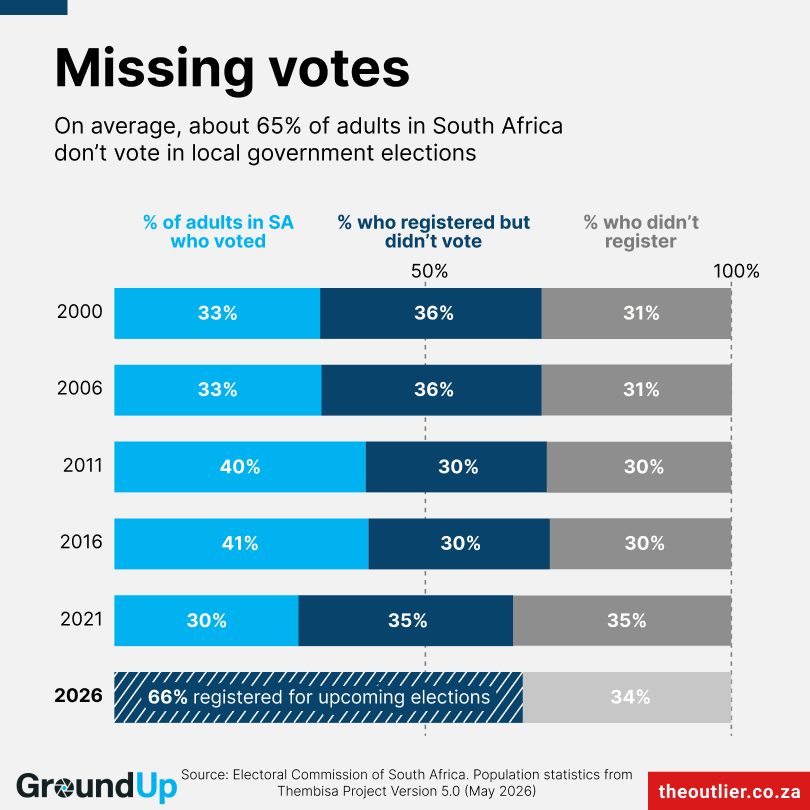
About two-thirds of adults in South Africa don’t vote in local government elections.
2021 saw the lowest registration rates and turnout for local elections held since 2000. Only 30% of adults voted, while 35% were registered but didn’t vote, and 35% weren’t registered.
About 2.1-million people have registered since the 2024 general election, but when taking into account the growth in the adult population, the proportion of registered adults has barely grown. 66% of adults in South Africa are registered for the upcoming local government elections.
To calculate this, we used the IEC’s voters’ roll and the Thembisa model’s projections for the voting-age population. The Thembisa model estimates include non-South Africans who live in the country and who would not be eligible to vote, but this is a relatively small proportion of the population.
The voters’ roll is also ageing. About 31% of 18 to 19-year-olds and 45% of 20 to 29-year-olds are registered, while 61% of people in their 30s, 72% in their 40s, 85% in their 50s, and 92% in their 60s are registered.

For more than a decade, researchers have highlighted how political disillusionment, rather than apathy, is keeping people away from the polls.
The Human Sciences Research Council found that, in 2024, satisfaction with democracy had decreased dramatically since 2003. While about half of people were satisfied with democracy in the early 2000s, only about a fifth were in 2024.
Trust in institutions, measured on a 100-point scale, fell from the mid-50s to the mid-30s.
“Across multiple indicators, including support for democracy, satisfaction with its performance, institutional trust and political efficacy, there has been a general erosion in positive sentiment over time,” the HSRC found.
“However, the decline does not reflect a wholesale rejection of democratic ideals. Younger South Africans continue to show commitment to democracy and voting, alongside growing scepticism about whether the system delivers on its promises. The result is a pattern of ambivalence: a society that values democracy in principle but questions its effectiveness in practice.”
Chart produced by The Outlier in partnership with GroundUp
Support independent journalism
Donate using Payfast

Don't miss out on the latest news
We respect your privacy, and promise we won't spam you.
Next: Eastern Cape woman’s soup kitchen gives more than warm meals
Previous: March and March returns to refugee camp after violent clashes
© 2026 GroundUp. This article is published under the GroundUp Republication Licence Version 1.0. Email [email protected] to request permission to republish.