6 July 2026
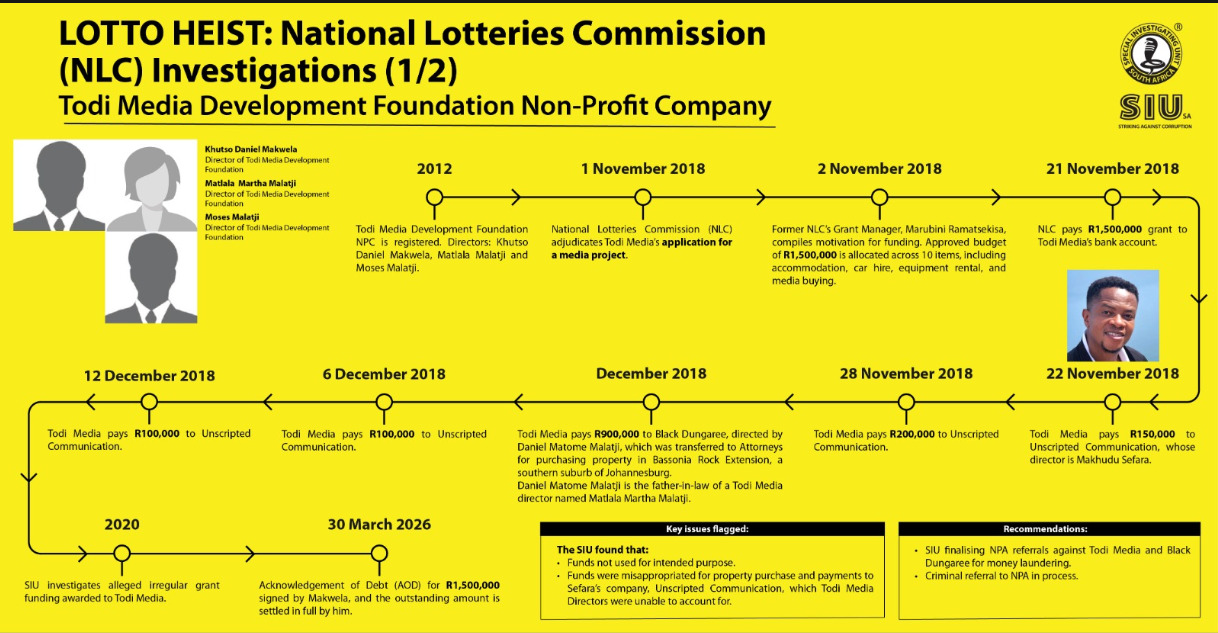
Graphics published by the Special Investigating Unit about lottery grant given to Todi Media.
Makhudu Sefara has been cleared of wrongdoing by an inquiry commissioned by the South African National Editors Forum (SANEF). He will not, however, be resuming his position as chairperson.
Sefara stepped aside as chair of SANEF in April when he was named in a Special Investigating Unit (SIU) statement in connection with a lottery grant. Sefara, also editor of the Sunday Times, was placed on special leave by Arena, the paper’s owner.
The SANEF inquiry was conducted by advocate Ofentse Motlhasedi. She was instructed by Power & Associates. Her report is dated 30 June 2026.
Motlhasedi made several findings which have been previously reported. The National Lotteries Commission paid Todi Media a R1.5-million grant in 2018 to organise a “media project”. Of this, R900,000 was paid to a company called Black Dungaree. This money was used towards the purchase of a property. The remaining R550,000 was paid to Unscripted Communications, a company solely directed by Sefara.
What does come to light in Motlhasedi’s inquiry is that an agreement was signed on 22 November 2018 between Unscripted Communications and Todi Media. It confirmed that Sefara’s company would receive a total of R250,000 for services, excluding expenses.
This was to organise a one-day conference (or workshop) at the Birchwood Hotel near OR Tambo Airport in Johannesburg. The event took place on 11 December 2018. According to the register, there were fewer than 50 participants, many of them living in Gauteng. Fifty rooms were booked at the Birchwood for the night of 10 December (this was for speakers and organisers too).
Exactly how much Sefara personally received for his efforts is not clear, but here is the breakdown of expenses he provided to the SANEF inquiry.
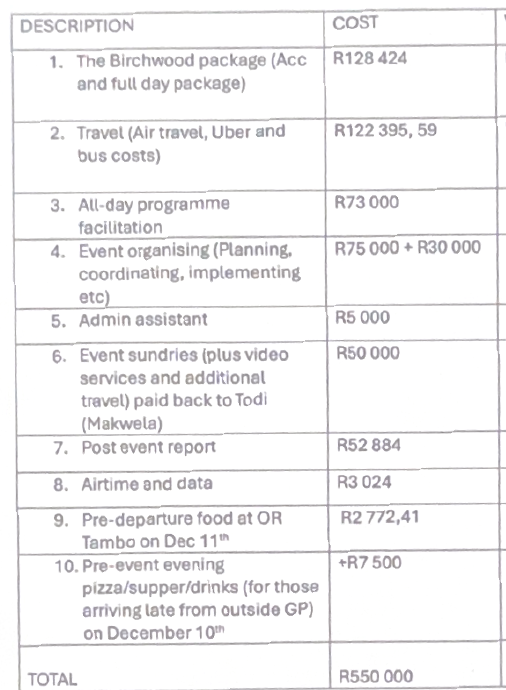
Breakdown of the R550,000 Unscripted Communications charged Todi Media for organising a one-day workshop, as provided by Makhudu Sefara to SANEF inquiry.
Sefara claimed he found out that the lottery was the source of the funding a few days before the conference.
Aimed at community media, the conference objectives were stated as:
”- To find ways of telling the South African story fully
- To raise awareness about the scant attention paid to development news by the media.
- To stimulate debate and improve the level of development journalism consciousness in the media
- To create a cohort of reporters and ambassadors committed to telling our story in its entirety.
- To inculcate a culture of fair and accurate news coverage of South Africa.”
Motlhasedi wrote: “On a reading of SANEF’s Membership Form, Code of Conduct and Constitution, there is no express obligation on SANEF members to disclose to SANEF their previous and current financial interests outside of the practice of journalism.” It was on this basis that she cleared Sefara of wrongdoing. The links between Sefara and Todi were not explored, nor was why Sefara’s company received Todi’s deposit the day after Todi received the lottery grant.
Motlhasedi recommended that nominees for senior roles in SANEF elections “should be required to disclose their financial interests, outside of the practice of journalism”.
In a statement published last week, SANEF confirmed that Sefara would not resume the chairmanship or stand for election, which took place this past weekend.
The SIU’s powers are limited to recovering misappropriated state funds, which it successfully did in this case. It does not prosecute.
Following SANEF’s statement, the SIU published a statement on Friday accusing the organisation of misrepresenting it.
“SANEF’s media statement gives the impression that the SIU has exonerated Sefara as a beneficiary of NLC funds. This is not a reflection of the letter sent to his lawyers,” the SIU states.
It further states:
“The SIU’s letter set out the following facts:
- Todi Media’s director … failed to provide evidence of how the R1.5-million NLC grant was used. Instead, he offered to repay R1.1-million. The SIU rejected the offer and demanded a full account of the funds in a sworn affidavit, along with supporting documents, before considering any settlement.
- When Todi Media could not account for the funds, it offered to repay the full R1.5-million as the final settlement.
The SIU explicitly stated: ‘Unscripted Communication was never a subject of the SIU investigation and as such there is no finding against your client nor his company.’ However, as part of the SIU investigation, the money was followed and found in Sefara’s business and personal bank accounts. Furthermore, Todi Media could not produce any agreement to justify the payment made to Unscripted Communication, a day after receiving money from the NLC.
The SIU confirmed it had no claim against Unscripted Communication and that liability rested solely with Todi Media, which refunded the entire grant. However, the SIU did not say that Sefara did not benefit from the funds, as Todi Media … could not provide any evidence of how the funds were utilised, as stated in the grant application.”
In response, SANEF said that it stood by its original statement.
Commissioning a formal inquiry into whether Makhudu Sefara strictly breached SANEF’s code of conduct missed the point.
Hundreds of millions of rands, perhaps billions, have been stolen through what was a corrupt lottery grant system. The peak of this corruption was in the period when Todi Media received this grant. While R1.5-million may seem small in relation to the huge amounts of misspending that our journalist Raymond Joseph has reported for GroundUp since 2018, it provides a case example of how this corruption took place:
Grants were hastily allocated to obscure companies, which then diverted most of the funds to personal purchases, like properties (as Todi Media did). Often, there has to be some rudimentary accounting, so in this case, a conference, of vague purpose was organised. The costs of this conference appear to have been unnecessarily high. There is no way a one-day conference like this should have come to half-a-million rand. And a service fee of R250,000 for a few weeks of work is outrageous.
This wasn’t private money; this was the state’s money. While Sefara may claim he only found out that it was Lottery-funded a few days before the conference, he’s an experienced journalist who may have been expected to find out a bit more about a payment that should have seemed too good to be true.
None of this was known to SANEF when it elected Sefara its chair. Yet it was known that Sefara had been the editor of Sunday World when it was implicated in running puff pieces for the Lottery and hit pieces on Raymond Joseph — and then getting a disproportionate piece of the Lottery advertising pie. Unscripted Communication had also done PR for Shepherd Bushiri, a notorious person, to put it mildly.
Editors do not need to be saints, but being implicated in misspending state funds is a red line, especially when it comes to the fraught issue of state advertising expenditure for newspapers. The Todi Media scandal merely emphasised the already existing suspicions about Sefara’s suitability. It does not reflect well on SANEF that he was elected chair.
