
William Sadiki fought in World War II. But he couldn’t afford to go to last week’s R172-million military parade
107-year-old Native Military Corps veteran couldn’t attend Armed Forces Day in Thohoyandou
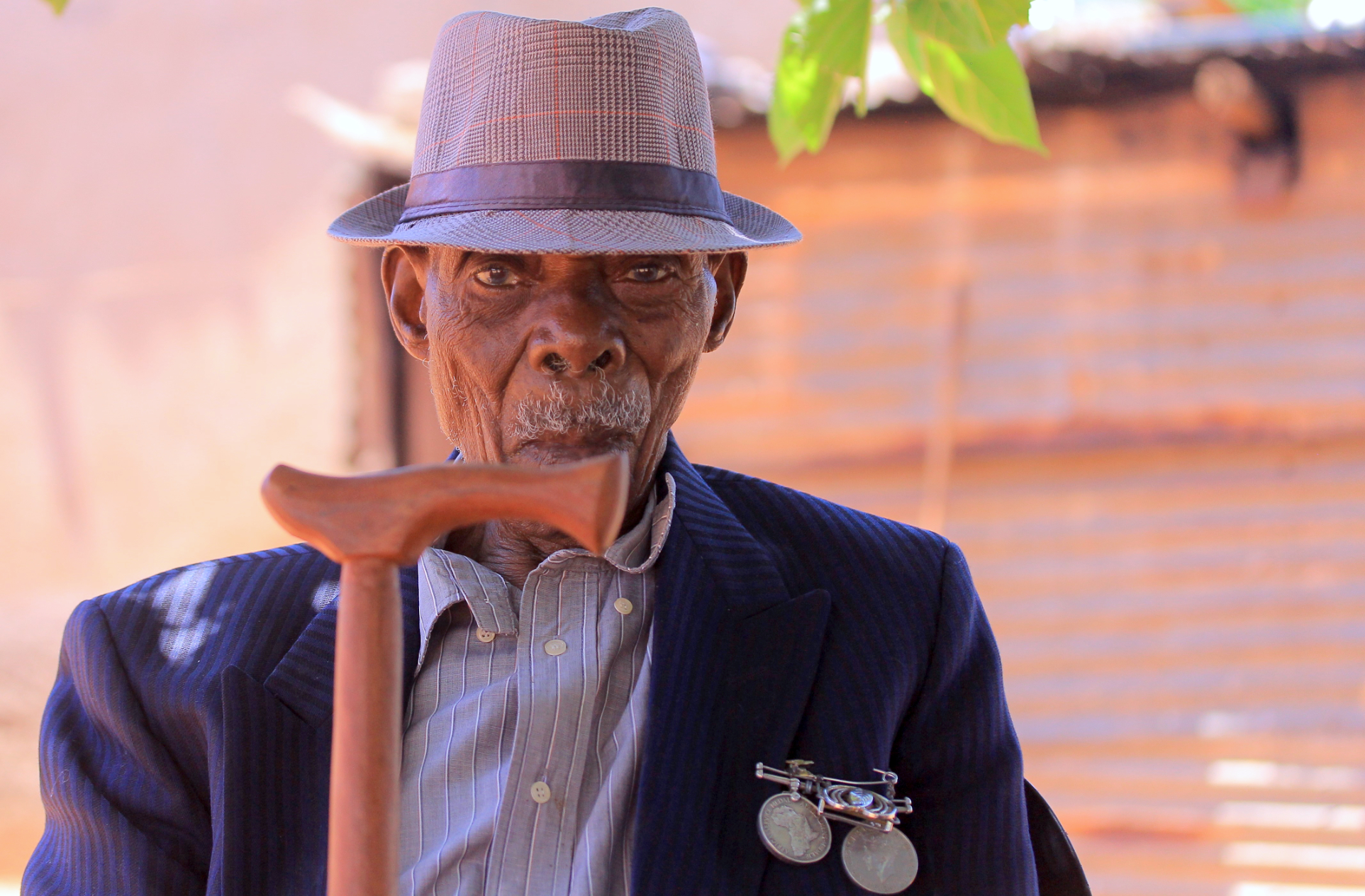
William Masindi Sadiki, who fought in World War II, could not afford to go to last week’s Armed Forces Day celebration. Photos: Thembi Siaga
While thousands gathered in Thohoyandou last Saturday for one of the largest military parades ever held in the region, one of South Africa’s oldest surviving World War II veterans remained at home.
Armed Forces Day, costing taxpayers an estimated R172-million, featured a parade, a flypast by Air Force fighter jets and even an extravagant music festival. President Cyril Ramaphosa, ministers, deputy ministers, senior military officials and members of the diplomatic corps attended.
Military veterans were also invited.
But William Masindi Sadiki — probably the oldest surviving black South African soldier who fought in World War II — was not among them.
Three days earlier, on 18 February, Sadiki celebrated his 107th birthday at his modest home in Hamanavhela, less than 50 kilometres from Thohoyandou.
His name did not appear on the initial guest list. After the omission was raised with the office of the Makhado Municipality mayor, officials attempted to arrange a late invitation. His name was eventually added to the list of accredited persons, but there was no budget to transport him to the event.
For Sadiki, that meant staying at home.
It was not because he was too frail to attend. Despite his age, he can still walk, albeit slowly. The trip simply cost more than his pension could cover.
“It is such a shame,” said Mr Josias Kutama, a community leader from the area. “I thought they would treat him well, as he is a war veteran and a hero,” he said.
A hero and a gentleman
Martha Mukatuni, who looks after Sadiki, describes him as a soft-spoken gentleman who takes pride in his appearance.
“You can see his shoes are shining; he always polishes them,” she said.
Sadiki pays Mukatuni from his social grant money to care for him during the day, while his grandchildren keep watch at night. He lives in a small room next to the house where his daughter and her children live.
He still washes himself daily before sitting outside, keeping busy with small tasks such as sharpening knives.
“He wakes up very early in the morning, around 5am, makes himself some tea and bathes,” Mukatuni explained.
“He loves eating meat. He does not have any illnesses. The other day, we took him to the doctor, and they were surprised that he is very healthy; his only problem is old age. He still has a lot of energy,” she said.
Mukatuni said he often reflects on the war.
“When he recalls something from the war, he calls me to come and sit next to him so that he can tell stories about what happened during the war,” she said.
Cattle herder
When William Sadiki left the Zoutpansberg district to join the army on 30 June 1941, he was 22 years old — at least according to his military records. His height was listed as 5 ft 4½ inches, and his occupation as “cattle herder”.
He was the only one of his brothers allowed to enlist. The Native Military Corps (NMC) 2nd Battalion recruited soldiers in the then Northern Transvaal, but only one man per family could join.
“They did not want all of the children to die in the war,” recalled Sadiki.
Only the senior traditional leader, Vhamusanda Kutama, was permitted to send more than one son because he had many. One of them, Thina Kutama, was killed during the war.
For more than four years, Sadiki served without seeing combat. He trained and worked at camps in Voortrekkerhoogte, Palmietkuil, Wonderboom and Welgedacht. As the war intensified, the NMC expanded beyond its original four battalions, and Sadiki became part of the 6th Battalion.
NMC soldiers were largely assigned support duties for white South African units, freeing white recruits for frontline combat.
In June 1943, he was posted to Ladysmith in the then Natal. A year later, he moved to Potchefstroom as manpower demands increased.
On 16 May 1945, Sadiki boarded a ship at Durban harbour heading north. Twelve days later, on 28 May, the ship reached Suez harbour.
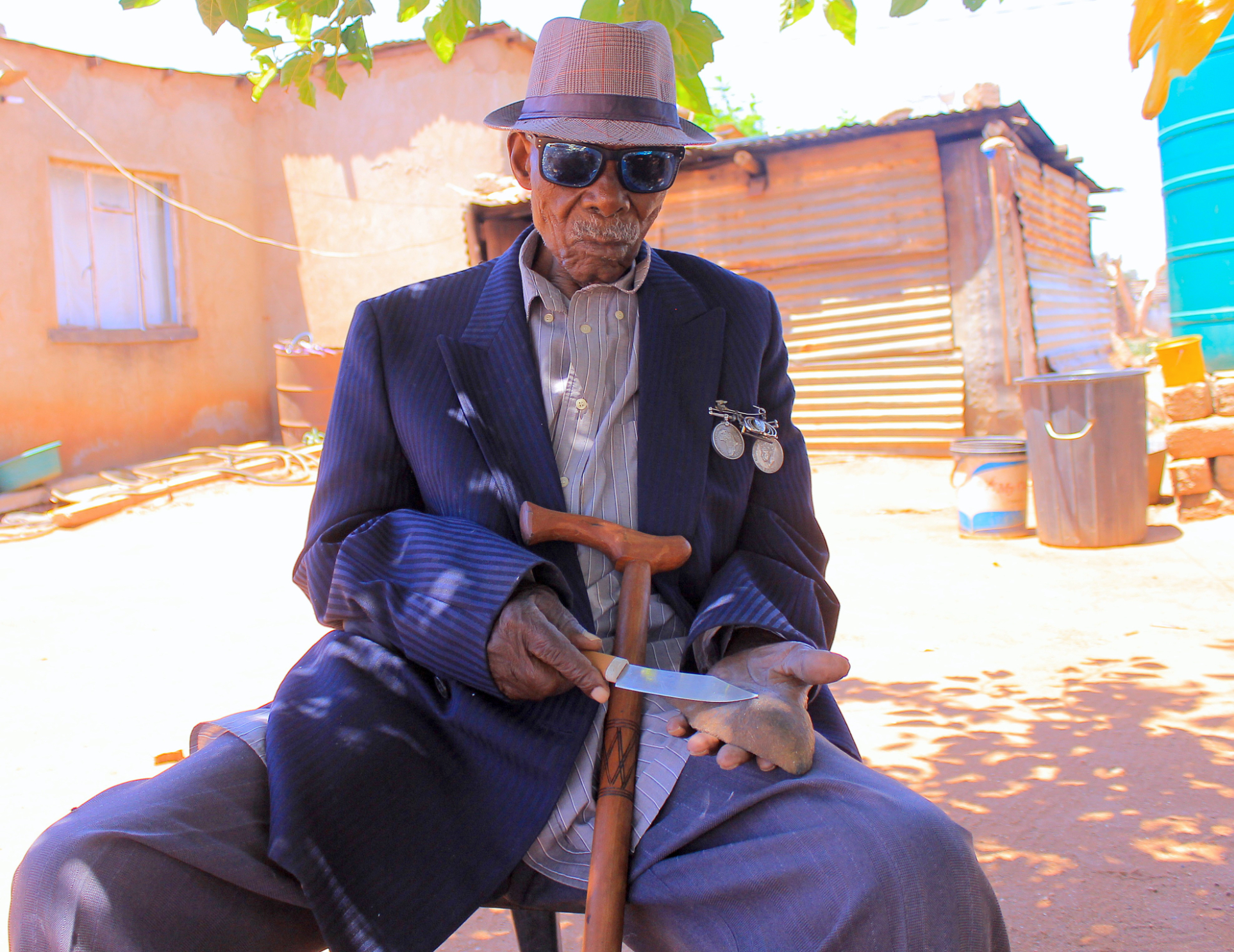
Sadiki keeps busy with small tasks such as sharpening knives.
Action in Italy
Detailed unit records for individual NMC battalions are scarce. After 1948, the corps’ contribution to World War II was largely removed from official narratives and dismissed by the apartheid government.
After eight decades, Sadiki himself remembers only fragments of the war.
The NMC’s 6th Battalion would most likely have served in support roles attached to South African troops fighting in Italy. NMC units operated across the Middle East and Italian theatres, performing engineering, transport, stretcher-bearing and labour duties.
Officially, NMC soldiers were not permitted to carry weapons, though historical accounts indicate many fought alongside their white counterparts.
“I used to carry a gun and a bag that contained food that helped us survive during the war,” Sadiki recalled.
He said he still knows how to use a firearm and believes he could still handle one today. He remembers the weapon as a 303, probably referring to the .303-calibre Lee–Enfield rifle. He said that during the war, he killed many enemies.
Sadiki also recalls being aboard a ship bound for Japan when the war ended.
This suggests he may have been part of a planned Allied occupation or invasion force mobilised after V-E Day (Victory in Europe Day) in May 1945, but never deployed after Japan surrendered following the atomic bombings of Hiroshima and Nagasaki. The war ended on 15 August 1945.
On 25 October 1945, Sadiki returned to what was then the Union of South Africa. On 4 January 1946, he received the Africa Service Medal.
“All I want is a toilet in my house”
On Wednesday, 18 February 2026, there were no celebrations at Sadiki’s home. No delegations arrived. No veterans’ organisations visited.
For him, it was a day just like any other.
He has spent most of his life in Hamanavhela, a picturesque village south of the Soutpansberg mountain range.
Asked about the secret to his long life, he shrugs. Some habits date back to his army days.
“I used to smoke, and they would give us cigarettes,” he said. Later in life, he stopped drinking and smoking. He tries to exercise regularly.
The surname Sadiki places him among the Lemba people, often referred to as the “Venda Jews”. He does not eat pork but enjoys meat and has a fondness for sweet treats. He was disappointed when visiting journalists arrived without cake.
His only wish is simple: a toilet inside his room. Using an outside toilet is difficult, especially at night and even during the day.
Installing an indoor toilet would likely cost less than R10,000 — a modest sum compared with the hundreds of millions spent celebrating Armed Forces Day.
Published with the Limpopo Mirror
Support independent journalism
Donate using Payfast

Don't miss out on the latest news
We respect your privacy, and promise we won't spam you.
Next: South Africa is getting a handle on debt
Previous: Joburg Ballet celebrates 25 years with return of Giselle
Letters
Dear Editor
What an utter disgrace to not ensure this gentleman was included in a parade he absolutely deserved to be at, probably more than most of the officials attending. All he wants is an inside toilet, this brought me to tears. Someone who fought for his country who lives on the bread line without basic needs being met. Can our government investigate this matter properly and look after this veteran for the rest of his life.
Dear Editor
Beautiful story about forgotten heroes. My grandfather died in the 2nd WW in Egypt and left my Dad without a father at the age of 10 years old. My grandmother raised 5 children on her own. Wars have no winners.
Dear Editor
I believe this is a reflection of the incompetance from the Department of Milirary Veterans. When I saw his age and the year when he fought in Italy, I realised that he served with my father, SJ Esterhuizen, as well as the then Head of Defence Mr Constant Viljoen.
William Sadiki needs respect and deserved to have been a guest of honour, above those with a chest full of medals without serving in any war.
Where is William's compensation of R175 000 towards a house so that he can have the luxury of an inside bathroom? Is he even on the military medical? He deserves this.
Dear Editor
I read with interest this article about a Second World War veteran and feel compelled to respond.
My grandfather also served during the Second World War. He returned home in 1945 deeply traumatised and received no support, no pension, and not even a medal in recognition of his service. Like many veterans, he carried the unseen scars of war alone. His untreated trauma devastated our family and ultimately cost him his life.
Stories like my grandfather’s show that many WWII veterans and their families were forgotten long after the war ended. While we honour a few, countless others served and sacrificed just as much, yet received nothing.
Their service deserves recognition, dignity, and remembrance — even now.
Dear Editor
I read this article with horror, dismay, and disgust at the total disrespect for Mr Sadiki's service.
As the grandson of a WWII veteran, I thought about how I would feel if my grandfather were still alive and he had been ignored or forgotten like this. He would have been around the same age as Mr Sadiki and he was incredibly proud of his military service in North Africa and Italy, and I get the impression that Mr Sadiki is just as proud of his contribution to the war. As one of the last (if not THE last) WWII veteran still alive, Mr Sadiki should have been the Guest of Honour, not a forgotten soldier, who only received an invitation as an afterthought! The Department of Military Veterans should have moved heaven and earth to get him there.
I have searched for a Back-A-Buddy campaign to help Mr Sadiki get that indoor toilet he so rightly deserves. It is the least South Africa can do for his service. If a non-profit is willing to set one up, I would gladly make a donation (I would start it myself but I don't know Mr Sadiki to get the money to him) and would encourage everyone I know to do the same.
Dear Editor
Mr William Sadiki is highly favoured to be blessed with 107 years and going strong. Is there a place where we can get more information on South Africans who fought in World War II? My great-grandfather, William Khulu, and his son Willie Khulu from Ladysmith also perished in World War II. My mother was five-years-old and does not remember much.
Where can I access the documented archives of World War II, especially on Black warriors from around Ladysmith, Ntshongweni and larger Newcastle?
© 2026 GroundUp. This article is licensed under a Creative Commons Attribution-NoDerivatives 4.0 International License.
You may republish this article, so long as you credit the authors and GroundUp, and do not change the text. Please include a link back to the original article.
We put an invisible pixel in the article so that we can count traffic to republishers. All analytics tools are solely on our servers. We do not give our logs to any third party. Logs are deleted after two weeks. We do not use any IP address identifying information except to count regional traffic. We are solely interested in counting hits, not tracking users. If you republish, please do not delete the invisible pixel.