
Canegrowers warn Tongaat liquidation will devastate economy
Minister Parks Tau opposes liquidation, says it will cause a “jobs bloodbath”
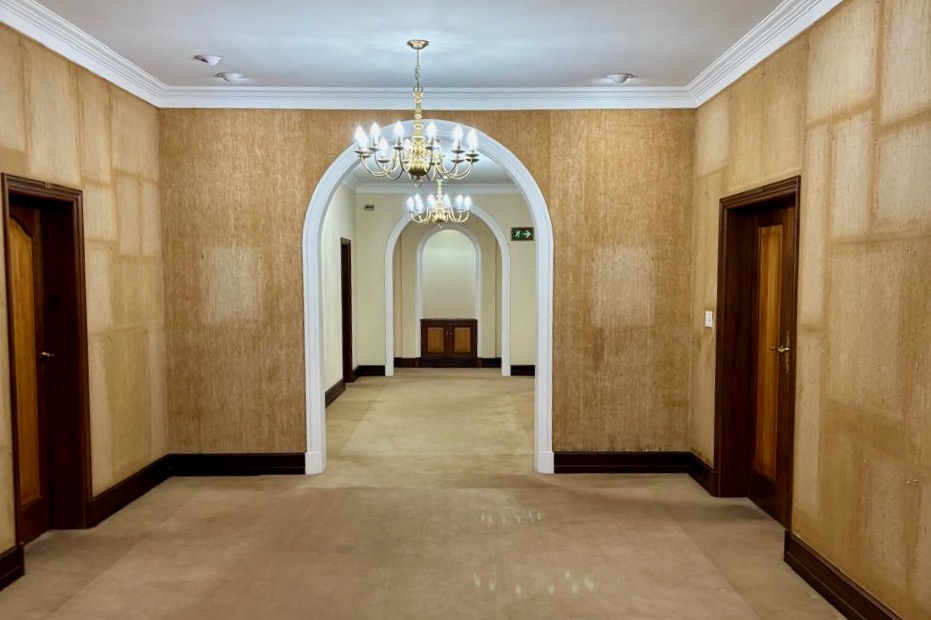
Tongaat head office stripped of expensive paintings and antiques ahead of a possible visit by liquidators. Photo supplied
- Trade and Industry Minister Parks Tau is opposing the liquidation of Tongaat Hulett, saying it would devastate the sugar industry and rural economy in KwaZulu-Natal and Mpumalanga.
- The minister took aim at the Vision Group, describing it as “unwilling to honour its commitments” after its acquisition plan was approved in January 2024.
- South African Canegrowers Association CEO Thomas Funke says the liquidation application has resulted in Tongaat’s bank accounts being frozen, jeopardising the sugar industry.
Trade and Industry Minister Parks Tau has joined the growing chorus opposing the liquidation of sugar giant Tongaat Hulett. He argues that the business rescue process must continue to prevent a “jobs bloodbath”, stabilise the sugar industry, and support small businesses at risk of “losing their main markets”.
In his affidavit filed in the Durban High Court, Tau took aim at the Vision Group, saying, “a business plan cannot succeed if stakeholders deliberately frustrate its implementation”.
He said Tongaat remains viable but Vision, whose acquisition plan was approved by creditors in January 2024, had been “unwilling to honour its commitments”.

The provisional liquidation application was launched by business rescue practitioners (BRPs) amid allegations that Vision had deliberately scuppered the plan by refusing to inject any of its own money into the company.
“This conduct should not be rewarded by liquidation, nor should it be allowed to derail a rescue process that remains capable of success,” said the minister in papers.
Liquidation would be devastating for the sugar industry, the South African economy and, in particular, the rural economy in KwaZulu-Natal and Mpumalanga, he said.
Tau said the Industrial Development Corporation (IDC), which had provided the post commencement funding, believed that viable rescue options still existed and “post commencement finance remains available”.
He said when provisions of the Companies Act, under which the BRPs operate, were “abused or perverted to force liquidation against the public interest”, he had to intervene.
“The BRPs application reflects such a misuse. Instead of pursuing rescue in good faith, they seek liquidation as a short cut, contrary to the Act’s purpose.
“The Act was designed to preserve viable enterprises and jobs, not to facilitate premature liquidation at the behest of creditors or frustrated stakeholders,” he said.
The SA Canegrowers Association has applied to intervene in the liquidation application. CEO Thomas Funke said the application had resulted in Tongaat’s bank accounts being frozen, affecting preparations for the start of the crushing season and the operation of Tongaat’s mills.
“If the three mills do not open at the commencement of milling season and remain open for the duration of the milling season and the growers are not paid the anticipated R3.8-billion, it will devastate the economy,” he said.
It would also leave vast amounts of the season’s sugarcane unmilled.
Funke said if the mills were not saved, small scale growers would be unable to continue farming, while commercial growers would be forced to lay off workers.
“This is the reality facing the 15,500 commercial and small-scale growers if the mills do not open,” Funke said.
He said the association supported the IDC and the Department of Trade and Industry in arguing that continuing the business rescue process was the only viable option.
This would give the BRPs time to consider competing bids for assets. It was “common cause” that at least three parties intended to submit bids.
Funke said that if the Vision Group, which controlled the lender group claim of R11.7-billion, making it the controlling creditor, “endeavours to impose its will on the BRPs unreasonably”, the practitioners could approach the court under the Companies Act to have its vote set aside.
As yet, no hearing date has been set.
Lawyers for the parties are expected to meet next week to determine the way forward.
Support independent journalism
Donate using Payfast

Don't miss out on the latest news
We respect your privacy, and promise we won't spam you.
Next: Central Karoo lags behind Western Cape’s progress
Previous: SA’s harbours are slowly recovering
© 2026 GroundUp. This article is licensed under a Creative Commons Attribution-NoDerivatives 4.0 International License.
You may republish this article, so long as you credit the authors and GroundUp, and do not change the text. Please include a link back to the original article.
We put an invisible pixel in the article so that we can count traffic to republishers. All analytics tools are solely on our servers. We do not give our logs to any third party. Logs are deleted after two weeks. We do not use any IP address identifying information except to count regional traffic. We are solely interested in counting hits, not tracking users. If you republish, please do not delete the invisible pixel.