
Imagine Hangberg, but with psychedelic toads
Kimon de Greef, who cut his teeth at GroundUp, follows the trail of a Mexican toad guru in his new book
 Add GroundUp on Google
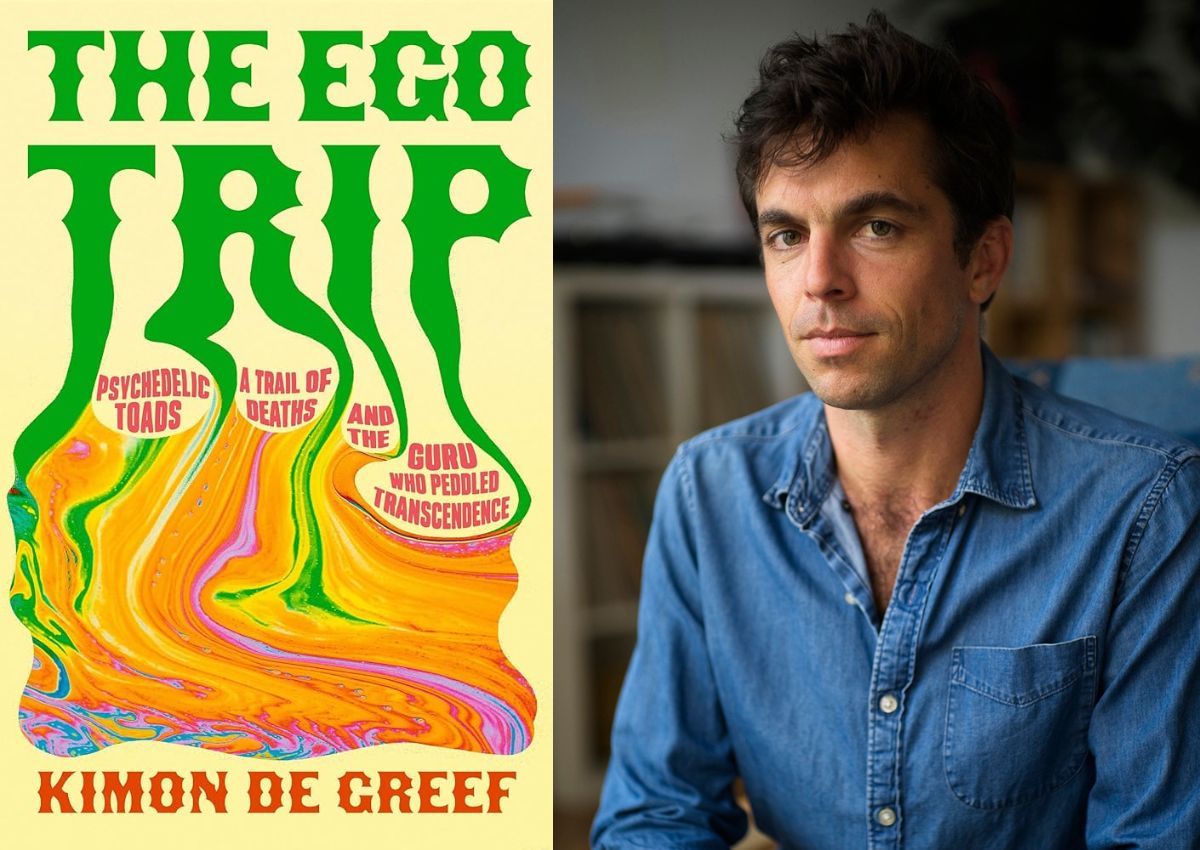
Kimon de Greef’s new book explores the consequences of the popularisation of a psychedelic toad. Author photo by Shaun Swingler
South African journalist Kimon de Greef has written another great book, titled The Ego Trip: Psychedelic Toads, a Trail of Deaths, and the Guru Who Peddled Transcendence.
It follows his impressive debut Poacher: Confessions from the Abalone Underworld, written with Shuhood Abader. But unlike Poacher, which tells a deeply local story, The Ego Trip is almost devoid of South African ties. In fact, it might well be the most un-South African book by a South African journalist since Jonny Steinberg’s Little Liberia: An African Odyssey in New York City.
Why read it then, as a South African? For one, it feels familiar and relatable. Like Poacher, we are dealing with what happens when a modest creature of this earth suddenly becomes sought after by human beings. For another, if you’re interested in the therapeutic use of psychedelic substances, then de Greef’s book is as good a ground report as we have to date.
De Greef, originally from Observatory, Cape Town, cut his teeth as a reporter for GroundUp and Mail & Guardian before moving to New York to further his studies. In 2020, he was researching a story about America’s black market for white sage (a plant which, like imphepho in South Africa, is used in rituals to facilitate ancestral connection) when he met a man who claimed to have discovered that by drying and smoking the secretions from a Sonoran Desert toad, it is possible to experience an extraordinary high, nothing less than a direct experience of the divine.
After some digging, de Greef discovered that the claim was only partly true. “Smoking toad” does indeed make people trip, because the toad’s secretions contain 5-MeO-DMT, a powerful, naturally occurring psychedelic, but the man de Greef spoke with was not the first to discover this. That honour belongs to a reclusive Texan called Ken Nelson, who published a pamphlet about his discovery in the early 1980s, under a pseudonym.

Nelson did not popularise the practice, however. The person who did that was a Mexican doctor and drug addict called Octavio Rettig, who, after smoking toad in 2006, experienced a reprieve from his drug cravings.
To procure his own supply of this wondrous “toad medicine”, Rettig travelled to Sonora on the Mexican Gulf of California coast, where he encountered the Seri, or Comcáac, an indigenous Sonoran tribe pushed to the edge of annihilation by centuries of Spanish and Mexican conquest.
After finding that substance abuse was rife among the Seri people, Rettig began “serving toad” to Seri men, women and children, telling them that toad smoking was in fact an ancient Seri healing practice, one which he had simply reintroduced to the community.
The absence of any real evidence to back up Rettig’s story did nothing to halt his rising fame in the psychedelics underworld: “psychonauts” from all over the world beat a path to his door, while Rettig, in turn, travelled the world smoking, serving, and speaking about toad.
It all had consequences, and indeed the messy aftermath of toad’s popularisation is the true subject of The Ego Trip.
Punta Chueca, the place where Rettig based himself, has been transformed into a kind of gaudy boomtown of Seri cultural appropriation and toad pageantry.
“Imagine a place like Hangberg in Cape Town, with all of its substance abuse issues and gang violence, transported to a desert in Mexico. Now imagine hordes of gringos turning up in beads, having their faces painted and their minds blown,” de Greef told the audience at the launch of the book in Cape Town last week.
Accusations of irresponsible practice began following Rettig around: at least three clients died on his watch; a girlfriend drowned in his care, in an underground cave. In de Greef’s account, Rettig comes across at times as a parody guru – a sort of Zoolander of the psychedelic renaissance – at other times like a poster child for sociopathic narcissism. Still, the “Pied Piper of Psychedelic Toads” continued to attract clients and acolytes, fuelling a toad rush in the Sonoran Desert.
The writing isn’t pretty, and this is deliberate (after all, it’s a book about smoking toad secretions!). The word “vomit” looms very large in the word cloud of The Ego Trip, as do “gland”, “secretion”, “sweat” and “swollen lips”.
And some scenes feel repetitive. Like a person lost in the desert, you might find yourself thinking at times “but haven’t I passed this way before?” I wondered if this too was deliberate: an attempt by de Greef to mimic, structurally, the disorientation of a toad trip. More likely is that the author, driven by an overriding instinct for fairness and honesty (the hallmark of all his reporting to date), has simply packed more information into his book than readers actually need, at the expense of flow.
The other consequence of this journalistic rigour is a cast of characters that grows to Tolstoyan proportions. For long periods, we lose sight of the main character, Rettig, and some of the scenes featuring him feel a bit leavened. Perhaps de Greef was not able to spend as much time with him as he would have liked. Or possibly Rettig was not as compelling a character as he had hoped. Either way (and probably both things are true), the result is a story that is fabulously rich in interconnected details but a little weak in the spine.
The Ego Trip is, regardless, a major contribution to the literature of the psychedelic renaissance, and for de Greef it represents a major step forward as a writer of longform journalism, placing him among the best young longform writers at work in the world today.
The Ego Trip is published by Orion and distributed in South Africa by Jonathan Ball Publishers.
Sean Christie first met de Greef in 2014, when they discovered they were both working on the same story about maritime stowaways, from different angles. They have been friends ever since.
Support independent journalism
Donate using Payfast

Don't miss out on the latest news
We respect your privacy, and promise we won't spam you.
Next: Four months of raw sewage on Durban road
Previous: Eastern Cape protesters win fight against municipal manager
© 2026 GroundUp. This article is published under the GroundUp Republication Licence Version 1.0. Email [email protected] to request permission to republish.