
Johannesburg sewerage treatment fails Green Drop assessment
Metro has dropped from 91% in 2011 to below 50%
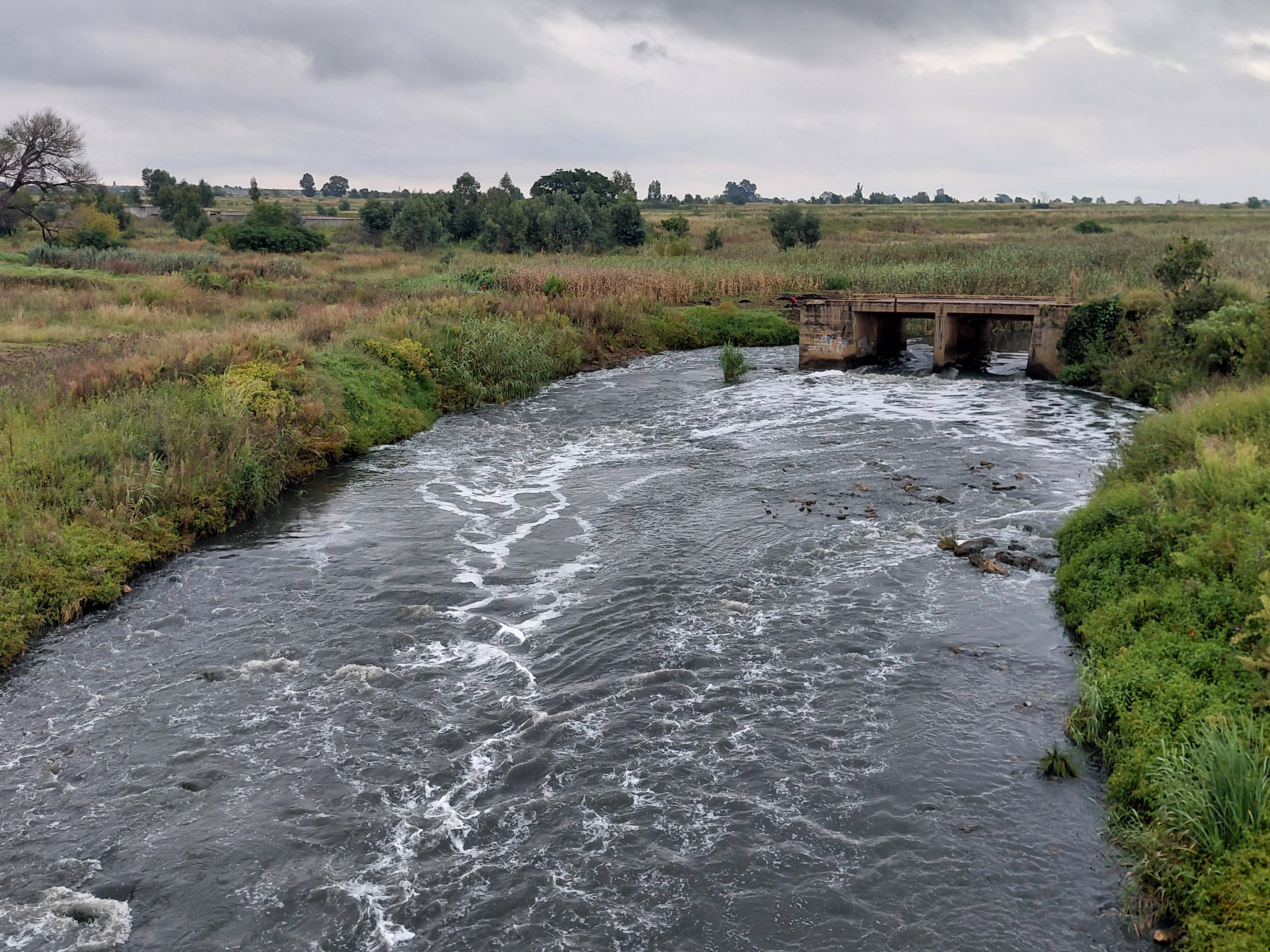
The Klip River is polluted by untreated sewage spilling from the Olifantsvlei wastewater treatment works. Photo: Seth Thorne
- The 2025 Green Drop Report gives a damning assessment of Johannesburg’s wastewater treatment plants.
- The metro received a “poor performance” rating due to failing infrastructure.
- Some treatment plants are underutilised, while others are over capacity.
- The Department of Water and Sanitation has issued several notices and directives, and referred criminal cases to the NPA for prosecution.
Half of Johannesburg’s sewerage treatment plants are in a critical state, according to the 2025 Green Drop Report.
The report, released on 31 March by the Department of Water and Sanitation, is the country’s primary regulatory assessment of wastewater management.
It details how Johannesburg’s wastewater system is breaking down. Failing treatment plants are releasing poorly treated or untreated sewage into rivers, with direct consequences for public health and the environment. It spreads harmful pathogens, which may cause diseases such as cholera and diarrhoea. Water quality is also degraded, depleting oxygen levels and killing aquatic life.

The Green Drop Report scores water authorities on operational capacity, environmental performance, financial management, technical skills, and compliance with effluent and sludge standards. A score of 90% or more is deemed excellent, while a score below 31% is rated critical and subject to regulatory intervention.
In 2011, the City of Johannesburg achieved a score of 91%. This fell to 86% in the 2013 and 73% in 2021. The most recent score is 48.8%, in the “poor performance” category.
“These results confirm what communities have been saying for years,” said Dr Ferrial Adam, executive director of civil society organisation WaterCAN. “The crisis is not new, what is new is the continued failure to act. Reports are being released, but where is the accountability?”
“We are moving backwards, and that should alarm every South African. Fewer high-performing systems and more in critical condition is not a trend; it is a collapse.”
“We cannot celebrate mediocrity while our rivers are being turned into sewage channels … Wastewater is still spilling into communities and making people sick,” she said.
Deteriorating treatment plants
Of the metro’s six wastewater treatment works, half fall in the “critical condition” category, requiring national intervention.
In 2021, the Northern Works scored 77%, the Olifantsvlei plant scored 73% and the Ennerdale system scored 65%. In the 2025 report, all three scored only 30%.
The other three plants in the city – Driefontein, Bushkoppies and Goudkoppies – achieved “good” or “average” performance.
The metro received a “poor performance” rating for its effluent and sludge compliance. This measures whether treated wastewater is safe to be released into the environment.
The national department has issued five directives and two notices against the municipality, and lodged five criminal cases with the NPA.
The Green Drop report explains that persistent vandalism has damaged infrastructure and disabled critical equipment for extended periods. There has also been inadequate preventative maintenance, leaving key treatment units non-operational across multiple sites.
At an administrative level, procurement delays – in some cases linked to political interference – have further slowed essential repairs and infrastructure upgrades.
The municipality, however, maintains strong staffing levels, with high technical compliance among supervisors and process controllers. But the report emphasises that technical expertise alone cannot compensate for governance failures, ageing infrastructure, and a collapsing sewer network.
Johannesburg’s six plants were built to handle a total of about 1.1-billion litres of sewage per day, but due to failing infrastructure and inadequate maintenance, they can now only reliably treating about 945-million litres.
The current sewage inflow is about 712-million litres per day, suggesting there is spare capacity. According to the report, some plants are operating over capacity while others are underutilised because not all sewage is reaching treatment facilities, due to leaks or spills, or sewage bypassing the network. At Ennerdale, the inflow of sewage exceeds 200% of design capacity, placing immense strain on already compromised systems.
Blockages, pump failures and infrastructure breakdowns are common across Johannesburg’s extensive 12,812km sewer network.
Johannesburg Water’s 2025/26 Business Plan outlines a turnaround strategy, which includes increased infrastructure investment, more preventative maintenance rather than only being reactive, and improving security to curb vandalism.
The utility has allocated R214.1-million for bulk wastewater upgrades, alongside R317.6-million to clear sewer blockages and expand pipe replacement.
However, the utility reports a backlog of R7.3-billion for wastewater treatment works and equipment replacement, R2.9-billion for sewer mains, and R13.7-billion for capacity upgrades.
Johannesburg Water’s senior manager for bulk wastewater, Motale Selesho, told GroundUp that the metro “has a sound foundation for recovery”. He acknowledged that “urgent and sustained improvement” was required.
“The City of Johannesburg remains committed to working closely with the Department of Water and Sanitation and sector partners to implement corrective measures, protect public health, and safeguard the environment through improved wastewater operations and management.”
Support independent journalism
Donate using Payfast

Don't miss out on the latest news
We respect your privacy, and promise we won't spam you.
Previous: How criminal cops escape justice
© 2026 GroundUp. This article is published under the GroundUp Republication Licence Version 1.0. Email [email protected] to request permission to republish.