
Court stops shacks from being built on District Six
State-owned land is reserved for land claims that will take several years to process
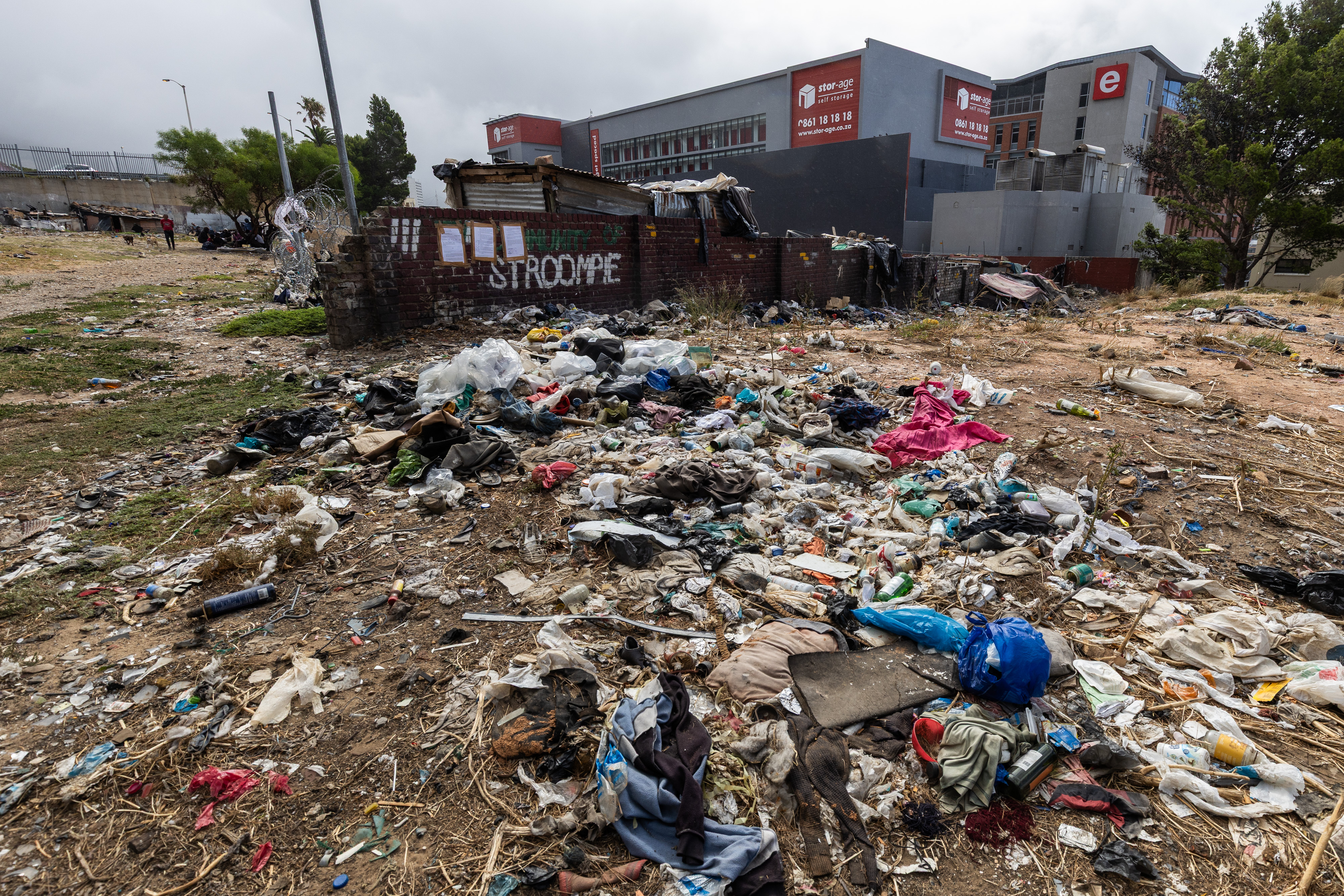
People living in the Stroompie informal settlement off Philip Kgosana Drive say they have been living there for 30 years.
- A piece of state-owned land in District Six is home to an informal settlement called Stroompie.
- Last month, the City of Cape Town obtained a court order preventing residents from erecting more structures.
- The land has been allocated to settle land claims lodged between 2014 and 2016.
- But those claims cannot be processed until all land claims countrywide lodged before 31 December 1998 have been settled.
“Simply because we are living in the space, we are deemed to be criminals,” says Ghaalib Beck, a resident of the Stroompie informal settlement in District Six in Cape Town.
Beck and dozens of other people live in shacks and tents in the settlement, without any water or sanitation. “Some people have been living here for more than 30 years,” says Beck. “We don’t have anywhere else to go.” (The Stroompie settlement has only existed for a few years. - editor)
Stroompie is situated on state-owned land currently under the custodianship of the City of Cape Town. It borders the historic Trafalgar High School, below Philip Kgosana Drive. Last month, the City obtained a court order preventing anyone from erecting any new structures at the site.
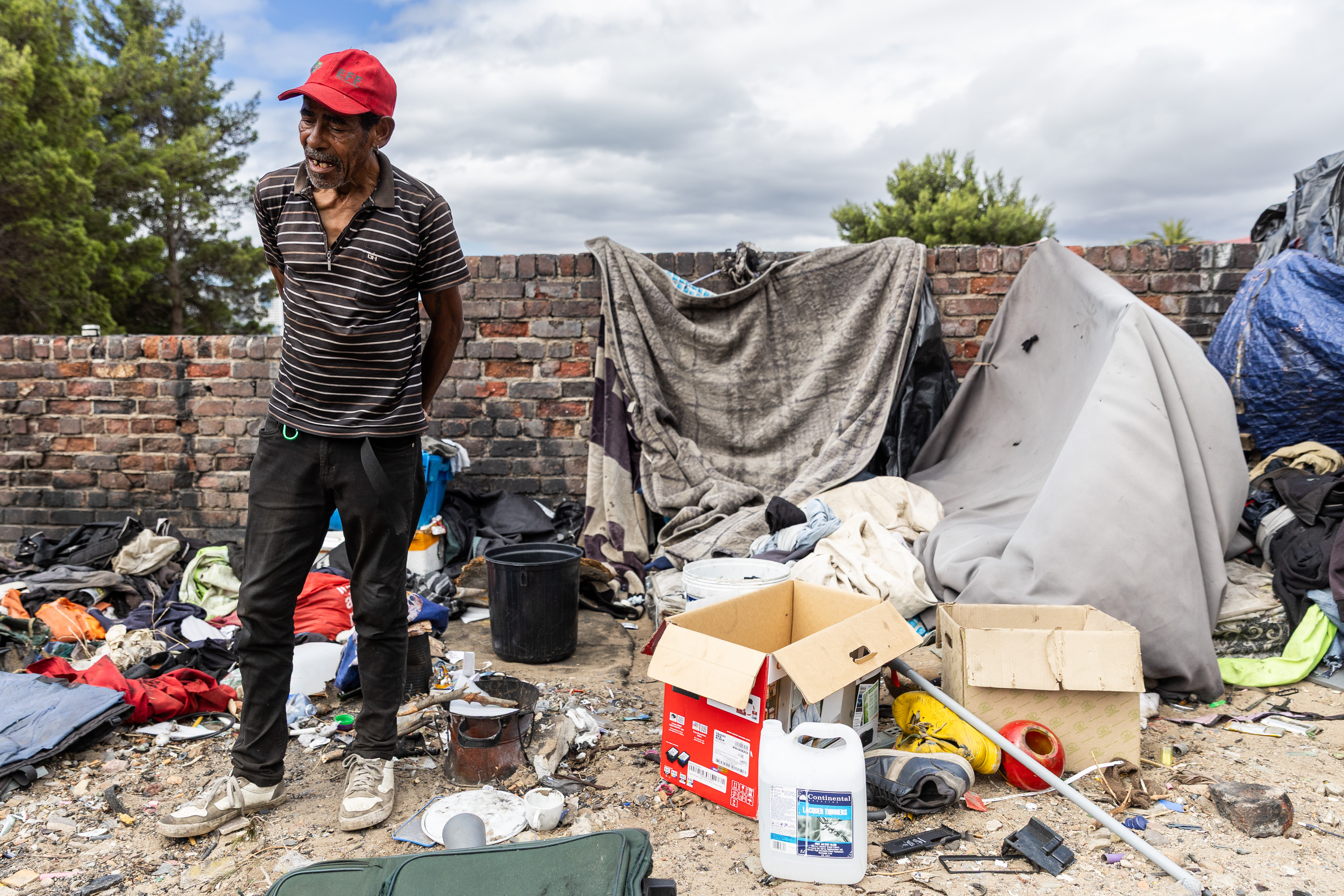
“Simply for living in the space, we are deemed to be criminals,” says Ghaalib Beck.
Francine Higham, the ward councillor for the area, said the municipality receives regular complaints about litter and sanitation on the site.
“There have also been complaints regarding criminal activity and inappropriate behaviour at the site,” said Higham.
There have been several fires, destroying homes and resulting in serious injuries, as well as at least one death, said Higham.
The land is unlikely to be developed any time soon, as it has been allocated to District Six claimants as part of a prolonged restitution process.
Sixty years ago, the apartheid government passed the Group Areas Act, under which District Six was declared a whites-only area and coloured and black families were forcibly removed to areas on the Cape Flats.
A total of 2,650 people lodged successful land claims before a 31 December 1998 deadline, of whom 1,485 received financial compensation, and 247 have returned to the area. More than 950 homes are still set to be built in the area for the remaining claimants, but the project is stalled due to funding constraints.
An additional 749 people lodged “new order” claims in a second window, between 2014 and 2016, but according to a court order, their claims may only be processed after all the land claims countrywide submitted before 1998 are finalised. As of July 2024, there were still 80,000 original land claims from 1998 (across the country) that had to be settled before the “new order” claims could be assessed.
The land on which Stroompie is situated is reserved for these “new order” claims, says Department of Land Reform and Rural Development spokesperson Linda Paige.
There have been several proposals for how to use the land until District Six claimants return, including turning it into a garden. Higham said the municipality is considering a new proposal by a non-profit organisation, but declined to provide details.
But Paige said in response to questions that any proposal for using the land would have to be “adopted and approved by the majority of the remaining claimants” of District Six.
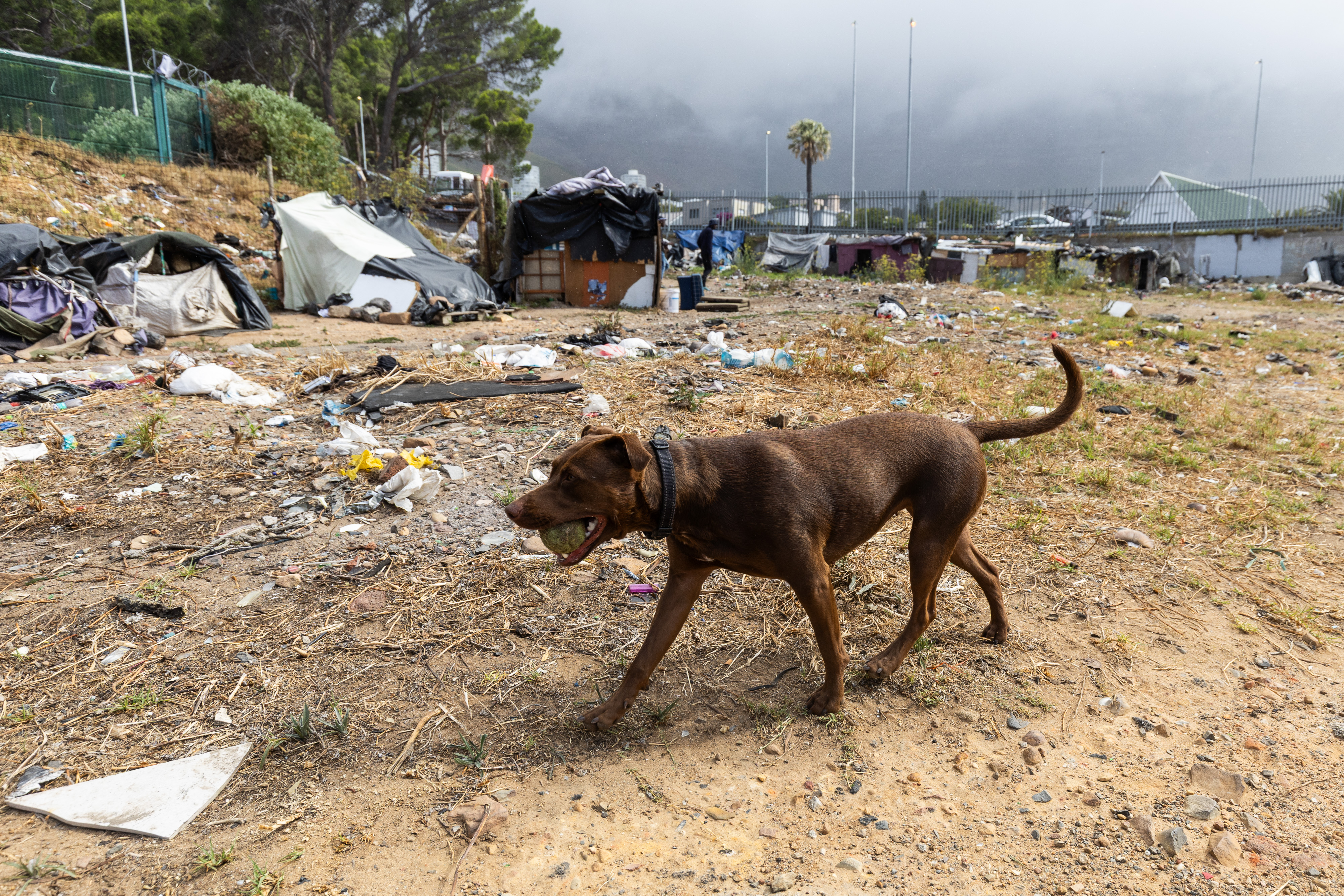
A dog walks across the Stroompie informal settlement, which borders Trafalgar High School.
Sandile Mhlongo, who has lived in Stroompie for more than 20 years, said the settlement is often raided by law enforcement officials.
Mhlongo said he would like to see toilets and taps installed at the site. At the moment, the only source of water is a stream running through the fence of the school.
“We would not want unilateral decisions being forced down our throat,” said Beck. “Obviously, we would have to be consulted. We are grown-ups.”
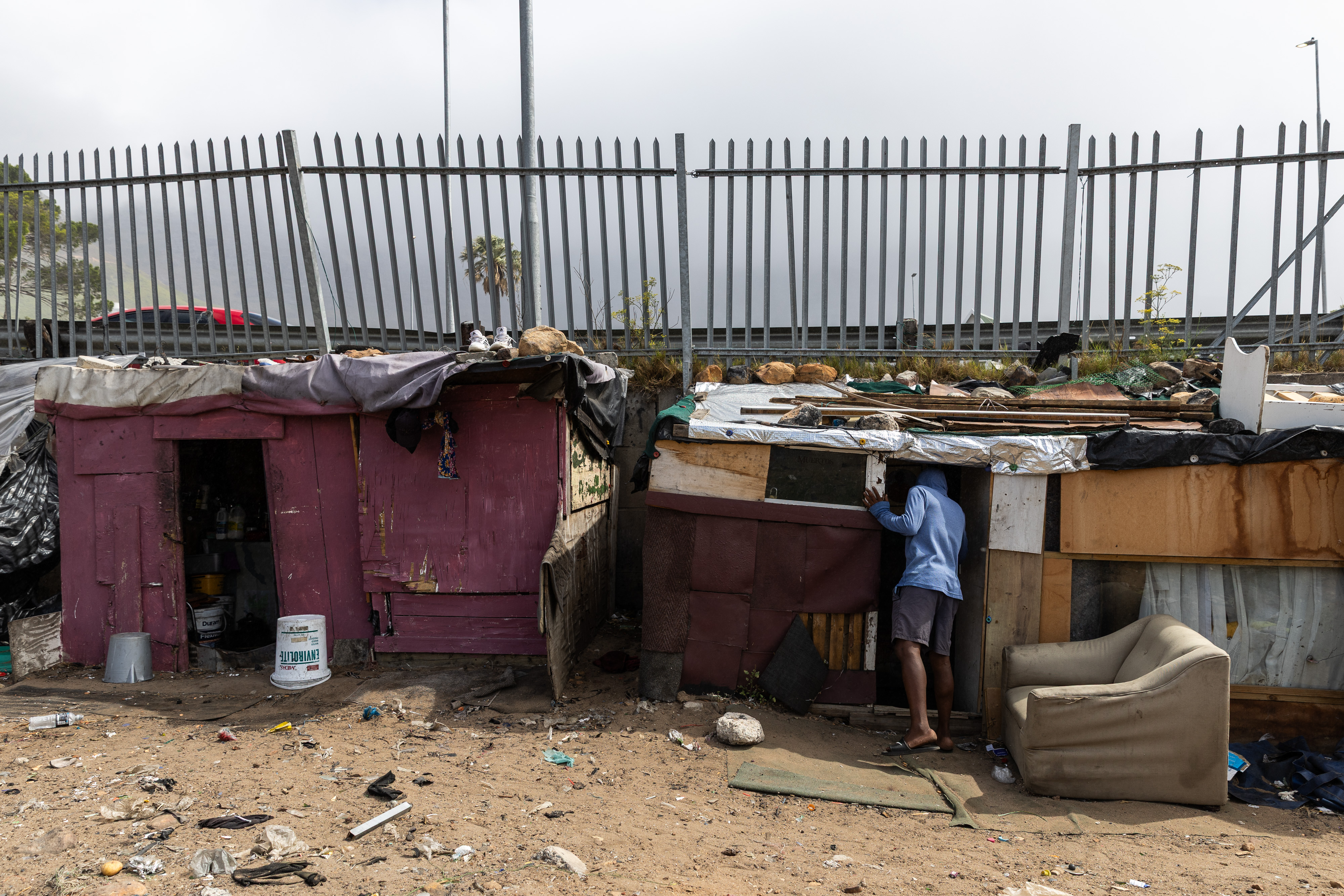
Shacks have been built against Philip Kgosana Drive.
Higham said the City’s offers of alternative emergency accommodation, at safe spaces or the Haven Night Shelter, have only been taken up by a few of the occupants. The most recent fire caused some of the occupants to re-erect shelters directly on the fence of Trafalgar High School, she said.
She said the City “remains deeply concerned about not only the living conditions of those occupying the property” on the edge of the school, but also about the effect that this is having on the learners of the school.
“Much of the land in question remains vulnerable to similar occupations, and the City spends a great deal of time and capacity monitoring this land as best we can,” she said.
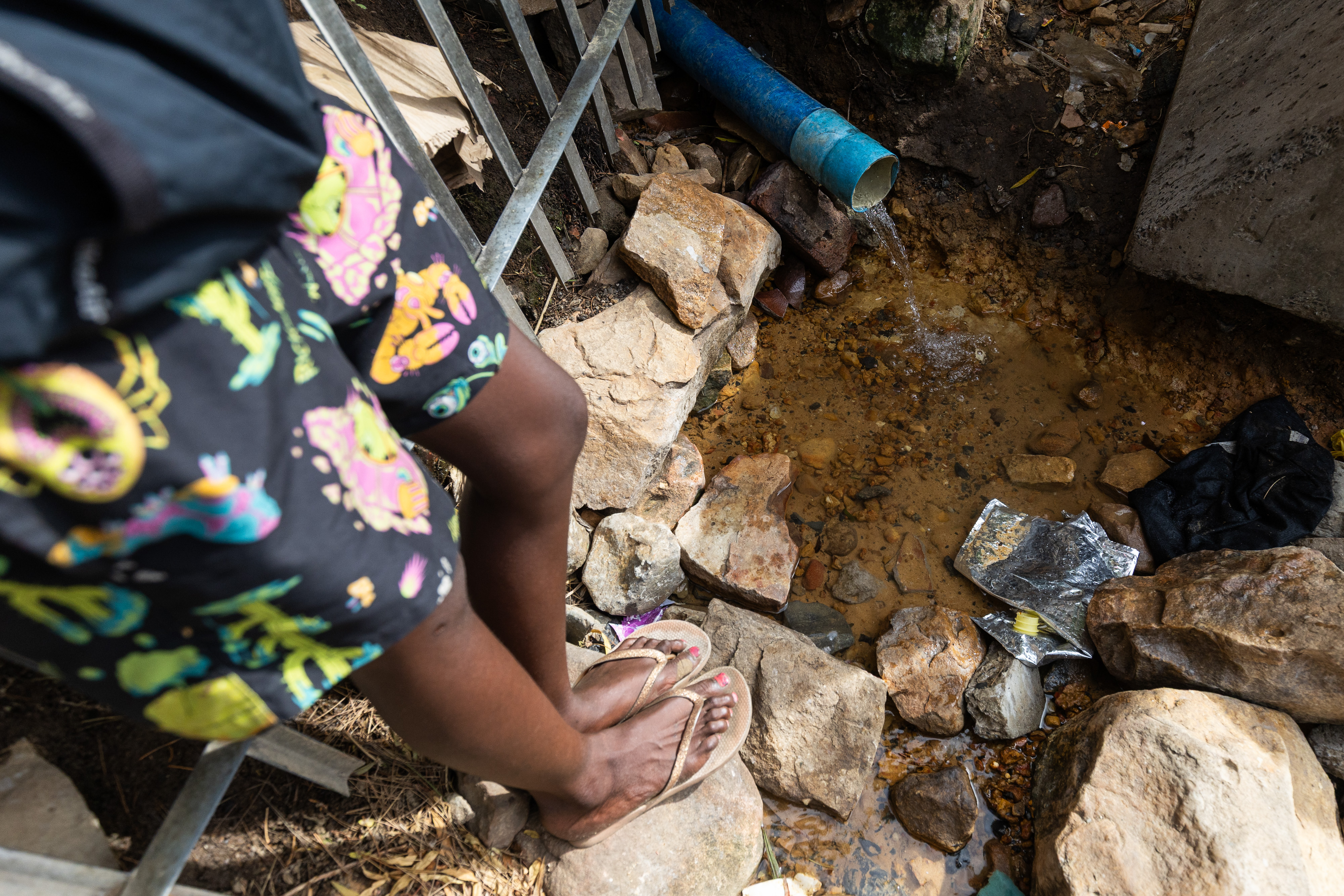
Residents of Stroompie get water from this pipe running through the high school fence.
Support independent journalism
Donate using Payfast

Don't miss out on the latest news
We respect your privacy, and promise we won't spam you.
Letters
Dear Editor
Stroompies has not been ‘occupied for 30 years'.
Look at the satellite images from the City of Cape Town’s own website for the truth. In 2011 it was a working yard. It only really started becoming "occupied" about six years ago.
Dear Editor
I have been resident in the neighbourhood since 2013, and can confirm BelindaC is correct. "Stroompie" was not in existence at that time. It indeed only started up around six years ago, basically during Covid Lockdown period.
We have been witness to all the fires that have broken out in the past, and the increase in refuse that litters the open green spaces. The surrounding areas are getting worse with informal structures being erected on a daily basis, namely the open space between Constitution Street and Justice Walk, and even further down toward the deaf school, Seven Steps Academy, and near the Zonnebloem Boys and Girls schools.
District Six has definitely become more dilapidated these past years, and the City of Cape Town seems unable to do anything about it. It's very sad. The east side of town has just as much potential to be beautiful and worth being taken into consideration.
Dear Editor
It is true, it has only been around for six years, even then it wasn't by right. No sewer or water. People were getting robbed and the robbers would hide there. I have personal experience of being robbed. It should be a greening safe and fenced open space, uninhabited.
Dear Editor
I am writing in response to your recent article on Stroompie to raise concerns about its tone and framing. In particular, the article appears to give limited consideration to the residents living in the surrounding area, their lived experiences, and their legitimate rights to safety and security.
For a number of years, residents in the area have raised consistent and well-documented concerns regarding the occupation of the land and its impact on community safety. I believe the following points are relevant context that was either omitted or insufficiently addressed in the article:
Duration of occupation: Satellite imagery indicates that the illegal occupation of the site began approximately ten years ago, rather than twenty years ago as claimed by a quoted “resident.” How has the claim from the resident been validated?
Public safety concerns: While it would be inaccurate to suggest that all individuals at the site engage in criminal activity, there is a persistent and demonstrable element of criminality associated with the area. The site is frequently used as a getaway point, and the surrounding streets are known hotspots for muggings and contact crimes. As a result, many residents no longer feel safe walking freely in their own neighbourhood.
Traffic-related crime: The nearby intersection is notoriously dangerous and has been the scene of numerous traffic accidents. On several occasions, individuals coming from the Stroompie site have been observed, and captured on camera, stealing from accident victims, including from individuals who were injured at the time.
Fire and safety hazards: There have been multiple fires and explosions originating from the site, with the fire department called out at least three times in the past twelve months alone.
Allegations involving minors: There have also been reports of individuals from the site selling drugs to learners at the adjacent school, a matter of grave concern to parents and the wider community.
Though I appreciate it is a sensitive matter and the indivudals have a right to housing a social security, these issues form an important part of the broader reality faced daily by surrounding residents. Concerns have been raised for years (at least 6 that I know about) with ward counsellors and the local government. Feedback provided is always the same, the National government has not responded to their communications - All affected parties are seeing a lack of service delivery and violations of their rights.
© 2026 GroundUp. This article is licensed under a Creative Commons Attribution-NoDerivatives 4.0 International License.
You may republish this article, so long as you credit the authors and GroundUp, and do not change the text. Please include a link back to the original article.
We put an invisible pixel in the article so that we can count traffic to republishers. All analytics tools are solely on our servers. We do not give our logs to any third party. Logs are deleted after two weeks. We do not use any IP address identifying information except to count regional traffic. We are solely interested in counting hits, not tracking users. If you republish, please do not delete the invisible pixel.