
COSATU congress ends with compromise
Delegates resolve to support both SACP and ANC in municipal elections
 Add GroundUp on Google
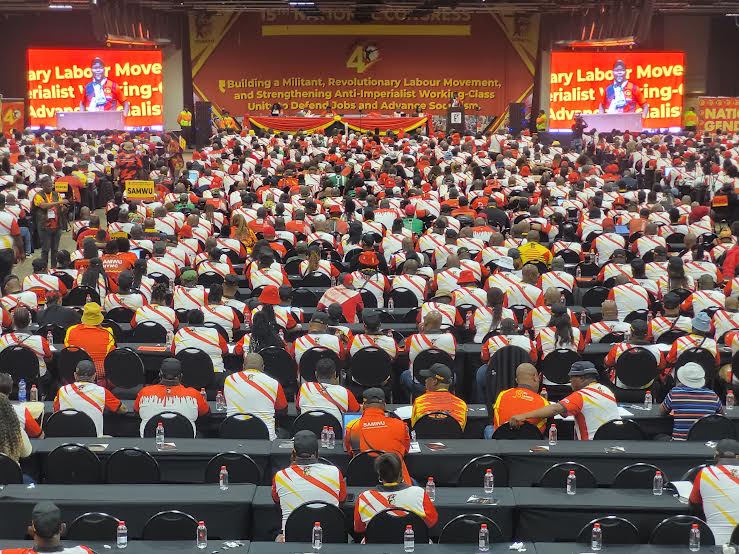
More than 1,800 delegates attended the COSATU congress, representing more than 1.5-million members. Photos: Greg Dor
- COSATU’s reconvened national congress ended on Wednesday with a compromise over leadership after days of sharp divisions.
- Former deputy president Mike Shingange was elected president, and outgoing president Zingiswa Losi was elected general secretary.
- Shingange was supported by the powerful National Union of Minewokers as well as the municipal workers’ union, and Losi by the major public sector affiliates.
- The congress resolved to support both the ANC and the SACP in the forthcoming municipal elections.
The Congress of South African Trade Unions (COSATU) national congress concluded its reconvened national congress on Wednesday with a new leadership and a resolution calling on workers to support both the ANC and the South African Communist Party (SACP), in spite of the decision by the SACP to contest elections on its own.
More than 1,800 delegates representing more than 1.5-million union members attended the congress, held at Emperors Palace in Kempton Park from 12 to 14 October. The previous congress, in September, was adjourned because of internal fights.
The Johannesburg High Court dismissed an urgent application by some unions last Friday seeking to block the new gathering.
Though delegates repeatedly called for unity, divisions over the federation’s leadership and its relationship with the ANC and SACP were evident.
In her opening address, outgoing COSATU president Zingiswa Losi acknowledged the damage caused by the preceding weeks of conflict.
“These, indeed, have been difficult weeks for our federation,” she said. “When workers’ organisations are divided, they will be defeated. When we are united, we will be victorious.”
She described the adjournment of the previous congress as an embarrassment and warned delegates against allowing their differences to destroy the federation.
“This is a moment that dares not bring pride to any among us,” she said. “We joined this federation in the spirit of comradeship, united in our determination to defeat unemployment, exploitation, poverty, inequality, racism, sexism and so many other enemies of the working class, yet instead we have descended into factions, to label each other as enemies who must be destroyed at all costs, even if we destroy COSATU.”
Losi called on delegates to put aside their differences. She reaffirmed COSATU’s commitment to the Tripartite Alliance, which comprises the ANC, SACP and COSATU, describing it as “the most effective and progressive political vehicle to advance working class struggles”.
ANC chair walks out
The first major confrontation came when ANC national chairperson Gwede Mantashe walked out of the congress after objecting to the order in which alliance partners were scheduled to deliver their messages of support.
COSATU had scheduled the ANC to speak before the SACP. Speaking to media outside the Congress, Mantashe insisted that the ANC should speak last, in keeping with what he described as the alliance’;s traditional hierarchy.
“You can’t wake up one day and change the alliance,” he told reporters afterwards. “It is the ANC, the party, COSATU, SANCO, and you don’t change that order as you like.”
Delegates reacted angrily to Mantashe’s departure. When SACP general secretary Solly Mapaila acknowledged the ANC delegation at the beginning of his address, he was met with loud jeering and chanting from the floor.
The South African Municipal Workers Union (SAMWU) said the ANC should not behave as if it were COSATU’s superior. “They are an alliance partner; they must not play Big Brother in this congress and undermine COSATU,” a delegate from the union said.
The National Education, Health and Allied Workers’ Union (NEHAWU) also rejected what it called the ANC’s “Big Brother” syndrome. NEHAWU general secretary Zola Saphetha said Mantashe’s conduct was disappointing, particularly given his history as a former general secretary of the National Union of Mineworkers (NUM).
A NUM delegate agreed that the ANC had no right to dictate COSATU’s programme. Other delegates stressed that Mantashe did not speak for all ANC members and branches.
Session chair Mike Shingange said neither Mantashe nor the ANC had been formally expelled from the proceedings; COSATU had simply refused to change its programme.
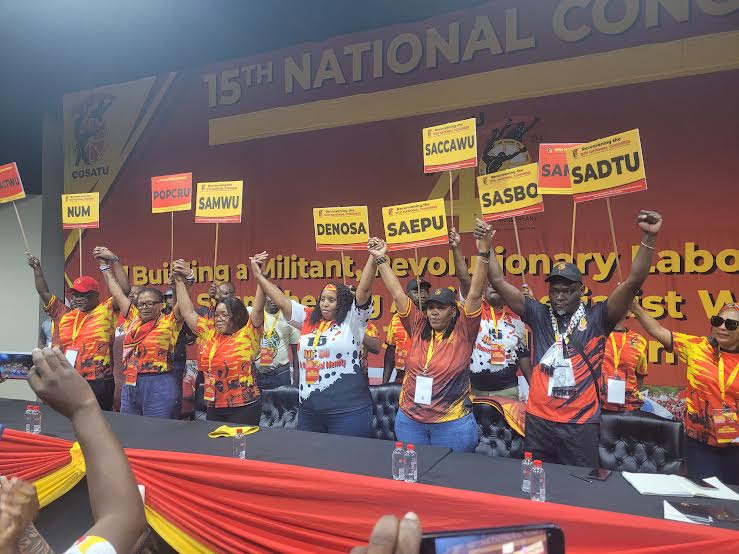
Delegates resolved to support both the SACP and the ANC in the forthcoming municipal elections.
Disagreement over political support
During debates on the political report, NEHAWU proposed a motion affirming support for the SACP; SAMWU proposed an electoral pact, while the Police and Prisons Civil Rights Union (POPCRU) called for an Alliance Summit and a Conference of the Left.
Other affiliates felt the federation should not have to choose between its alliance partners.
NEHAWU subsequently amended its proposal, accepting the argument that COSATU should maintain its relationship with both parties rather than endorse one against the other.
Finally, a consolidated set of resolutions, referred to during the congress as the “super resolution”, was passed in which COSATU reaffirmed its commitment to the alliance and called on workers “to support and vote for both the ANC and the SACP as components of the alliance.”
The resolution emphasised that political and electoral backing for alliance partners must be conditional on their commitment to workers’ struggles and a clear working-class programme. The federation also resolved to consult affiliates and alliance partners to develop a coordinated electoral strategy, including for circumstances in which the ANC and SACP contest against each other.
Notably absent from the debates were the economic and workplace issues facing workers, despite the emphasis in opening speeches and declarations on unemployment, poverty, exploitation and inequality.
The new leadership, from left to right: Gerald Twala, Zingiswa Losi, Kgomotso Makhupola, Mbali Blose, Susan Khumalo, Mike Shingange
Leadership nominations expose divisions
Divisions over leadership became visible during nominations on the second day of the congress.
Shingange, COSATU’s deputy president, was nominated for the presidency by four affiliates. SADTU’s Mabutho Cele also received nominations from four affiliates.
The nominations prompted sharply divided reactions from the floor. NUM, SAMWU and SACCAWU cheered Shingange, while public sector unions NEHAWU, SADTU, POPCRU, along with SACTWU, supported Cele.
Similar divisions emerged over other positions.
The nomination of Solly Phetoe for general secretary was greeted with loud applause from SAMWU, SACCAWU and NUM. When Losi was nominated, she received applause from supporters but was booed by delegates from SAMWU and SACCAWU. No other nomination was booed.
The results announced on Wednesday reflected a compromise between these factions. Shingange was elected president with 972 votes against 836 for Cele. The result indicated that delegates from at least some public sector affiliates that had supported Cele’s nomination broke ranks and did not vote according to the initial alignment of their union.
Susan Khumalo was elected first deputy president, Mbali Blose second deputy president and Kgomotso Makhupola from NEHAWU treasurer. Losi was elected general secretary with 996 votes against 809 for Phetoe. Her election was met with loud applause from across the congress, in contrast to the mixed reaction when she was nominated the previous day. Gerald Twala was elected deputy general secretary.
The results left three national office-bearers aligned with each of the two competing camps, reflecting a compromise in the distribution of leadership positions. But the vote counts also showed how divided the congress remained. None of the candidates secured more than 1,000 votes, and the relatively narrow margins in several races suggested that neither camp had secured an overwhelming mandate.
In his first address to the congress as COSATU president, Shingange said: “It might have looked dangerous, it might have looked scary, it might have looked like we were going to tear each other apart. Surely there was some divine intervention in the process. We went away to cool down and seek intervention from all over the place.”
“I think we must appreciate that, because it looked like we almost risked collapsing and destroying an instrument of workers and the people of South Africa.”
Support independent journalism
Donate using Payfast

Don't miss out on the latest news
We respect your privacy, and promise we won't spam you.
© 2026 GroundUp. This article is published under the GroundUp Republication Licence Version 1.0. Email [email protected] to request permission to republish.