16 November 2026
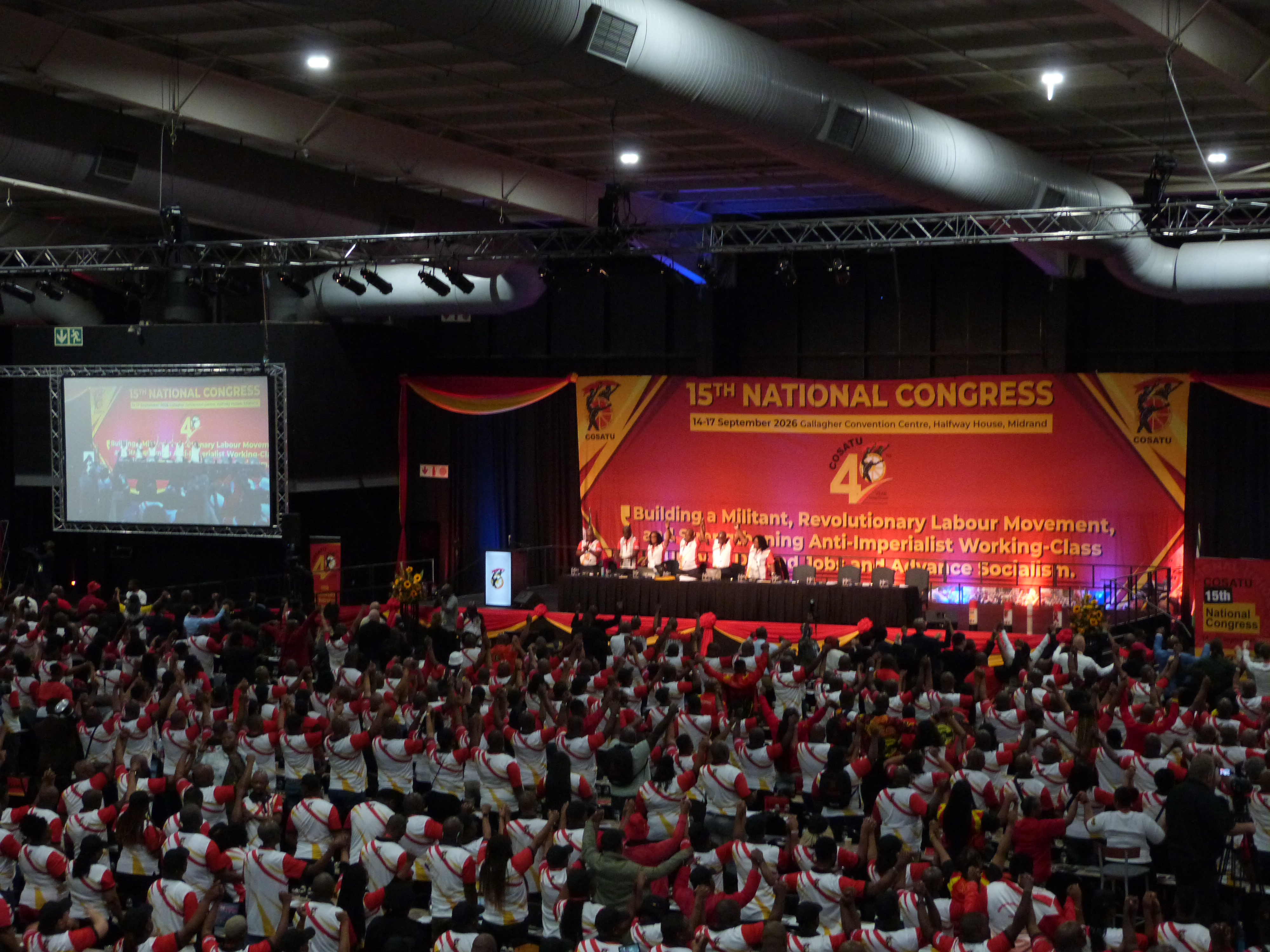
For the first time in COSATU’s history, its National Congress collapsed this year as delegates were split over the future leadership of the federation. Archive photo: Greg Dor
Against the background of a fierce and very public struggle for power in the National Union of Metalworkers of SA these last few weeks, we describe some of the changes in the South African trade union landscape over the past decades.
In the past weeks, a rival faction in National Union of Metalworkers of SA (NUMSA) has suspended general secretary Irvin Jim and other office bearers. The rival faction wants a national congress from 30 November to 4 December. Jim has said his suspension is invalid.
Meanwhile, the Congress of South African Trade Unions (COSATU) failed to convene its own congress in September, as affiliates split over leadership mostly along sector lines. In October, it reconvened and ended in a compromise.
These are the latest developments in a long history of splits and changes in South Africa’s trade unions, which to some extent reflect political and economic changes in the country.
The emergence of COSATU in the 1980s was rooted in the mining, manufacturing, metal, chemicals, transport and other industries, where large concentrations of workers provided the foundation for collective bargaining and industrial power.
Over time, however, the centre of gravity of organised labour shifted towards the public sector. In 1991, public sector workers made up about 7% of COSATU’s membership, according to data compiled by editor Martin Nicol for New Agenda. Today, roughly 60% of COSATU members are concentrated in the public sector.
This shift forced COSATU affiliates into direct conflict with the government and created tensions within the ANC-COSATU-SA Communist Party (SACP) alliance over the everyday interests of union members in the public sector.
The alliance also faced growing criticism over corruption and the relationship between political office, business interests and trade union leadership.
COSATU leaders and affiliates differed over how forcefully the federation should challenge the ANC and whether it should continue supporting the party at the ballot box. The 2012 Marikana massacre, when police killed 34 striking mineworkers at Lonmin’s Marikana mine in North West, brought tensions within the alliance to a head, posing questions about the relationship between the state, employers and organised labour.
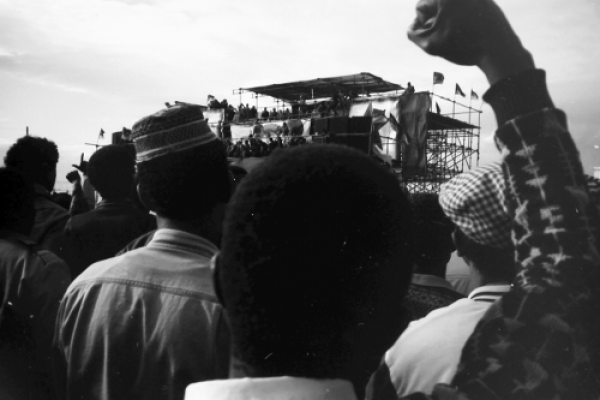
COSATU was launched in 1985. Archive photo: Jack Lewis
By 2014, the disagreements within COSATU had developed into an organisational crisis. NUMSA, one of COSATU’s biggest unions, called for a special national congress to debate the federation’s political direction. It argued that COSATU should reconsider its support for what the union saw as the increasingly pro-business direction of the ANC, and instead develop an independent political programme for workers.
COSATU’s leadership rejected NUMSA’s position. In November 2014, a special Central Executive Committee meeting voted 33 to 24 to expel NUMSA, which then had about 350,000 members.
NUMSA argued that the expulsion was politically motivated. But COSATU cited NUMSA’s conduct, including that it was expanding into sectors traditionally covered by other affiliated unions without approval.
NUMSA had also put its weight behind COSATU general secretary Zwelinzima Vavi, who had become a prominent critic of corruption and the direction of the ANC-led government, and had fallen out of favour with COSATU leaders who supported the Zuma presidency.
COSATU had suspended Vavi in 2013 after he admitted to having sex with a junior staff member at the federation’s office. The Johannesburg High Court later overturned the suspension. In 2015, Vavi was dismissed officially for gross misconduct. His opposition to NUMSA’s expulsion was widely seen as the real reason.
The Food and Allied Workers’ Union (FAWU) and several other unions subsequently left COSATU.

COSATU members take to the streets on World Day for Decent Work in Johannesburg, October 2025. Archive photo: Ihsaan Haffejee
The departure of NUMSA, FAWU and smaller unions reshaped the federation and broader labour movement. A new federation, the SA Federation of Trade Unions (SAFTU), was formed in 2017, with Vavi as general secretary. It brought together 24 unions and claimed a founding membership of roughly 700,000 to 800,000 workers, according to a SAFTU organisational report.
SAFTU positioned itself as an independent, socialist federation, not aligned with the ANC or the SACP. It argued that the ANC-led government had pursued economic policies that disadvantaged workers.
The new federation opposed privatisation, austerity measures and changes to labour laws that it believed would weaken workers’ rights. It also sought to mobilise workers and community organisations outside the formal structures of the alliance.
By 2022, COSATU affiliates accounted for only 38% of registered union membership, according to the New Agenda article. But COSATU is still by far the biggest federation, with about 1.4-million members, compared to SAFTU with about 506,000, the Federation of Unions of South Africa (FEDUSA) with 604,000 and the National Council of Trade Unions (NACTU) with 394,000, according to minutes of a July 2026 NEDLAC meeting.
Today COSATU has 16 active affiliates. The two largest unions are public sector affiliates, the National Education, Health and Allied Workers’ Union (NEHAWU) and the SA Democratic Teachers’ Union (SADTU) with 275,000 and 260,000 members, followed by the National Union of Mineworkers (NUM) with 150,000.
Among SAFTU’s affiliates, only NUMSA, and probably FAWU, have more than 100,000 members. FAWU’s size is uncertain, with some sources putting it at more than 100,000 and others at 85,000. SAFTU’s largest affiliate in the public sector, the National Union of Public Service and Allied Workers (NUPSAW), has around 60,000 members.

Zwelinzima Vavi, who was dismissed by COSATU and went on to lead SAFTU, addresses protesters in Cape Town, April 2018. Archive photo: Ashraf Hendricks
FEDUSA, formed in 1997, has maintained a stable base, starting out with a membership of 515,000 and currently claiming 617,000 members across 21 affiliates.
The core of its members are in the public sector, with the largest group, 240,000, belonging to the Public Servants Association (PSA). The federation has generally maintained a politically neutral position, engaging with government on issues affecting workers.
NACTU was formed in 1986 from a merger of the Council of Unions of South Africa and the Azanian Confederation of Trade Unions. Its membership grew from around 150,000 to 400,000, although this number has declined with the departure of its largest affiliate, Association of Mineworkers and Construction Union (AMCU). Like SAFTU, it has a large number of affiliates, most of which are in the private sector and none of which has more than 100,000 members. Its policy is to reject alliances with political parties.
The largest independent and non-affiliated trade unions are the Association of Mineworkers and Construction Union (AMCU), which rose to prominence after the Marikana massacre of 2012, and Solidarity, each with roughly 200,000 members.
The Marikana strike exposed tensions between workers and NUM, and the subsequent reorganisation of union representation in the platinum sector challenged COSATU’s influence in mining.
AMCU also demonstrated that a union outside the traditional federation system could become a major force in collective bargaining.
Total trade union membership in South Africa today is estimated at 2.93-million, according to NEDLAC. The Department of Employment and Labour’s latest published register, from November 2025, lists 213 trade unions.
This number has fallen sharply since the 2000s. In 2003/04 alone, the registration of 155 unions was cancelled under amendments to the Labour Relations Act, and more were to follow.
By 2024, nearly two workers in three (64%) in the public sector were members of a union, compared to about one in five (20%) in the private sector, according to COSATU. And among permanent public sector employees, almost 87% were union members.
Yet the private sector is the country’s largest source of employment, accounting for about 13.8-million workers, according to Stats SA, compared with approximately 2.8-million in the public sector.
This is the first in a short series on the state of the labour movement in South Africa. Next: Why trade unions have lost thousands of members